ADAD
ADADUpdating your news feed...

NEWS EXPRESS is Nigeria’s leading online newspaper. Published by Africa’s international award-winning journalist, Mr. Isaac Umunna, NEWS EXPRESS is Nigeria’s first truly professional online daily newspaper. It is published from Lagos, Nigeria’s economic and media hub, and has a provision for occasional special print editions. Thanks to our vast network of sources and dedicated team of professional journalists and contributors spread across Nigeria and overseas, NEWS EXPRESS has become synonymous with newsbreaks and exclusive stories from around the world.


.webp)
.webp)








.webp)

Loading banners
Loading banners...

By LANRE OGUNDIPE
One of the greatest disservices we can do to history is to allow it to become the exclusive property of those who once wielded power. History belongs not to presidents alone, but also to governors, legislators, judges, traditional rulers, party leaders, journalists and ordinary citizens who witnessed the events of their time. When competing narratives emerge, our duty is neither to applaud nor condemn. It is to interrogate.
Former President Olusegun Obasanjo's recent attempt to revisit the political events surrounding the 2003 elections deserves precisely that kind of interrogation. Not because he was not a central actor—he undoubtedly was—but because he was not the only actor. History seldom has only one witness.
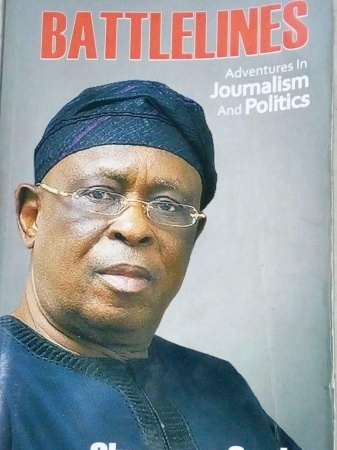
Fortunately, we are not compelled to choose between fading memories or partisan loyalties. We have before us the documentary record, including the memoir of another principal participant, Chief Olusegun Osoba. In Battlelines: Adventures in Journalism and Politics, published in 2018—years before the present controversy—Osoba painstakingly recounts the negotiations between the Presidency, Afenifere and the Alliance for Democracy (AD). He identifies the principal actors, the venues, the constitutional questions under discussion and the political understandings that, according to him, shaped the decisions leading to the 2003 elections.
According to Osoba, these were not casual political courtesies. Meetings held at Dodan Barracks, Ota Farm and the Presidential Villa brought together Chief Abraham Adesanya, Chief Ayo Adebanjo, Dr. Cornelius Adebayo, Senator Femi Okunrounmu, respected traditional rulers led by the Awujale of Ijebuland and eminent clerics, including Bishop Emmanuel Gbonigi and Archbishop Ayo Ladigbolu. The agenda, as he records it, included restructuring, devolution of powers, fiscal federalism, meritocracy, a credible national census and guarantees of free and fair elections.
Osoba's central contention is not that discussions never took place. Quite the contrary. His argument is that the assurances upon which Afenifere and the Alliance for Democracy based crucial political decisions were ultimately not fulfilled. That is a serious historical claim. It deserves engagement rather than summary dismissal.
If Osoba were standing alone, one might dismiss the controversy as a clash of memories between two ageing statesmen. But he is not.
Long before the present exchange, Chief Bisi Akande, in his memoir The Inner Mind, also described negotiations between the Presidency and the Yoruba political leadership. His account recalls discussions on restructuring, devolution of powers, fiscal federalism, a national conference and other constitutional questions that dominated those engagements. He also recounts the atmosphere of distrust that prompted the intervention of eminent traditional rulers and respected clerics.
Senator Femi Okunrounmu has independently spoken of those same negotiations. He recalled serving on the delegation led by Pa Abraham Adesanya, alongside Chief Ayo Adebanjo and Dr. Cornelius Adebayo. According to his recollection, constitutional restructuring, a credible census and the future of the federation formed the substance of the discussions, leaving participants with the belief that important political understandings had been reached.
Three independent participants.
Three separate accounts.
One broad historical narrative.
That convergence cannot simply be ignored.
This does not mean that every sentence in every memoir is beyond dispute. Memoirs are written by human beings, and memory is never infallible. But when independent participants, writing or speaking at different times and from different perspectives, substantially describe the same negotiations, involving the same personalities and addressing remarkably similar constitutional issues, history demands that such convergence be taken seriously.
The debate, therefore, is no longer about whether President Obasanjo has the right to defend his record. He certainly does. The real question is whether a later recollection can, by itself, displace a body of contemporaneous and corroborative evidence.
Did the meetings take place?
If they did, what precisely was discussed?
Did constitutional restructuring, fiscal federalism and electoral guarantees form part of those discussions?
Did those engagements influence the decision of the Alliance for Democracy not to field a presidential candidate in 2003?
If so, what became of the understandings that participants say emerged from those meetings?
These are not partisan questions. They are historical questions.
History demands more than categorical denials. It demands evidence.
This is not an invitation to place Osoba, Akande or Okunrounmu beyond scrutiny. Their accounts, like every historical source, should be critically examined. But neither should any former President assume that his recollection alone constitutes the definitive version of events. In a democracy, history is neither the possession of the powerful nor the privilege of the victorious. It is constructed from memoirs, interviews, official documents, court records, archival materials and the testimony of those who sat around the same table and witnessed the same events.
That is how societies preserve the integrity of their democratic memory.
No one disputes that President Obasanjo was one of Nigeria's most consequential political figures or seeks to diminish his contributions to the country's democratic journey. Yet greatness does not place any statesman beyond historical scrutiny. Indeed, the higher the office once occupied, the greater the obligation to historical accuracy.
Perhaps the most enduring lesson from this renewed controversy is that history has an unusually long memory. Documents endure. Books remain on shelves. Speeches are archived. Court records survive political careers. Memoirs continue to speak long after public office has been relinquished.
History, after all, is a stubborn witness.
It listens to every credible voice.
It weighs every piece of evidence.
And whenever one participant seeks to rewrite the past, it quietly summons the testimony of the others.
That is how history protects itself.
And that is why no single voice, however eminent, can ever have the final word.
•Ogundipe, Public Affairs Analyst, former President Nigeria and Africa Union of Journalists writes from Abuja