ADAD
ADAD
Updating your news feed...
NEWS EXPRESS is Nigeria’s leading online newspaper. Published by Africa’s international award-winning journalist, Mr. Isaac Umunna, NEWS EXPRESS is Nigeria’s first truly professional online daily newspaper. It is published from Lagos, Nigeria’s economic and media hub, and has a provision for occasional special print editions. Thanks to our vast network of sources and dedicated team of professional journalists and contributors spread across Nigeria and overseas, NEWS EXPRESS has become synonymous with newsbreaks and exclusive stories from around the world.





Loading banners
Loading banners...

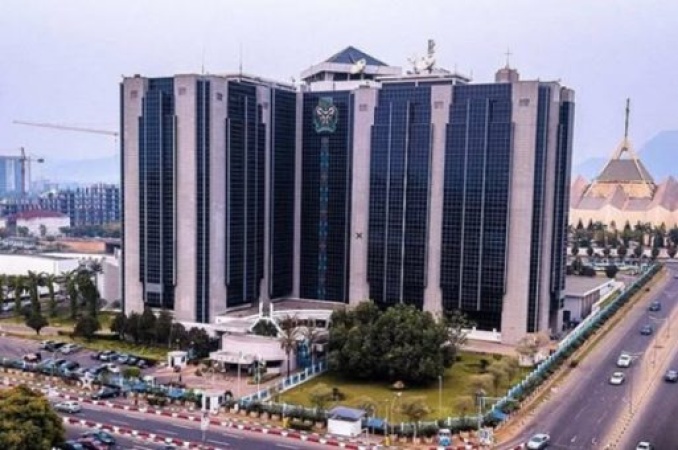
The Office of the Accountant General of the Federation (OAGF) has told the House of Representatives Committee on Public Accounts that the Central Bank of Nigeria (CBN) was indebted to the government to the tune of N5.3 trillion in unremitted revenue from its operating surplus.
The Director of Revenue and Investment in the OAGF, Makinde Mogaji, stated this while responding to questions from members of the committee when the Accountant General of the Federation, Shamsedeen Babatunde Ogunjimi, appeared before the committee to defend audit queries from the Office of the Auditor General for the Federation.
Mogaji said: “Early last year, they were owing Federal Government N5.3 trillion from their operating surplus. Despite all the efforts of the PAC to recover the money, they refused to pay. The PAC said 70 per cent of that money should be paid, but CBN has refused to pay. And that is just one of our huge sources of revenue. For an agency like the Federal Airports Authority of Nigeria (FAAN), we have a record of N473 billion paid.”
The House directed the Accountant General to provide details of the amount of money owed the Federal Government in the form of unremitted Operating Surplus and other revenues by the CBN, the Nigerian National Petroleum Corporation Limited (NNPCL) and other agencies.
The House also requested the Accountant General to explain the alleged withdrawal of N15 billion from the account of the Universal Basic Education Commission (UBEC) as well as other agencies by the OAGF.
Responding to questions on automatic deduction of revenues from MDAs, which sometimes leads to reversal of alleged over-remittances, the AGF described it as “an ingenious way of taking in advance what is due to government last year, and that was how we were able to rake in a lot of revenue last year”.
He explained that “when we (OAGF) initiated that move and we were able to rake in a lot of revenue, some of these agencies went back to seek a reversal. So, we’ve been battling with that issue because some went back to Mr. President and said that was too much and some got total cancellation, while some got reduced advance.
“So, we have been battling with that, and that’s why we were not able to return to the level we were last year. Also, you have instances where agencies like NNPCL refused totally to cooperate, to the extent that they had to be walked out because of their non-compliance and cooperation. NNPCL agreed to some of those abilities, and for some, they do not agree. So, all of that is still being handled by a post-mortem committee.”
Shedding light on the issue, Mogaji said: “The auto deduction established last year has worked perfectly. As the AGF said, the auto deduction is an advanced way. It’s a mechanism designed to pick the operating surplus in advance from these agencies. At the end of the day, they will collect, they will compute OPS and see whether they have excess or they have been over-deducted.”
The chairman of the committee, Bamidele Salam said UBEC and some other MDAs had complained about how funds meant for their statutory responsibilities were being deducted and used for other purposes by the OAGF.
He said: “There is an ongoing investigation involving UBEC and other agencies. And in the course of the investigation, UBEC claimed that there was a shortfall. There was an authority to incur expenditure in November 2025, which was not released by the Accountant General and that N16 billion was taken from the commission’s account and another N15 billion from the commission’s account, which has not been refunded.
“We are actually wondering why these deductions are made from the statutory payments of some of these very critical institutions of government. UBEC is not the only agency affected by this. We had the same thing with NASENI with about N70 billion or more deducted. I have different agencies that havecomplained. So, what is the justification?
Salam challenged the OAGF on the alleged deductions and claims of refund to the MDAs, which he said was not justified because the MDAs have statutory mandates to execute with the funds.
He asked: “So, which ones have you refunded? UBEC is crying, NASENI is crying, NBC too is crying. We have quite a number of them. We have more than six that are under various investigations here, and that is their major claim that they don’t know how to approach this matter because the Accountant General just gets into their accounts, gets out money from them and when they need it, they cannot get the money to use.
“Like the one in UBEC, you will agree with me that the problem we have today, including banditry and what have you, are also as a result of our neglect of basic education, especially in the northern part of the country. We have about 13.5 million out-of-school children. UBEC is to construct schools, they are to provide infrastructure and instructional materials. They can’t do that because the fund that is statutorily made for them is being taken for other purposes.”
Responding, the Accountant General said: “We have instances when we have to take money from some of these agencies to be able to meet critical financial obligations of government. Yes, it’s like a loan. We are going to refund it and we have been refunding the money to these agencies. It’s just to meet those critical obligations.
“Sir, first and foremost, Accountant General cannot just sit and begin to pick money from account of these agencies. The directives come from the Honourable Minister and we first analyse how long these funds have remained in the accounts of these agencies unutilised. So, if you have this money like six months and government needs funding. We say let’s take it and refund your money when you need it.
“Like TETFund, for instance. We took over N300 billion and we have refunded the whole amount to them. If you come back and tell us that you need your money, we process and give it back to you.”
A member of the committee, Gboyega Nasir Isiaka, noted that non-remittance of revenue has been a major challenge to Nigeria.
He said: “Considering our GDP, you know, I mean, ours is one of the lowest in the continent, at about 16 per cent. Now, I know that business entities are meant to return about 80 per cent of their taxes, and others are between 20 per cent and 50 per cent.
“From the totality of what we are seeing, there appears to still be some backlog of remittances. Can you give some instances or some figures around this? That is one. Two, even those business entities that are returning, as a member of the economic team, how comfortable are you with the performance of some of those entities given their assets and all of that?
“Like CBN, SEC, NIMASA, and some of those agencies, it’s not just enough for us to say 80 per cent of their surpluses. What exactly is the surplus they are giving us? These are the asset base that they have in their hand. So, I think it’s important for us to have a look at that. In addition to some of the revenues that they are meant to have paid, that they have not paid for.” (The Nation)