ADAD
ADAD
Updating your news feed...
NEWS EXPRESS is Nigeria’s leading online newspaper. Published by Africa’s international award-winning journalist, Mr. Isaac Umunna, NEWS EXPRESS is Nigeria’s first truly professional online daily newspaper. It is published from Lagos, Nigeria’s economic and media hub, and has a provision for occasional special print editions. Thanks to our vast network of sources and dedicated team of professional journalists and contributors spread across Nigeria and overseas, NEWS EXPRESS has become synonymous with newsbreaks and exclusive stories from around the world.
.webp)





.webp)






Loading banners
Loading banners...

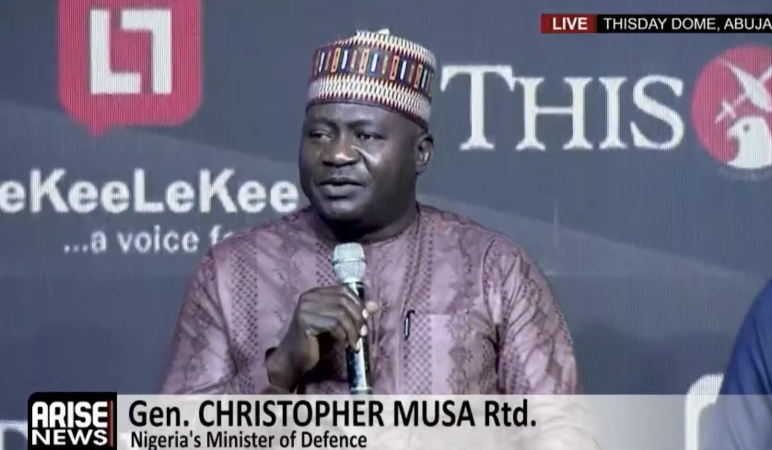
Minister of Defence, Gen. Christopher Musa (Rtd.), has said military force alone cannot end insecurity, stressing that defeating terrorism and banditry requires a combination of kinetic and non-kinetic measures, stronger community collaboration, and improved governance.
Speaking at the ARISE News Town Hall on State Police, Musa defended the military’s rules of engagement while responding to questions about his recent directive that any security operative, traditional ruler, religious leader, or individual found supporting terrorists or bandits would be treated as an accomplice.
Responding to concerns over how security personnel distinguish between genuine tactical delays and cowardice in combat, and how the military avoids civilian casualties, the Defence Minister said members of the Armed Forces operate under clearly defined rules of engagement and receive extensive training before deployment.
“Let me thank ARISE for organising this forum. It is always important that we have opportunities to speak and communicate to Nigerians for a better understanding,” he said.
“Members of the Armed Forces have their rules of engagement. Once you are deployed for an operation, you are allowed to take out the enemy using standards that are already stipulated in the rules of engagement.”
He explained that troops are authorised to use lethal force only under specific circumstances.
“One, when your life is at stake and you have no other way of stopping it. Two, when your colleagues’ lives are at stake and you have no other way of stopping it. Three, when the community or property you are protecting is under threat. As professionals, we train our troops before deploying them, and once they are deployed, they are able to identify who is a bandit, who is a terrorist, and who is a civilian.”
Musa acknowledged the complexity of fighting insurgency, noting that asymmetric warfare differs significantly from conventional warfare because the enemy often hides among civilians.
“I’ve always said that asymmetric warfare is a very difficult operation because the enemy is within. Conventional warfare is between one state and another—you know who your enemy is. In asymmetric warfare, the individual you think is your citizen, your brother or your uncle, whom you are protecting, could be the one trying to harm you. That makes it extremely difficult.”
He added that countries around the world have faced similar prolonged battles against insurgent groups.
“If you look worldwide, anywhere there is asymmetric warfare, it takes a very long time before success is achieved. In Turkey, for example, they dealt with the PKK for over 40 years. It is only recently that they have begun to make significant progress because they combined kinetic and non-kinetic approaches.”
According to the Defence Minister, military operations account for only a fraction of the solution.
“No country can shoot itself to peace. You must be able to bring the kinetic and the non-kinetic together. I’ve said repeatedly that the kinetic aspect is about 25 to 30 per cent. The non-kinetic aspect—which includes dialogue, discussion, understanding and working with communities—is equally important.”
He explained that terrorists often operate within local communities, making public cooperation essential.
“These terrorists live within the communities. If the communities are on their side, it makes it difficult for the security forces to win the battle. If the communities are with the security forces, it becomes much easier.”
Musa urged Nigerians to examine the root causes of insecurity rather than focusing solely on military responses.
“We must ask ourselves where we are today and whether we are addressing the factors that brought us here. We are in a democratic setting, and it is about perception. It is about the relationship between the leaders and the led.”
“The question is: do the people feel they are being led properly? Why are they not supporting the Armed Forces? Why are they not supporting the government? Those are areas we need to examine if we want lasting solutions.”
The Defence Minister emphasised that security requires collaboration between all levels of government and society.
“It is only when the Armed Forces, the communities and the government work together that we will make real progress. That is why it is critical for us to keep engaging communities so they understand they have a role to play.”
“The government has a role. Local governments have a role. Communities have a role. We must empower traditional rulers, religious leaders and local governments to contribute to security within their communities. When people can report suspicious activities and know that the information will be acted upon appropriately, it makes a huge difference.”
Musa also identified the absence of a comprehensive national database as a major obstacle to effective policing and national security.
“For security agencies and the police to work effectively, we need a database. Abroad, if you commit an offence, it is easier to identify you because they have your fingerprints, your photograph, your signature and other personal records. They know your address, your vehicles and other details because they have a proper database.”
“Do we have that? What is delaying us from putting those systems in place? We must return to those fundamentals if we want to strengthen our security architecture.”
He further called for reforms in the justice system and correctional services while stressing the importance of good governance.
“We must also examine our legal system and our correctional facilities. We should ask whether people are satisfied with governance within their communities because security is also linked to whether citizens feel they are being governed properly.”
Concluding, Musa reiterated that tackling insecurity requires collective national responsibility.
“This is a whole-of-community, whole-of-society and whole-of-government effort. What we are dealing with is not unique to Nigeria, but for us to succeed, everybody has a role to play.” (Arise News)