ADAD
ADAD
Updating your news feed...
NEWS EXPRESS is Nigeria’s leading online newspaper. Published by Africa’s international award-winning journalist, Mr. Isaac Umunna, NEWS EXPRESS is Nigeria’s first truly professional online daily newspaper. It is published from Lagos, Nigeria’s economic and media hub, and has a provision for occasional special print editions. Thanks to our vast network of sources and dedicated team of professional journalists and contributors spread across Nigeria and overseas, NEWS EXPRESS has become synonymous with newsbreaks and exclusive stories from around the world.


























Loading banners
Loading banners...

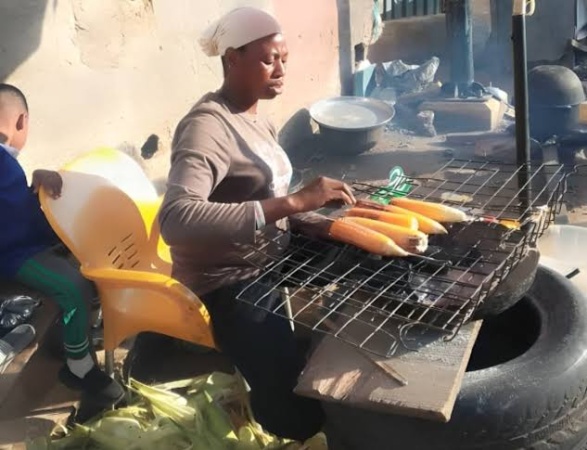
Roasted corn seller, Mrs Lateef Rukayat
The drizzling of Tuesday evening cools the atmosphere, but an irresistible aroma of fresh roasted corn lingers in the atmosphere, forcing passers-by to patronise Mrs Lateef Rukayat, among other roadside corn sellers at a popular junction in Oke-Ado, Ibadan, the capital city of Oyo State.
Rukayat, a woman in her forties, was out on this rainy day, defying all odds to fulfill a covenant she unknowingly made to people around the area, among other loyal customers who preferred the taste of her daily smokes when plying the road to Molete.
Speaking to Tribune On The Street, Rukayat opened up on how she chose survival over hairdressing work, the risks in the roasted corn business, the cost of venturing and banking on roasted corn to sponsor two children in higher education.
‘Starting with small capital, an olden-day testament’
Roasted corn is a seasonal snack, and due to its large consumption, many consider it an easy venture with little capital. However, Rukayat said the inflation in the country once kept the business out of reach for people without a strong financial backbone.
According to her, starting roasted corn with small capital was an old reference, stating that the trade does not have a stable capital to start with.
“A few days ago, the price of a bag of corn reduced. Before this time, I used to buy a bag of corn between N30,000 to N35,000 and above. But, as the price reduced, a bag is now sold for N15,000,” she told this reporter in Yoruba language.
Despite the recent crash in the price of corn, Rukayat believed it would be difficult to start with a small amount. While corn is the major ingredient, she noted that the business needs other basic items to stand.
“The cost of everything we are going to buy is one of the reasons people do not want to start the trade again. We will start from transportation, the money used to take the corn from the farm to where we’re going to sell. Also, we buy charcoal to roast the corn, nylon and paper for packaging. These are all to consider in starting a roasted corn business. You now see that it’s not some kind of trade to just jump into,” the mother of six explained to Tribune On The Street.
Dumping dream for survival
Unlike many people who learnt hairdressing and made it their only stock-in-trade, Rukayat could not sail through the tides in the business. She explained how difficult it was to cater for six children from her proceeds in the hairdressing business, a situation that pushed her to the brick wall of alternatives. She had to make a decision, and roasted corn it was — choosing to move from the shade of her struggling shop to dare the scorching sun and stubborn rain by the roadside.
Whenever conversations swing to her initial and dream work, Rukayat said she still boasts of being a certified hairdresser, but continuing to stick with her dream work was a risky gamble she was not ready to stake her agile phase on; hence, she took another route to survival.
“Hairdresser is my hard-earned work; it’s my early dream work, and I did freedom after completion,” she confirmed to this reporter, recalling that she “started roasting corn when my hairdressing business was not moving. All my children are in school, with two of them in higher institutions.”
‘Network borrowing’: Roasting corn with interest
Detailing how she sustains herself and family, Rukayat said that while neither she nor any of her friends chose the business from scratch, Mrs Lateef switching occupations from a position of have-not, according to her, was never an easy start.
Finding no other means to start afresh, the mother of six said she turned to borrowing. And with the aid of ‘Network,’ a popular borrowing scheme in the city, she stated that she’s able to roast her way out of poverty with interest.
“I started this trading in 2021 and I started by collecting Network. During that time, a bag of corn was sold for N35,000. That’s what I used to start this trade in January 2021 and till now, the price was going up and down.”
Speaking on how she managed to fend for six, two of whom are in higher institutions, Rukayat credits her roasted corn business, stating that God’s mercy never leaves God’s servant.
She further explained that daily earnings from the business go into a thrift, which has been helpful in financing the schooling of her children.
“With God’s mercy, on a daily basis, if I borrowed money and got like N20,000 to buy corn, I used to earn about N25,000 to N27,000 daily.
“From the earnings, I contribute and that’s what I collect in supporting my children’s schooling,” she explained.
On The Street about the challenges she had encountered since starting the roasted corn business in 2021, the woman recounted one of the challenges she considered inevitable for corn sellers.
According to her, roasted corn is a daily sale, and not finishing the stock for the day means loss, noting that selling remnants from the previous day is less costly than letting it go. To her, customers’ trust keeps one in the market.
“Agbado is a daily sale, and the shortage we sometimes encounter is when it remains, and we’re unable to sell everything finished in a day. Because it cannot be sold the next day, it would have lost taste, and no one will want to buy corn that is not fresh,” she told this reporter.
But that was not all; Rukayat also recalled a painful period when her expensive corn left the corn husk, only to end up not leaving her stall.
She continued, “There was a time when corn was super expensive, and we concluded on selling N200 corn for N400. Did you know that I did not benefit a kobo? It was totally a loss for me because nobody bought it that time, and I have to mourn my loss.”
Responding to a question on how the government can support her, Mrs Lateef said she never received a grant and believed getting such will help her do more to fend for her family through the business.
“Yes, the government can help us. Firstly, the cost of goods should be reduced and provide money to us who are selling so that we’ll be able to keep on doing our trade and cater for our families,” the woman begged. (Nigerian Tribune)