ADAD
ADAD
Updating your news feed...
NEWS EXPRESS is Nigeria’s leading online newspaper. Published by Africa’s international award-winning journalist, Mr. Isaac Umunna, NEWS EXPRESS is Nigeria’s first truly professional online daily newspaper. It is published from Lagos, Nigeria’s economic and media hub, and has a provision for occasional special print editions. Thanks to our vast network of sources and dedicated team of professional journalists and contributors spread across Nigeria and overseas, NEWS EXPRESS has become synonymous with newsbreaks and exclusive stories from around the world.
























Loading banners
Loading banners...

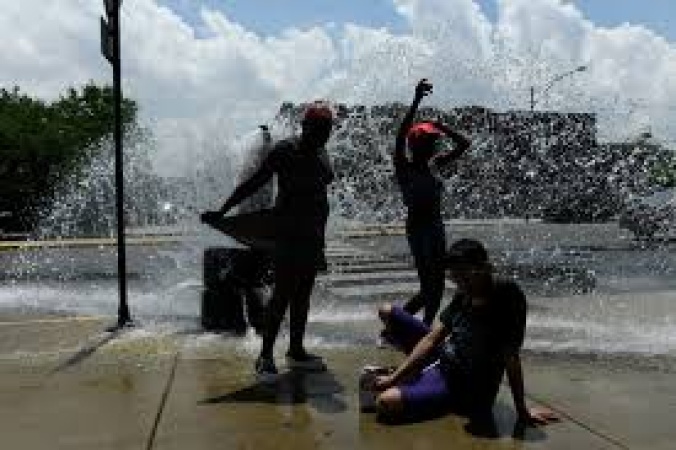
A person cools off with water from an open fire hydrant during a heat wave on the West Side of Chic
Extreme heat has forced the temporary closure of the White House’s signature Great American State Fair on the National Mall, among a series of events marking the July Fourth holiday in Washington, DC.
More than 165 million people were sweltering on Friday under record temperatures along the US East Coast and Midwest, according to the US National Weather Service.
“The safety and well-being of our guests, volunteers, performers, vendors, and staff is our highest priority,” the event organiser wrote on social media.
The heatwave Is disrupting a busy weekend as US President Donald Trump hosts a celebration marking America’s 250th birthday and multiple World Cup matches taking place outdoors.
A person cools off with water from an open fire hydrant during a heat wave on the West Side of Chicago
The State Fair will reopen at 17:00 local time (22:00 BST) when heat conditions improve, the organiser, Freedom 250, said.
The extreme heat was expected to continue through the weekend as the hottest spell of the year so far sends the mercury soaring to levels not seen, in some areas, in decades.
It follows an unprecedented spell of early summer heat across Europe, with record highs across the continent.
The Weather Service issued warnings that areas of the Midwest and East of the United States face “major” or “extreme” heat‑related health risks.
Searing heat and high humidity is not unusual across North America.
But the widespread nature of this event, across central and eastern areas on Friday and then the east for the weekend, sets it apart as potentially dangerous.
Philadelphia and Washington, DC are expected to reach around 106F (41C), approaching their all-time record highs, with forecasts calling for three and four consecutive days of 100F-plus (38C) temperatures, respectively.
The 4 July holiday is traditionally characterised by lots of outdoors activities – barbecues in yards and on rooftops, community parades and fireworks at night.
But because of the heatwave many of these activities have been curtailed or cancelled.
In Washington DC, US Capitol Police delayed public entry for Friday evening’s outdoor ‘A Capitol Fourth’ concert from 15:00 local time (19:00 GMT) to 19:00 as temperatures were expected to exceed 100F (38C).
Freedom 250 announced shortly after midday that the fair on the mall would be shutting down until the evening. Entry to the National Mall for this year’s fireworks show already had been pushed to 17:00 local time. The fireworks are expected to begin at 22:30, which is later than usual.
A representative for America 250, the non-partisan commission established by Congress for 250 celebrations, told the BBC that while it was “closely monitoring” weather forecasts “events are currently expected to proceed as planned”.
The commission Is hosting block parties in a handful of cities, including Boston, Philadelphia and New York City.
Trump is expected to speak outside at a 4 July celebration on Saturday, despite the predicted high temperatures. The president has maintained that he wanted to gather outside for the celebration.
“I’m gonna make a really long speech just to show that I can do anything,” he said.
In Philadelphia, officials cancelled Friday’s Salute to Independence Semiquincentennial Parade due to “extreme heat”, organisers, Wawa Welcome America, shared in a post on social media.
“As much as this decision pains everyone inside our organisation, we simply cannot host an event of this size and scale under these dangerous heat conditions,” its CEO Michael DelBene said in a statement provided to the BBC.
Having to cancel the event last-minute, DelBene said, is “heartbreaking for all of us”.
“While large-scale celebrations and community events may be our mission, our first responsibility will always be to the safety and security of our staff, our guests, and our event participants,” he added.
On Thursday, New York City hit 100F (38C) degrees, its hottest day since 2012, and the heat index remains at triple digits again on Friday.
“These are extremely dangerous conditions,” said New York City Mayor Zohran Mamdani.
Saturday might see the heat breaking in some central areas, but not in the east where it will be dangerously hot for those at outside events.
The other concern is severe thunderstorms on the northern plains, the Midwest and across to the Great Lakes. These will bring a dramatic end to the heat - damaging hail, destructive winds, flash flooding and even a few tornadoes.
By Sunday the heat will intensify in Virginia, the Carolinas and the southeast before building in western parts of the USA and Canada into next week.
America’s northern neighbour, Canada, has also been seeing extreme heat this week, with temperatures in Ontario expected to hit mid 30s Celsius (over 90F).
Heat warnings are also in place across much of Quebec, including Montreal and Quebec City.
On Friday morning, more than 51,000 Hydro-Québec customers were still without power due to the aftermath of the thunderstorms. The Laurentians, Lanaudière, and Laval remained the hardest-hit regions.
In a statement to CityNews, Hydro-Québec spokesperson Audrey St-Pierre said that at its peak around 9 p.m. Thursday, more than 137,000 customers in the province were without power.
“Outages were caused primarily by strong wind and lightning,” St-Pierre added.
Heatwaves have become more frequent, more intense, and last longer because of human-induced climate change. The world has already warmed by about 1.1C since the industrial era began and temperatures will keep rising unless governments around the world make steep cuts to emissions.
Temperatures in the north-east will drop a couple of degrees on 4 July with the threat of severe thunderstorms. Temperatures will still be well above average, though with a more significant drop on Sunday and Monday as cooler air moves down from the north. (BBC)