ADAD
ADAD
Updating your news feed...
NEWS EXPRESS is Nigeria’s leading online newspaper. Published by Africa’s international award-winning journalist, Mr. Isaac Umunna, NEWS EXPRESS is Nigeria’s first truly professional online daily newspaper. It is published from Lagos, Nigeria’s economic and media hub, and has a provision for occasional special print editions. Thanks to our vast network of sources and dedicated team of professional journalists and contributors spread across Nigeria and overseas, NEWS EXPRESS has become synonymous with newsbreaks and exclusive stories from around the world.










.webp)






Loading banners
Loading banners...

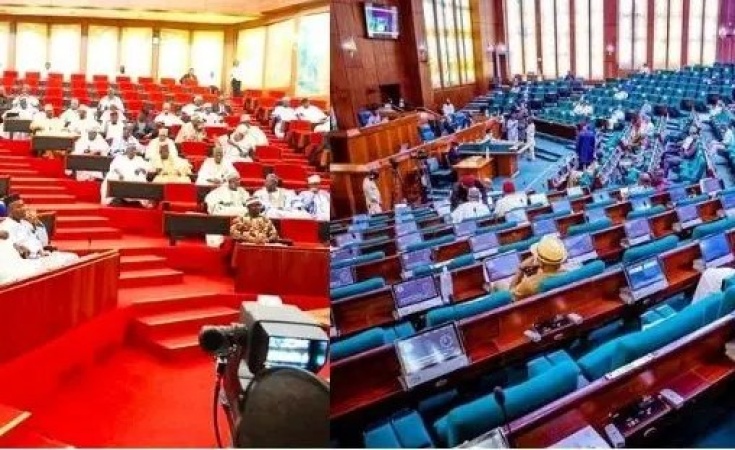
Joint session of the National Assembly
The Senate and House of Representatives are bracing for the harmonisation of the different versions of the State Police Bill they recently passed.
While the House of Representatives passed the bill on June 10, the Senate passed the Executive Bill transmitted by President Bola Ahmed Tinubu on June 24.
There are differences between the two versions, which lawmakers will reconcile through a joint conference committee of both chambers.
The bill seeks to alter the Constitution and will require the concurrence of at least two-thirds of the 36 state Houses of Assembly before it is presented to the President for assent.
The Senate version contains 26 clauses, while the House version has 18.
While the House made minimal alterations to Sections 34, 35, 39, 42, 89, 129, 153 and 197 of the Constitution, the Senate amended Sections 84, 89, 121, 124, 129, 157, 158, 160, 197, 201 and 202.
A comparison of the two versions shows that both chambers introduced a new Section 214 to replace the existing provision in the Constitution.
However, the Senate introduced 15 new sub-clauses, compared with the seven introduced by the House.
Although both chambers amended Section 215, which deals with the appointment of the Inspector-General of Police and the control of the Nigeria Police Force, the Senate retitled the section “Appointment, Command, Direction and Tenure,” while the House titled it “Appointment of Inspector-General of Police and Commissioner of Police of a State.”
Under the section, the Senate introduced 10 new clauses and designated the head of a state police command as “Commander”, while the House introduced five new clauses, naming the head of the state police “Commissioner of Police.”
Similarly, both chambers substituted Section 216, which deals with the delegation of powers to the Inspector-General of Police, with entirely new provisions but adopted different titles.
The Senate titled the section “National Police Standards, Oversight and Accountability”, while the House titled it “Removal of Inspector-General of Police and Commissioner of Police of a State”, replacing the existing constitutional provisions with entirely new ones.
Although both versions contain four sub-sections under Section 216, they assign different functions, which could eventually be separated into two distinct sections during harmonisation.
The Senate version also contains seven transitional provisions for the establishment of state police, while the House version has none. In addition, the Senate made substantial amendments to the Second, Third and Fourth Schedules to the Constitution, while the House amended only the Second and Third Schedules.
House of Representatives Deputy Speaker Benjamin Kalu and House spokesman Akin Rotimi said the conference committee to harmonise the differences between the two chambers would be constituted after the House resumes on July 7.
Kalu, who described the bill as a product of national consensus, said extensive consultations were held with the Executive and other critical stakeholders before its passage.
Last week, the Conference of Speakers pledged support for the bill and assured that it would receive diligent consideration once transmitted to the state Houses of Assembly.
Yesterday, Lagos State Governor Babajide Sanwo-Olu, who spoke at the 80th Memorial Lecture in honour of the late Herbert Macaulay in Lagos, said the state was ready for state police and would draw on the experience of retired security chiefs in its operations.
“If there are minor changes, where to cross the T’s and dot the I’s, we do that, and that will be done in the coming days. From there, it will be transmitted to the states.
“My joy, and the joy of everyone backing this particular piece of legislation, is that there is currently a national consensus that cuts across all stakeholders in Nigeria.
“Everybody’s concern is whether it is well structured and well framed. I am assuring Nigerians that a lot of work has gone into it. If there is any area we need to touch, we will do so before it goes to the Houses of Assembly.
“The body language of the governors has been quite positive because they are the chief security officers of their various states. Most of these security challenges occur at the state level, and any help in that direction is welcome.
“We are going to test the governors to see how committed they are and how quickly they want the bill by the way they engage their respective Houses of Assembly to return it to us promptly.”
Kalu said the Senate and House passed substantially the same bill, with only minor drafting differences.
“They are fundamentally the same bill. I am sure what we are going to change, what we are going to dot or cross, will be less than one or two per cent.
“There is nothing fundamental. But we must be in tandem for it to become a unified piece of legislation from the National Assembly.”
He said President Tinubu was keen on the speedy passage of the bill, adding that it would be transmitted to the state legislatures as soon as harmonisation was completed.
“Once we come back from recess on July 7, the House will constitute the conference committee. If there is any need to convene an emergency meeting before then, the leadership of the National Assembly will consider it.
“Once we are done, we intend to hand it over to the states the same day. It will be a ceremonial handover where we invite the Speakers of the state Houses of Assembly and formally present the bill to them.
“I believe the governors have already done the groundwork and, once it gets to them, it should be back within a week for Mr President’s assent.”
Kalu said the bill contains safeguards against possible abuse by state governments.
“It’s very important because standards are everything in policing. President Tinubu is a federalist who believes in strengthening the sub-national governments, but that does not diminish his role as Commander-in-Chief.
“If you don’t put those guardrails in place, you could end up with police structures that fall below global best practices. We want the policing system in Nigeria to remain consistent with international standards.
“The National Police Council will set the minimum standards. Any state that wants to establish a police service must meet those requirements before it is certified.
“States are free to exceed those standards, but the minimum benchmark is necessary to ensure professionalism and accountability.”
On fears that governors might misuse state police, Kalu said such abuse could lead to the withdrawal of certification. (The Nation)