ADAD
ADAD
Updating your news feed...
NEWS EXPRESS is Nigeria’s leading online newspaper. Published by Africa’s international award-winning journalist, Mr. Isaac Umunna, NEWS EXPRESS is Nigeria’s first truly professional online daily newspaper. It is published from Lagos, Nigeria’s economic and media hub, and has a provision for occasional special print editions. Thanks to our vast network of sources and dedicated team of professional journalists and contributors spread across Nigeria and overseas, NEWS EXPRESS has become synonymous with newsbreaks and exclusive stories from around the world.













.webp)












Loading banners
Loading banners...

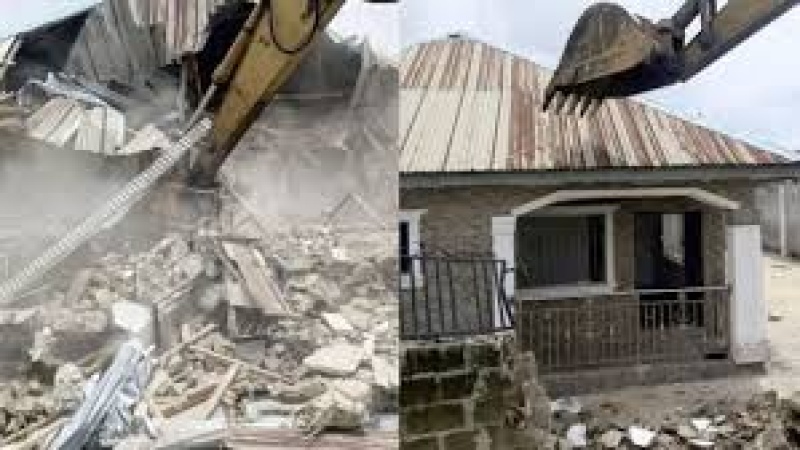
The kidnappers' den recently demolished by the Oyo State government
The instant demolition of a building allegedly used in keeping hostages by the Oyo State Government following the abduction surge in the state and its attendant public outrage, has raised legal, economic, moral and security questions, ROTIMI AGBOLUAJE reports.
When officials of the Oyo State Government arrived with bulldozers at a modest three-bedroom bungalow in Lako Community, Ayegun-Anaye Road, Ibadan, on June 8, 2026, they were not merely demolishing a building; they inadvertently also destroyed important evidence that would have aided an investigation into kidnapping and sundry illicit conduct.
Days earlier, the structure had allegedly served as a hideout where Mrs Olaide Busayo Adegoke John-Paul, younger sister to the former Minister of Power, Chief Bayo Adelabu, and her 11-year-old twin sons, Peter and Paul, were held after being abducted from Elewura Street, off Ring Road, Ibadan, days earlier.
Under the watch of security operatives and government officials led by the Commissioner for Public Works and Transport, Abdulmojeed Mogbonjubola, the bungalow was reduced to rubble, while the government also revoked the occupancy rights of the plot of land.
A few days later, another property, a residential compound comprising a storey building and two bungalows at Gbenku, along Arubiewe Road, near Olodo Garage, Ibadan, suffered the same fate. A It was demolished after security agencies allegedly discovered a cache of arms and ammunition on the premises.
For Governor Seyi Makinde’s administration, the demolitions represent a bold step in the war against kidnapping and violent crimes. The message was unmistakable: Oyo State would not only pursue kidnappers but would also destroy the infrastructure that enables their operations.
Yet beyond the dramatic images of collapsing buildings and billowing dust lies a much deeper debate, one that touches the very foundations of law, governance, economics, morality, and constitutional democracy.
And the critical question to be asked is: “Can the state destroy private property because it was allegedly used for criminal purposes? Does the fight against insecurity justify extraordinary executive action? Should innocent landlords bear the consequences of crimes committed by their tenants? Is demolition a legitimate deterrent or an economically wasteful exercise? And where should society draw the line between public safety and individual rights?
The questions have become even more significant because Oyo State did not act in isolation.
Across Nigeria, state governments have adopted aggressive measures against properties linked to crime. In Anambra State, authorities have demolished buildings associated with kidnapping and violent crimes as part of anti-kidnapping measures designed to deter criminal activity.
Enugu State has embraced property forfeiture provisions targeting assets connected to kidnapping. The trend reflects a growing frustration among state governments confronted with worsening insecurity and public demands for stronger action.
But it also raises concerns about whether the country is entering a new era where executive power intersects with constitutional rights.
At the heart of Oyo’s actions is the Oyo State Kidnapping (Prohibition) Law, 2016, a legislation believed to provide legal backing for measures against facilities used for kidnapping operations.
Those who supported the demolitions argued that the state acted within the law and in the overriding public interest. A former Chairman of the Nigerian Bar Association (NBA), Ibadan Branch, Ibrahim Lawal, said security considerations justify the government’s action.
“The government can take action to override public interest. We are talking about security,” he said. For Lawal, if a property constitutes a threat to public safety and the law empowers the government to act, then the larger public interest must prevail.
“If it is in the interest of the public that the place should be destroyed to prevent breakdown of law, particularly a threat to national security, then the government is in order,” he argued.
On his part, a Security and Criminal Justice scholar at the University of Ibadan, Prof Oyesoji Aremu, said: ‘’If we accept demolition as a legitimate response, then its morality aligns with the principle of deterrence that underpins criminal justice. It is this reasoning that informed the government’s decision to demolish those properties.”
Lawal and Aremu’s position resonates with many Nigerians who have watched kidnapping evolve from isolated criminal incidents into a major national security crisis. They insisted that buildings used to detain kidnap victims or warehouse illegal arms have effectively become components of criminal enterprises. They argued that once that threshold is crossed, society’s interest in preserving life outweighs concerns about preserving property.
In his submission, a former Oyo State Attorney-General and Commissioner for Justice, Mr Oluwaseun Abimbola, justified the demolition exercise. “There is an Anti-Kidnapping Law that was passed some years back, even before the current administration,” he noted.
According to him, if the legislation empowers the government to act in such circumstances, the governor’s action may be lawful, even if affected parties challenge its constitutionality.
“That distinction is important because legality and constitutionality are not always identical. A law may exist and be enforceable until successfully challenged in court,” he explained.
Abimbola, however, suggested that demolition may not be the most economically prudent course of action, adding that the State House of Assembly should revisit the law. “Rather than demolish, they can expropriate it as state property,” he suggested.
Similarly, a Senior Advocate of Nigeria, Dipo Olasope, agreed with Abimbola, adding that under the Anti-Kidnapping Law, the state has the right to knock down such structures.
To Olasope, demolitions also serve as a deterrent. According to him, every demolished building sends a warning to property owners, agents and communities that vigilance is no longer optional. “Every landlord needs to take an inventory of everyone you are giving your house to,” he said.
Olasope, though in agreement about the demolition, acknowledged that it was done too quickly.
“The demolitions were done in a hurry because they should have gone to those houses and searched very well for useful evidence,” he said.
Also speaking, a former State Security Service (SSS) intelligence officer and lawyer, Fatai Akinsanmi, argued that the philosophy behind the policy is clear. If landlords, he said, become more careful, communities more observant and agents more diligent, criminals may find it increasingly difficult to establish operational bases in people’s property.
“The law is not draconian if you look at the consequences of kidnapping. Many people have died by abduction. Kidnapping needs more draconian laws to serve as a deterrent,” he said.
Akinsanmi also shared the same reservations that the demolition of buildings was a waste of resources for the economy.
The reservation raises a fundamental question: whether confiscation, forfeiture, or expropriation would achieve the same security objectives while preserving economic value.
The question becomes even more relevant when viewed through the lens of speed, with which the structure was demolished.
For opponents of the demolition policy, the constitutional implications are far more troubling than the security arguments advanced in its defence.
Section 43 of the 1999 Constitution (as altered) guarantees the right of citizens to acquire and own immovable property anywhere in the federation. Under
Section 44 goes further by protecting citizens against compulsory acquisition of property except under conditions prescribed by law and subject to due process and compensation provisions.
Analysts argued that these protections cannot simply be swept aside by executive action or subsidiary legislation.
Speaking on this, a human rights lawyer, Niyi Aborisade, contended that the demolitions raise serious rule-of-law concerns.
“The governor is taking the law into his own hands by demolishing the property without an order of court,” he argued.
Aborisade emphasised that the issue extended beyond kidnapping and concerned the constitutional separation of powers. He argued that the executive investigates while the judiciary determines guilt.
He said: “The Executive will make allegations. The court will conduct a proper trial, make findings and determine if the accused is guilty.
“The concern is that if the government can identify a property, declare it connected to criminal activity and destroy it without judicial scrutiny, the precedent could prove difficult to contain.
“Today, the target may be kidnappers’ hideouts. Tomorrow, pundits fear the same principle could be extended to other situations where evidence is less clear and motivations more contentious,” he said.
A former Oyo lawmaker Muideen Olagunju, in his intervention, raised another fundamental issue about ownership. “The property does not belong to the kidnappers,” he argued.
Landlords rarely possess the investigative capacity available to law enforcement agencies, he said, adding that tenants often present themselves as legitimate professionals and business people.
“Anyone renting a property can claim to be anything,” Olagunju stated, wondering why innocent property owners lose lifetime investments because tenants secretly engage in criminal activity.
He argued that demolishing crime scenes too quickly may destroy valuable evidence.
Crime scenes often contain forensic material, digital records and intelligence capable of exposing wider criminal networks. The government ought to investigate what transpired in the building,” he said.
An estate surveyor and valuer, Mr Fisayo Alo, agreed that the practice is unfair to property owners.
Punishing innocent landlords for crimes committed by tenants, he argued, risks creating injustice and undermining confidence in government.
Demolition, he said, destroys capital assets, eliminates potential income streams and may adversely affect innocent parties, including dependants, lenders and investors.
An investment risk analyst and asset valuer, Dr Adewale Rufai Adedokun, noted that in present-day Nigeria, the losses run into millions of naira.
“If a property was financed through loans, demolition may leave owners burdened with debt while eliminating the asset securing the investment,” he said.
Alo proposed an alternative, saying that where criminal ownership or criminal use is established beyond doubt, the government could confiscate and auction the property.
Such an approach, he said, would preserve value, generate revenue and avoid unnecessary destruction.
Across the world, tough-on-crime policies often generate public support because they produce visible and immediate outcomes. A demolished building is tangible evidence of governmental action; it communicates resolve, strength and decisiveness.
For elected leaders confronting public anxiety over insecurity, such symbolism can be politically valuable. The question, however, is whether symbolism translates into lasting security gains.
Do dramatic demolitions dismantle criminal networks or merely create powerful images? Do they reduce kidnapping or simply demonstrate government determination?
Analysts said visible enforcement actions frequently generate political capital, especially during periods of heightened public concern about security. However, they caution that symbolism should not substitute for deeper reforms involving intelligence gathering, policing, prosecution and judicial efficiency.
Therefore, the controversy surrounding Oyo’s demolitions reflects a broader national dilemma.
Nigerians want security. They want kidnappers punished. They want governments to act decisively. At the same time, they want constitutional safeguards, property rights, fair hearing and protection from arbitrary state action.
So, the challenge is finding a balance between those competing demands. For now, the demolished structures in Ibadan remain powerful symbols. (The Guardian)