ADAD
ADAD
Updating your news feed...
NEWS EXPRESS is Nigeria’s leading online newspaper. Published by Africa’s international award-winning journalist, Mr. Isaac Umunna, NEWS EXPRESS is Nigeria’s first truly professional online daily newspaper. It is published from Lagos, Nigeria’s economic and media hub, and has a provision for occasional special print editions. Thanks to our vast network of sources and dedicated team of professional journalists and contributors spread across Nigeria and overseas, NEWS EXPRESS has become synonymous with newsbreaks and exclusive stories from around the world.



.webp)



Loading banners
Loading banners...

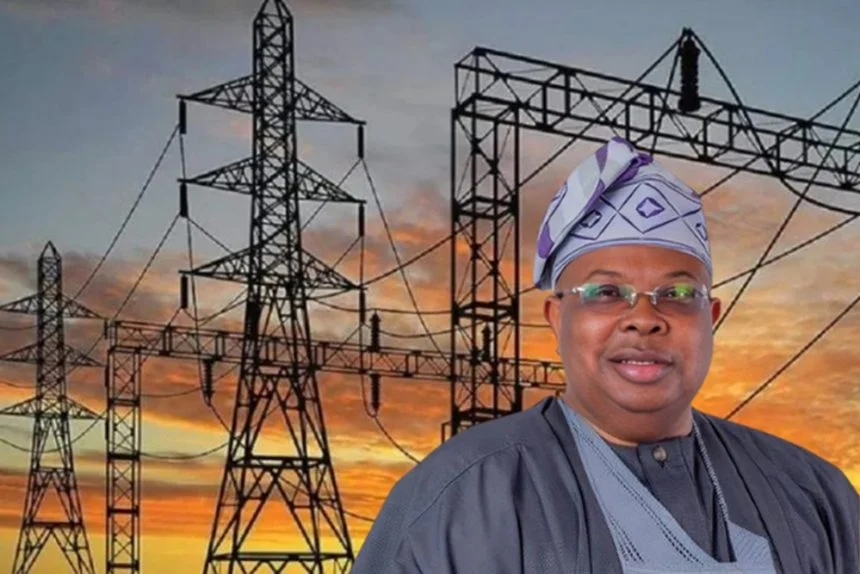
Engineer Joseph Olasunkanmi Tegbe, the Nigeria’s Minister of Power spoke about the giant strides being recorded by the Federal Government through the Rural Electrification Agency, in the deployment of solar mini grids across the country. He also gave an update on the power sector’s debt when speaking with journalists after the inauguration of 505kwp interconnected mini-grid in Epe, Lagos State. DAYO AYEYEMI brings some excerpts.
What can you say about the delivery of 505 kilowatt peak (kwp) Epe interconnected?
I call it democratization of electricity. By virtue of the Electricity Act 2023, President Bola Tinubu made it known that one of the major landmarks that he has done is to decentralize both generation, transmission and distribution from federal to sub-nationals.
The commissioning of today’s project is not just about electricity, it’s not just about decentralization, it’s actually beyond that.
What we’ve done here, Rural Electrification Agency, alongside with the sponsors, European Union, the government of Germany and A4&T, is to create a solar mini-grid, thus generating power.
You see behind me transmission line. If you go in there, you see battery stems for the purpose of power storage. And then you see them connecting and putting grid meter in the houses.
So what they’ve done is taking from generation to end-user.
Not only that, it requires also interface and interconnectability with Ikeja Electric, who is responsible for this territory.
So you see the electricity has to work in practical terms; and that’s what we’re trying to demonstrate.
We’re not stopping at 5.5 kilowatts. We’re going to break ground now for 5 megawatts that will serve the larger Epe communities.
So I think, kudos to Mr. President, for example, for decentralization, for empowering the sub-nationals and empowering private sectors in government.
Of course, you saw earlier the private sector players, and you saw the banks. For the banks to participate in this project, it means they are able to get the blended rates.
With the intervention of European Union, government of Germany through GIZ, it means funding are also coming in from external communities.
This means there’s trust in our economy, and there’s trust in economic growth.
So I think we’re in for a great time.
Are we expecting this to go all over the geopolitical spaces?
Already we’re doing beyond this. In most of our universities, teaching hospitals, we are deploying 10 megawatts, 12 megawatts in most of those places.
And I said earlier on, a private sector got 500 hectares of land from Niger State to build at 200 megawatts.
What they are doing is because the electricity has allowed net metering.
Can you tell us what net metering does?
What net metering does is that if you are generating more than you require, you are allow to actually feed in the excess into the grid.
So what do we do as we are stabilising the grid?
We’re also expanding off-grid, and also connecting off-grid to the main grid.
So you can see that there’s interconnection.
I commend Rural Electrification Agency for that.
And I commend, honestly, the communities.
I will like to tell the community, leaders, kings and the chiefs that this is their own asset.
These guys have been out of light for many years.
And it’s not because we never had a light here. It was because it was vandalized.
Now what we’ve done is that we’ve replaced it with a mini-grid.
And they’re going to be expanding this since they have more land.
They’re just giving us more land, which means we can expand the solar farm.
There are rooms to accommodate more batteries.
So you mean you can have more storage capacity?
Yes. Very soon, even at this location, the 505 megawatts could become 1.5 megawatts.
Sir, you inherited a lot of issues in the Nigerian Electricity Supply Industry. One of them is GenCos’ outstanding debt. How soon are they getting this money paid?
It’s being resolved already.
The total debt estimate was about N3.33 trillion, and President Bola Tinubu approved that we raise bond and make cash available to pay the GenCos.
After due verification, the first tranche of N501 billion has been paid to GenCos.
The second tranche is due sometime in July.
So we’re on course.
And look, whatever it is, it’s a bond that’s been raised for seven years to ease liquidity of government.
So we’re addressing all those things.
And we’re also plucking the hole that’s creating such debts.
At the same time, we need to ensure that the debt is not accumulated over and over again. (TRIBUNE)