ADVERTISEMENT

ADVERTISEMENT
Updating your news feed...

NEWS EXPRESS is Nigeria’s leading online newspaper. Published by Africa’s international award-winning journalist, Mr. Isaac Umunna, NEWS EXPRESS is Nigeria’s first truly professional online daily newspaper. It is published from Lagos, Nigeria’s economic and media hub, and has a provision for occasional special print editions. Thanks to our vast network of sources and dedicated team of professional journalists and contributors spread across Nigeria and overseas, NEWS EXPRESS has become synonymous with newsbreaks and exclusive stories from around the world.
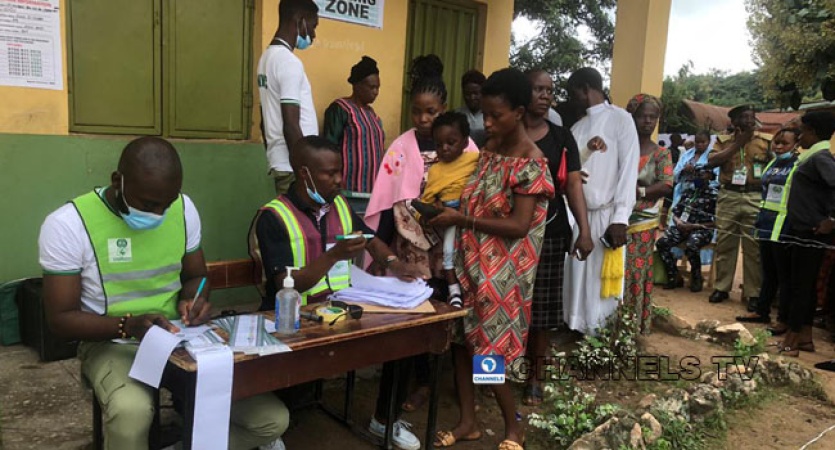
Voters queuing up at a voting booth
The Independent National Electoral Commission (INEC) yesterday distributed sensitive and non-sensitive materials to the 16 local government areas for the conduct of tomorrow’s governorship election in Ekiti State.
The exercise was monitored by security agencies, civil society organisations, political party agents and the media.
Speaking during the distribution, the Ekiti State Resident Electoral Commissioner, Bunmi Omoseyindemi, expressed confidence that the election would be hitch-free and transparent.
He said: “This process is being coordinated by the Resident Electoral Commissioner for Ekiti State. We also have representatives of political parties here. We have representatives of civil society organisations, and we also have, of course, the media covering it.
“This is making it transparent, and what we are actually seeing is the sorting of both sensitive and non-sensitive materials and distribution to each of the 16 local government areas. Just as I stated, we’re starting with the farthest local government.
“The Independent National Electoral Commission is to provide the avenue and provide where people will come and vote, and this is what we are doing. This is the process.
“Our message is that people should vote for the candidate of their choice and that the election will be conducted in a peaceful atmosphere. As you can see, Ekiti has been peaceful, and we promise them we are going to have a free, fair, transparent and inclusive election.”
Also, INEC announced the successful conclusion of the Permanent Voter Card (PVC) collection exercise for the Ekiti State governorship election, revealing that over 1.02 million voters have collected their cards ahead of tomorrow’s poll.
The Commission disclosed that the number of registered voters in the state increased from 987,647 in 2023 to 1,059,360 in 2026, following the Continuous Voter Registration (CVR) exercise and subsequent clean-up of the voters’ register.
INEC, in a statement issued yesterday by the National Commissioner and Chairman of the Information and Voter Education Committee, Mohammed Kudu Haruna, said 1,028,929 PVCs had been collected, representing 97.1 per cent of registered voters.
The figure marks a slight improvement from the 2023 governorship election when 958,052 PVCs were collected, representing a 97 per cent collection rate.
The commission noted that the PVC collection exercise, initially scheduled to end on June 11, was extended to June 14 following consultations with stakeholders at a meeting held in Ado-Ekiti.
According to INEC, all eligible applicants, including those who registered during the CVR exercise, transferred their registration to Ekiti State, or applied for replacement of lost, damaged or defaced PVCs, had their cards printed and made available for collection.
The electoral body disclosed that it received 14,406 applications for replacement PVCs in line with the provisions of Section 18(1) of the Electoral Act 2026, which mandates the commission to provide replacement cards to voters whose original PVCs were lost, damaged or defaced.
Haruna said all 14,406 replacement cards were produced, with the majority already collected by their owners.
INEC, however, explained that it was unable to introduce the proposed downloadable voter card option for affected voters because the required technological infrastructure had yet to be completed.
It added that the innovation is expected to be available for future elections, beginning with the Osun State governorship election in August 2026 and the 2027 general election.
The commission commended traditional rulers, community leaders, civil society organisations, political parties and the media for supporting voter mobilisation efforts and encouraging citizens to collect their PVCs.
Speaking on the security being provided for the election, the Commissioner of Police in charge of the exercise, Abayomi Shogunle, disclosed that the Inspector-General of Police had deployed multilayered security to ensure the sanctity of the ballot and prevent a breakdown of law and order.
He said: “We have considered different inputs apart from our own intelligence report. We have also considered risk assessments carried out by different stakeholders, and at the place you mentioned, we have put in place adequate measures to forestall the issues or the apprehension people have mentioned.
“We have identified different elements here and there, and we are putting in place different measures to take care of the issues that have been identified. Different measures have been put in place, so even if it skips one, it definitely won’t skip the other one.”
Its pre-election press briefing, Yiaga Africa noted that vote-buying remained a significant threat to the integrity of the Ekiti election, urging INEC, in collaboration with security agencies and anti-corruption bodies, to proactively identify, arrest and prosecute individuals engaged in vote-buying on election day.
Also speaking on security, Yiaga Africa said it recognised the efforts of security agencies, through the Inter-Agency Consultative Committee on Election Security (ICCES), to coordinate security arrangements for the election.
“While the security environment remains relatively calm, Yiaga Africa notes lingering security concerns in parts of the state, particularly in identified hotspot LGAs such as Ado-Ekiti, Ikole, Oye and Ikere.
“The organisation is also concerned about the movement of citizens, election officials, observers, party agents and election materials during collation in LGAs such as Ilejemeje and Moba, where recent kidnapping incidents may affect public confidence and safe movement, especially after 7:00 p.m.”
In a separate press briefing, the Independent Press Centre (IPC) and the Centre for Media and Society (CEMESO) said the deployment of journalists to cover the Ekiti governorship election was not merely a professional exercise but an act of democratic service.
At the media parley, Executive Director of IPC, Lanre Arogundade, and Executive Director of CEMESO, Akin Akingbulu, said the admonition had become necessary in light of the critical role the media plays during electioneering processes and elections, when journalists’ safety may be threatened.
Arogundade said: “When a journalist is harassed, barred or attacked at a polling unit, it is not simply that individual who suffers — it is the electorate that is robbed of the witness it deserves.
“Journalists are expected to be non-partisan. Being partisan is not only about being a member of a political party but also includes the use of expressions and/or impressions with statements, tags, symbols and colours that portray or identify with a particular political party or personalities.
“Journalists who are to cover the elections should ensure that they are fully kitted and accredited to do so, in order to avoid situations wherein security agencies would have to question them or bar them from performing their duties. Journalists who are not on election duty should avoid straying into identified polling units at will during the stipulated period of the election.
“At all times, journalists covering the elections must have their identification cards and press or media tags clearly displayed to avoid undue harassment and unnecessary identity checks by security agencies.”
Arogundade also encouraged journalists to report any threats to the Nigeria Union of Journalists (NUJ), Ekiti State Council.
IPCR, others urge Nigerians to reject electoral violence ahead of 2027 polls
Relatedly, the Institute for Peace and Conflict Resolution (IPCR), Search for Common Ground (SCG) and the Centre for Democracy and Development (CDD) have urged Nigerians across all sectors to reject electoral violence and embrace peaceful, inclusive and responsible democratic participation as the country prepares for the 2027 general elections.
The organisations warned that electoral violence continues to pose a serious threat to democratic consolidation, national unity and sustainable development.
Speaking on behalf of the organisations at a joint news conference held yesterday to commemorate Democracy Day 2026, Director-General of IPCR, Joseph Ochogwu, said the occasion serves as an important reminder of Nigeria’s democratic journey and the collective responsibility of citizens and institutions to protect and strengthen democratic values.
According to him, electoral violence remains one of the most significant challenges confronting democratic processes in many societies.
“Across election cycles, incidents of political intimidation, destruction of property, misinformation, hate speech, voter suppression and physical attacks have undermined public confidence in elections and weakened citizens’ trust in democratic institutions.
“Such actions not only threaten lives and livelihoods but also discourage meaningful participation in governance.
“Elections should be opportunities for citizens to freely express their choices through peaceful and lawful means. Democratic competition should be based on ideas, policies, competence and service to the people rather than intimidation, coercion, violence or divisive rhetoric.
“A peaceful electoral environment is essential for ensuring credible elections, protecting citizens’ rights and strengthening democratic accountability.”
Ochogwu said preventing electoral violence requires the active participation of all stakeholders, urging political leaders and candidates to demonstrate statesmanship by promoting issue-based campaigns and publicly discouraging violence among their supporters.
He also underscored the role of government institutions, electoral bodies, security agencies, traditional rulers, religious leaders, women-led organisations, community-based groups and civil society actors in preventing electoral violence.
According to him, stronger collaboration among these stakeholders is essential for identifying early warning signs of conflict, promoting peaceful dialogue and responding effectively to emerging tensions before they escalate into violence.
NHRC flags dangers of hate speech as electioneering gathers pace
Also, the National Human Rights Commission (NHRC) has warned that the growing spread of hate speech poses a serious threat to Nigeria’s democracy, peace and socio-economic development ahead of the 2027 general elections.
Executive Secretary of the commission, Tony Ojukwu, gave the warning while marking the International Day for Countering Hate Speech, describing hate speech as a violation of human rights that undermines dignity, equality and national cohesion.
Ojukwu said that while freedom of expression remains a fundamental right, it does not protect statements capable of inciting hatred, hostility or violence against individuals or groups.
He noted that the Cybercrimes Act 2015, particularly Sections 24 and 26, recognises the deliberate spread of offensive and inflammatory content online as a punishable offence.
The NHRC boss stressed that, beyond legal measures, political actors, traditional and religious leaders, media practitioners and citizens must promote responsible communication.
According to him, unchecked hate speech can deepen divisions, trigger conflicts, weaken public trust and negatively affect economic growth.
“Conflict destroys infrastructure, displaces families, and reverses years of developmental gains. No nation can build on the ruins of hatred,” he said.
With the 2027 elections approaching, Ojukwu warned that inflammatory rhetoric could threaten electoral credibility by intimidating voters, discouraging participation and worsening ethnic and religious tensions.
“Hate speech is not harmless talk. It is a trigger for conflict, a brake on national development, and a betrayal of our shared humanity,” he cautioned.
He urged citizens to verify information before sharing, reject messages that promote hatred and report incitement to violence or discrimination to relevant authorities.
Ojukwu also assured that the commission would continue to monitor, document and respond to incidents of hate speech across the country. (The Nation)