Updating your news feed...
NEWS EXPRESS is Nigeria’s leading online newspaper. Published by Africa’s international award-winning journalist, Mr. Isaac Umunna, NEWS EXPRESS is Nigeria’s first truly professional online daily newspaper. It is published from Lagos, Nigeria’s economic and media hub, and has a provision for occasional special print editions. Thanks to our vast network of sources and dedicated team of professional journalists and contributors spread across Nigeria and overseas, NEWS EXPRESS has become synonymous with newsbreaks and exclusive stories from around the world.





Loading banners
Loading banners...

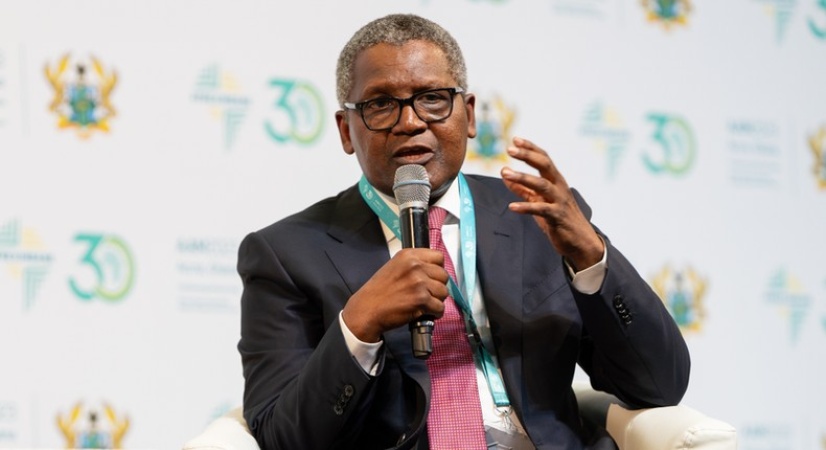
Africa’s richest man, Aliko Dangote has said China has become the dominant foreign business partner across Africa because it is more willing than the United States and Europe to provide long-term financing for major industrial and infrastructure projects.
Speaking during an interview with Nicolai Tangen, the billionaire said Chinese companies have gained an edge in Africa by combining business deals with strong credit support backed by the Chinese state.
Asked which global power is helping Africa most in business among China, the U.S., and Europe, Mr Dangote replied: “It’s China.”
According to him, the absence of flexible financing from Western countries created room for China to dominate large-scale projects across the continent.
Mr Dangote explained that many Chinese suppliers allow African businesses and governments to acquire equipment through long-term repayment structures rather than demanding full upfront payments.
Using his cement operations as an example, he said Chinese firms often supply heavy industrial equipment backed by export credit guarantees, allowing buyers to spread payments over several years.
He contrasted that approach with some European suppliers that require immediate payment for projects worth hundreds of millions of dollars.
“If I go to Italy, for example, and they are asking me to write a cheque for a power plant of $500 million… and the Chinese are saying just give me 20 per cent, the rest I will finance for five years, which one are you going to take?” he said.
“Obviously, you take the Chinese one.”
China has expanded its economic influence across Africa over the last two decades through infrastructure lending, construction projects, mining investments and trade partnerships.
Through its Belt and Road Initiative, Chinese lenders and contractors have financed railways, ports, roads, power plants and industrial projects in several African countries.
Nigeria alone has received billions of dollars in Chinese-backed financing for rail and transport infrastructure, including the Abuja-Kaduna and Lagos-Ibadan railway projects.
Western governments and multilateral institutions have recently become more cautious about large infrastructure lending in developing economies, partly due to rising debt concerns and tighter global financial conditions.
That shift has widened the financing gap for African countries seeking funds for industrialisation and infrastructure expansion.
Mr Dangote said financing flexibility remains critical for companies hoping to scale operations across Africa without exhausting cash reserves.
“These ones will suck out my cash and I won’t be able to do more,” he said, referring to suppliers demanding upfront payments.
The businessman also disclosed that the Dangote Group plans to spend about $45 billion between 2026 and 2030 on expansion projects across its businesses.
“We want to do projects… we’re spending $45 billion between 2026 and 2030,” he said.
He noted that large industrial growth requires companies to carefully leverage financing instead of relying entirely on direct cash payments.
“For me to grow that big, I also need to leverage. I’m not going to over-leverage, but I need to leverage the business to be able to get to where I want to be,” he added.
Despite praising China’s financing model, Mr Dangote said the United States is beginning to show stronger interest in infrastructure investment opportunities in Africa.
He cited recent discussions with the U.S. International Development Finance Corporation, saying the agency appeared increasingly willing to fund large projects on the continent.
“This time around when I went to the Development Finance Corporation of the U.S… they were very hungry for infrastructure. They are very hungry for projects, and they are ready to lend,” he said.
Mr Dangote also warned that countries such as Japan risk losing relevance in Africa’s investment landscape if they fail to compete on financing terms.
“What I told them is that Japan will be missing for a very long time,” he said.
“Today when you are coming, make sure that you come with your own balance sheet on the table, because we have choices of buying from many other countries.” (Business Insider Africa)