ADAD
ADAD
Updating your news feed...
NEWS EXPRESS is Nigeria’s leading online newspaper. Published by Africa’s international award-winning journalist, Mr. Isaac Umunna, NEWS EXPRESS is Nigeria’s first truly professional online daily newspaper. It is published from Lagos, Nigeria’s economic and media hub, and has a provision for occasional special print editions. Thanks to our vast network of sources and dedicated team of professional journalists and contributors spread across Nigeria and overseas, NEWS EXPRESS has become synonymous with newsbreaks and exclusive stories from around the world.










Loading banners
Loading banners...

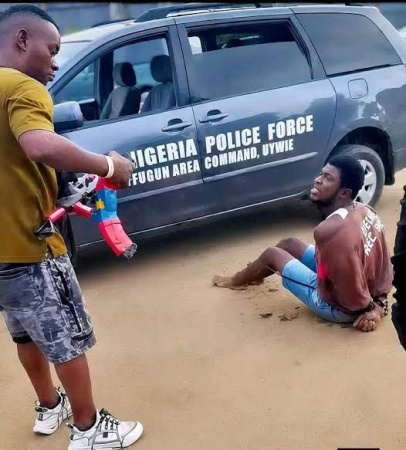
Mene Ogidi was murdered in cold blood by trigger-happy ASP Usman Nuhu
The 28-year-old Mene Ogidi had his hands tied behind his back. He was seated on the bare ground, pleading for his life.
“I’ll tell you everything,” he begged. But moments later, a gunshot cracked through the air. Then another, and his body went limp.
It was the extra-judicial killing of Ogidi in Effurun, Delta State, on April 26, 2026, which was captured in a viral video, and greeted with global outrage.
A trigger-happy police officer, Usman Nuhu, an Assistant Superintendent of Police (ASP), fired at the restrained suspect at close range, in what police authorities later acknowledged as an extra-judicial killing. The officer has since been arrested, with promises of prosecution.
Sources described the case of Ogidi as the latest entry in a long bloody ledger tied to the Nigeria Police Force. They said it is a pattern of lethal force, weak accountability, and a justice system that struggles to close the gap between promise and consequence.
As gathered, what made the Delta killing particularly jarring was not just the act itself, but its visibility.
The victim was subdued. He posed no possible threat. Yet, he was executed in broad daylight.
For many Nigerians, the footage reopened the yet unresolved trauma from the #EndSARS protests, which was a nationwide uprising that forced the government to confront police brutality.
Investigation revealed that between 2020 and 2026, conservative estimates suggest that at least 900 Nigerians were killed in extra-judicial circumstances.
But human rights groups, in their various reports, insisted that the true figure could be as high as 3,000. They pointed to widespread underreporting, as well as alleged secret executions in detention facilities, and a persistent culture of impunity within law enforcement agencies.
A news report was published on the website of the Voice of Nigeria (VON) in October 2023. The source of the news is an international human rights group, known as Global Rights.
The report stated that Nigeria recorded over 800 extra-judicial executions in 2020, 2021, 2022, as well as January to June 2023, making a period of three and half years. The report added that a total of 127 cases were reported in the first half of 2023 alone. In the partial breakdown of the figures, the study stated that 271 cases of extra-judicial killings were recorded in 2020, while the number was 253 in 2022.
On April 25, 2026, a serving corps member, Abdulsamad Jamiu, was shot and killed in his room by suspected soldiers. The soldiers were allegedly from the Guards Brigade Quick Response Force in Dei-Dei, Shagari Estate, Abuja.
The Guards Brigade headquarters, in a statement, explained that Jamiu was caught in a crossfire on April 25 when troops responded to a distress call from residents reportedly under attack by armed robbers. But the deceased’s family rejected the military’s account of the incident.
About two months ago, a labourer, Oluwaseyi Adeoye, who worked with the Ogun State Government, was allegedly shot dead by a military operative during a demolition exercise at a company around Orile-Imo, along the Sagamu-Abeokuta Expressway in the Obafemi/Owode Local Government Area of the state.
He was part of a team from the Ministry of Physical Planning and Urban Development assigned to pull down illegal structures in the area.
The state town planning enforcement team was reportedly at the company to enforce building regulations concerning the acceptable height of the company’s fence when the incident occurred.
On January 1, 2026, a 13-year-old boy, Timothy Daniel, was allegedly shot in the head by a soldier attached to a company in Ikot Abasi Local Government Area of Akwa Ibom State. The boy was said to have confronted the solder after the latter allegedly made sexual advances to his 15-year-old elder sister, Miracle Daniel.
A source said Timothy and his sister were returning from Mount Zion Full Gospel Church along the Akongntekong Road, Ete community when the incident occurred.
In the same vein, on October 20, 2021, Al Jazeera, published a story of how one woman, Ukamaka Obasi lost three sons allegedly at the hands of Awukuzu SARS police officers.
In 2025, the news of torture rooms in Owerri, the Imo State capital, came to the fore. It is identified as the Tiger Base police unit. Amnesty International described the facility as a hub of systemic abuse.
As gathered, one victim, Japhet Njoku, was arrested in May 2025. He never came out alive. Another, Okechukwu Ogbedagu, reportedly died in custody, though an autopsy later pointed to asphyxiation.
Sources alleged routine torture, executions without trial, bodies quietly removed, and in some cases, detainees were reportedly taken out and shot. No court proceedings, no convictions, and no closure.
During the #EndBadGovernance protests in 2024 security forces responded with lethal force across multiple northern states.
According to Amnesty International, at least 24 people were killed by the police within a 10-day period.
In Kano, 12 protesters were shot dead at Rijiyar Lemo and Kofar Nasarawa. Jigawa recorded three deaths in Hadejia. Katsina reported one fatality at Kofar Sauri.
In Kaduna, one person was killed. In Maiduguri, three lives were lost at Bolori Junction, while at least three others were killed along the Abuja-Kaduna Expressway in Niger State. Many of the victims were shot at close range, with bullets aimed at vital organs.
Like the killing of Ogidi in Delta, the incidents also sparked outrage. But an observation raised by concerned Nigerians showed that the case of extra-judicial killing in Delta quickly gained national attention because of the viral video.
They argued that most cases of extra-judicial killings lacked a single viral video that is powerful enough to sustain national attention.
In Adamawa State, allegations linked to ‘Operation Farauta’ in 2023 mentioned another dimension of the crisis in rural and low-visibility operations. A 17-year-old student, Abdallah Abba, was taken from his home in Yola South by operatives. He was allegedly killed in custody.
Similarly, in Anambra State, viral reports of extrajudicial killings in 2023 led to the arrest of three police officers. Yet, as with many such cases, the judicial outcome remains unclear.
On December 25, 2022, which was Christmas Day, a tragedy struck in Ajah, Lagos. A pregnant lawyer, Bolanle Raheem, was driving home with her family when a police officer opened fire at close range. She died instantly.
The officer, later identified as Drambi Vandi, was arrested, taken to court and was also convicted and sentenced to death.
On August 19, 2021 in Sokoto State, the Shi’ite community was conducting their Ashura religious procession, a mourning event for the death of Imam Hussain. Then, members of the Nigeria Police Force allegedly opened fire on the peaceful mourners. The attack resulted in the deaths of four individuals.
While the initial response to the Sokoto killings followed a familiar path of denial, the tide turned in the courtroom years later. In a judgment delivered in March 2024, the Court of Appeal, Sokoto Division, condemned the police action as ‘deliberate, unwarranted, and unlawful.’
The court awarded N80 million in damages to the victims’ families, a rare and significant judicial attempt to close the gap between the promise of constitutional protection and the consequence of state-sanctioned violence.
Rights groups asserted that the real number is significantly higher, due to underreporting, lack of official data, unrecorded custodial deaths, and weak investigations.
From Effurun to Kano, from Owerri to Yola, one question refuses to fade:
How many more Nigerians must die before justice becomes the rule, not the exception?
Why extrajudicial killings persist –Lawyers, activists
A rights activist and lawyer, Sonayon Hunjo, described the killing of a young man allegedly by a police officer in Delta State as an “alleged extrajudicial killing,” stressing that the final legal classification rests with the courts.
According to him, the killing fits the description of an extrajudicial act because it involves a state actor taking a life outside the bounds of due process.
However, he noted that whether the act constitutes murder would be determined after a thorough investigation and judicial proceedings.
“At this stage, it can properly be described as an alleged extrajudicial killing. Whether it amounts to murder is a legal question that can only be determined by a court after proper investigation and trial. Of course, the officers involved may ultimately be charged with murder,” Hunjo said.
The lawyer attributed the persistence of such incidents to a mix of systemic challenges within law enforcement agencies, including weak accountability mechanisms, inadequate training on the use of force, and poor supervision.
He also pointed to broader institutional and welfare concerns.
“These incidents continue due to weak accountability systems, poor training, and a policing culture that sometimes tolerates excessive force. In addition, stress, poor welfare, and possible psychological strain may also affect officers’ behaviour,” he explained.
Hunjo called for comprehensive reforms to curb police brutality, emphasising the need for strict enforcement of use-of-force regulations, improved recruitment standards and better training.
He also advocated stronger independent oversight, transparency in handling misconduct cases, and swift punishment of erring officers to serve as a deterrent.
On why such abuses persist despite reported dismissals and prosecutions, Hunjo said enforcement has often been inconsistent, while deeper institutional problems remain unresolved.
“Punishing individual officers without reforming the system allows the cycle to continue,” he said.
The lawyer cautioned against speculation regarding the circumstances surrounding the victim’s death, particularly claims that the deceased may have possessed sensitive information implicating the police.
“It would be purely speculative to suggest that the victim had such information. Conclusions must be based on credible evidence from a proper investigation,” he added.
He urged the authorities to conduct a thorough and impartial investigation into all aspects of the case, including the origin and contents of any parcel linked to the incident and the intended recipient.
A civil society leader and Executive Director of the Rule of Law and Accountability Advocacy Centre, Okechukwu Nwaguma, described the recent killing as both murder and an extrajudicial act, warning that entrenched impunity within the police system continues to fuel abuses.
Speaking on the incident, Nwaguma said the classification depends on perspective.
“In legal terms, if proven in court, the act constitutes murder under the criminal laws. However, from a human rights standpoint, it is more accurately described as an extrajudicial killing – the unlawful taking of life by a state agent without judicial process,” he explained.
According to him, the two terms are not contradictory but complementary, with “extrajudicial killing” highlighting abuse of state power, while “murder” establishes criminal liability.
Nwaguma attributed the persistence of police brutality to a combination of systemic failures, impunity within the Nigeria Police Force.
He identified weak accountability mechanisms, poor recruitment standards and inadequate training as key drivers of misconduct.
He noted that many officers operate with the belief that serious consequences are unlikely, often facing only internal disciplinary measures.
The RULAAC director also pointed to a “toxic institutional culture” in some police units that normalises brutality, extortion and abuse of power, as well as lapses in leadership.
“Supervising officers often fail to enforce discipline or are themselves complicit,” he said, adding that while psychological factors may influence individual behaviour, they are not the primary cause. “The system enables and protects misconduct.”
To curb such incidents, Nwaguma stressed the need for comprehensive structural reforms rather than reactive measures.
He called for independent investigations into alleged police abuses, insisting that the police should not be left to investigate themselves.
He also advocated transparent prosecution processes, strengthened oversight bodies such as the Police Service Commission and enforcement of command responsibility to hold senior officers accountable.
The adoption of technology, including body cameras and forensic systems as well as improved documentation practices, were also highlighted as critical steps.
Additionally, he noted that police welfare reforms, while not justifying misconduct, could help reduce corruption and improve professionalism.
Despite periodic dismissals and announcements of prosecution, Nwaguma said meaningful accountability remains elusive due to inconsistencies and weak follow-through.
“In many cases, what is publicly presented as prosecution does not translate into diligent investigation or sustained trial,” he said.
He cited recurring issues such as compromised evidence, poor investigation, witness intimidation and internal sabotage, all of which contribute to the collapse of cases in court.
“This creates both the perception and reality that consequences are avoidable,” he added.
On whether the victim may have possessed sensitive information that could implicate officers, Nwaguma said the possibility cannot be dismissed but must be handled with caution.
Such claims, he noted, could point to deeper issues, including potential criminal collusion involving law enforcement personnel.
He stressed that investigations must go beyond the immediate act to examine underlying motives and broader operational contexts.
Nwaguma called for decisive action against the officer involved and any accomplices, including dismissal, arrest, and prosecution for murder in a competent court.
He further urged authorities to investigate the entire operational team, including any vigilante collaborators and extend probes to supervising officers for possible negligence or complicity.
“Most importantly, the process must be transparent and followed through to its logical conclusion. Justice must not end at a press statement or first arraignment,” he said.
The rights advocate lamented that several past cases involving alleged unlawful killings by police officers failed to secure convictions due to compromised investigations.
He listed common shortcomings such as failure to preserve crime scenes, disappearance or manipulation of evidence, contradictory police reports and the absence of independent witnesses due to fear.
Nwaguma maintained that until accountability becomes consistent and certain, rather than selective, incidents of extrajudicial killings will persist.
“The real deterrent is not dismissal, but credible, consistent conviction and punishment under the law,” he said.
A human rights lawyer, Mr Nnemeka Amaechina, decried the rising cases of extrajudicial killings in Nigeria, warning that the trend reflects a deepening collapse of public trust in law enforcement institutions.
Amaechina said the crisis extends beyond the police to the wider architecture of governance, which he described as increasingly compromised.
According to him, the situation has created fear among citizens who would ordinarily rely on the police for protection.
“Ordinarily, the first place a citizen should run to when faced with danger is the police. But with what is happening today, people are afraid. The same institution meant to protect them can turn against them,” he said.
He alleged that some security operatives now act with impunity, carrying out unlawful killings in public without fear of consequences.
“These acts are no longer hidden. They happen in the open, in full view of the public. It shows we are in an era where perpetrators believe nothing will happen to them,” Amaechina stated.
The lawyer linked the trend to systemic failures in recruitment and accountability within the police, arguing that unqualified individuals have been allowed into the force, thereby undermining its core mandate.
He further alleged that corruption has eroded justice delivery, claiming that outcomes of complaints often depend on financial influence.
“In many cases, when you report a genuine issue, the outcome can be influenced by money. The complainant can suddenly become the accused,” he said.
Amaechina also warned that the deteriorating security and justice environment could discourage legitimate investment, leaving room only for individuals willing to exploit lawlessness.
He called for urgent collective action to address the situation, stressing that unchecked abuses could endanger more lives.
Another rights activist and lawyer, Chijioke Ifenkwe, described the recent killing of a young man by a police officer in Delta State as “murder” and a “clear-cut execution,” blaming the incident on deep-rooted systemic failures within Nigeria’s policing structure.
Speaking on the incident, Ifenkwe said the persistence of such killings reflects a lack of accountability and diminishing value for human life in the country.
According to him, reports of citizens dying at the hands of law enforcement have become alarmingly frequent.
He attributed part of the problem to recruitment challenges within the police force, arguing that poor welfare and treatment by the executive arm of government discourage qualified individuals from joining.
“The lowest quality of people in society are those interested in policing because the police themselves are not treated right. While improved training and capacity building may help, the underlying issues run much deeper”, he said.
The lawyer called for a comprehensive restructuring of the police, describing the current system as “faulty” and “failed,” with problems rooted in both the hierarchy and leadership.
He stressed that better political leadership would help curb abuses, warning that forcing police officers to shield criminal elements creates psychological and institutional breakdowns.
Ifenkwe also questioned the credibility of disciplinary measures within the force, expressing doubts about whether dismissals and prosecutions of erring officers are genuine or effective.
He raised concerns about transparency in the ongoing case, noting that suspects were reportedly taken to Abuja for prosecution with their identities concealed.
“There is no public trust to know if the real culprits are being tried. We can’t even trust the police itself. That is how bad the system is,” he said.
He further suggested the possibility that the victim may have been deliberately targeted, calling for a thorough investigation into whether the killing was intended to silence him.
“There is a huge chance the police could have been sent to silence him. That itself should be investigated—it could have been an assassination to cover the truth,” he added.
The activist urged the authorities to conduct open trials to rebuild public confidence and deter future misconduct.
“Let the public and other police officers see the consequences. Let everyone know there will be genuine accountability,” he said.
Ifenkwe warned that Nigeria risks normalising impunity if urgent reforms are not implemented, alleging that a culture of leniency has extended even to serious crimes.
He called for a “new wave” of systemic change to address what he described as a deeply flawed governance and justice framework (The Sun)