ADAD
ADAD
Updating your news feed...
NEWS EXPRESS is Nigeria’s leading online newspaper. Published by Africa’s international award-winning journalist, Mr. Isaac Umunna, NEWS EXPRESS is Nigeria’s first truly professional online daily newspaper. It is published from Lagos, Nigeria’s economic and media hub, and has a provision for occasional special print editions. Thanks to our vast network of sources and dedicated team of professional journalists and contributors spread across Nigeria and overseas, NEWS EXPRESS has become synonymous with newsbreaks and exclusive stories from around the world.








Loading banners
Loading banners...

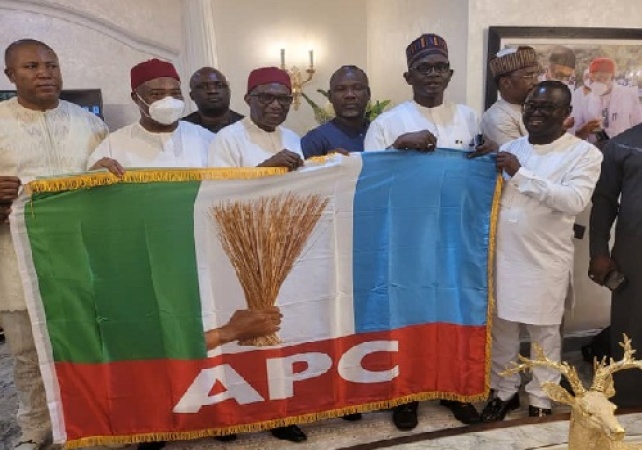
File photo of APC chiefs holding the party's flag
The bid by the ruling All Progressives Congress (APC) to decide those that will fly the party’s flag in the 2027 general elections through a consensus arrangement is experiencing hitches in many states.
Our correspondents report that the process has plunged many state chapters of the APC into crisis, as governors are trying to take advantage of the provision to endorse their preferred candidates.
The Electoral Act 2026 makes provision for two methods of primaries, either through consensus or direct primary. This rules out the option of indirect primary, which could have been the third option.
The APC leadership, however, prefers the consensus option, as it is less cumbersome in terms of logistics than direct primaries, which require large venues and mass movement of people to conduct.
The party noted, however, that where a local chapter fails to reach an agreement, a direct primary should be conducted to select candidates.
Weekend Trust notes that since the commencement of the sale of nomination forms, many state chapters have attempted to adopt the consensus model.
Our correspondents report that some governors have taken advantage of the party’s resolve to endorse their preferred aspirants.
To seal such endorsements, the governors take their preferred candidates to meet with the president and subsequently splash the photos across media platforms.
A source in the ruling party said the visits to the president by outgoing governors and their preferred choices mean “some aspirants succumb to the gimmicks and withdraw from the race, not wanting to be seen as challenging the decision of the leaders of the party.”
Weekend Trust reports that so far, no fewer than six governors have announced their successors. They include Babajide Sanwo-Olu of Lagos, Mai Mala Buni of Yobe, Babagana Zulum of Borno, Abdullahi Sule of Nasarawa, Dapo Abiodun of Ogun and AbdulRahman AbdulRazaq of Kwara.
The bid by some outgoing governors to position themselves as consensus candidates has also created more problems for the party.
So far, Governors Ahmadu Umaru Fintiri of Adamawa, Mai Mala Buni of Yobe and Dapo Abiodun of Ogun are known to be eyeing the Senate seats of their respective constituencies.
Many aspirants have reacted negatively to the arrangement, insisting on purchasing forms to contest the primaries openly.
APC Organising Secretary, Alhaji Sulaiman M. Argungu, had reiterated that if a chapter fails to agree on a consensus candidate, direct primaries must be held.
Our correspondents report that the situation is worsened by a directive from President Bola Ahmed Tinubu asking governors to take charge of the primaries in their respective states.
In states where the APC is not the ruling party, notable party members have been appointed to oversee the process.
consequently, many aspirants have accused governors of “hoarding” nomination forms for their preferred candidates—an allegation the National Deputy Publicity Secretary of the party, Duro Meseko, has since denied. But this has triggered crises in many states.
Consensus in the past
Consensus has hardly worked in the current political dispensation, which commenced in 1999. Most arrangements, either in favour of zoning or candidates, have been contested by party members.
In 2003, even as president, Olusegun Obasanjo had to submit himself to the process of primaries when other aspirants like Abubakar Rimi and Barnabas Gemade, among others, could not agree on automatic tickets, choosing to slug it out with him.
Obasanjo, however, succeeded in anointing Umaru Yar’adua to succeed him in what, though contested, appeared more like a consensus.
By 2015, due to uncertainty over whether allowing Jonathan as the sole candidate would pull through, the ruling party, the PDP, toyed with the idea of printing only one form.
In 2023, the announcement of then Senate President Ahmed Lawan as the preferred candidate of the APC could not sail through, as other aspirants did not submit to the party and contested in the primary that threw up Bola Ahmed Tinubu as the APC candidate.
But consensus has worked at the state level, where many governors have succeeded not only in endorsing their candidates to succeed them but also in ensuring they won the party’s tickets.
They include Ahmed Sani of Zamfara, who handed over to his deputy, Mahmuda Aliyu Shinkafi; Ali Modu Sheriff, who handed over to Kashim Shettima and the latter to Babagana Zulum; George Akume to Gabriel Suswam and later Samuel Ortom. Yahaya Bello also chose and handed over to Usman Ododo.
APC national leaders under pressure
A source within the party’s hierarchy confirmed mounting pressure on the party’s leadership.
The source said the pressure, mainly from governors and lawmakers, is heightening tension ahead of the primaries.
He, however, said the party, in the long run, will do the right thing to keep its structure intact ahead of the general elections in 2027.
The Chairman of the 2026 APC National Convention Central Coordination Committee, Aminu Bello Masari, warned the newly elected NWC against undue influence, stressing that the integrity of the process must not be compromised.
The gathering storm in Kano APC
Stakeholders of the All Progressives Congress (APC) in Kano State have ruled out automatic tickets for National and State Assembly lawmakers from the state.
They insisted that all other positions, aside from that of Governor Yusuf, would be determined through internal processes, particularly consensus.
The stakeholders had purchased expression of interest and nomination forms for Governor Abba Kabir Yusuf, it was gathered.
The immediate past National Chairman of the party, Abdullahi Umar Ganduje, presented the form to the governor during a stakeholders’ meeting in Kano.
Presenting the form to the governor, Ganduje said party leaders agreed to endorse him for a second term.
He said, “We have already agreed that you are our sole governorship candidate, and in order to actualise that promise, I, as a former Deputy Governor for eight years, former governor for eight years and former National Chairman of our great party, hereby hand over these two important forms to you.”
Although Kano State Governor Abba Kabir Yusuf has no challenger for the party’s ticket in 2027, his biggest headache is probably how to superintend over party primaries for the National Assembly and the State House of Assembly, following directives by President Tinubu to governors to handle primaries in their states.
National Assembly seats up for grabs are three for the Senate and 24 for the House of Representatives, while 40 seats for the State House of Assembly are also available.
It is safe to say the governor has no personal or political problems with the two APC-serving senators from Kano, one of whom is the Deputy President of the Senate, Barau Jibrin, representing Kano North, who stepped down his governorship ambition to support the re-election bid of Abba following his defection to the APC from the NNPP in January this year.
Senator Abdulrahman Kawu Sumaila, representing Kano South, elected on the NNPP platform, defected to the APC along with other lawmakers from Kano and has also been supportive, Weekend Trust gathered.
Senator Rufai Sani Hanga did not defect to the APC with the governor and therefore is a political foe.
In Kano North, it is a contest between Senator Barau Jibrin and former Minister of State for Housing and Urban Development, Engineer Tijjani Muhammad Gwarzo, who has declared his intention to challenge Barau for the party ticket to represent Kano North Senatorial District.
Can the governor afford to choose Barau over Gwarzo this time, or Gwarzo over Barau? Either way, the choice may prove difficult and, if not managed well, may open old wounds and lead to unpleasant political consequences.
Commenting on the situation in Kano, Mustapha Fage, a public affairs commentator, said the party has bitten more than it can chew by engineering mass defections into it, and the outcome can be unpredictable.
“It is clear the party has bitten more than it can chew. In my view, it is the fear of the opposition that led to the unchecked and unstrategic muscling of other political parties. The primaries will give us a hint of the direction the party is headed before the election,” said Fage.
Bitter rivalry in Bauchi
Internal wrangling and bitter rivalry among the APC governorship aspirants is proving to be a stumbling block to reaching a consensus to produce the party’s flag bearer ahead of the 2027 elections in Bauchi State, Weekend Trust gathered.
The situation might likely compel stakeholders to adopt direct primaries if the consensus fails, as recently suggested by an elder and former governor, Malam Isah Yuguda.
“The party’s position is simple: if consensus does not work, we will adopt ‘Option A4,’ also known as direct primaries. So, it’s not as contentious as it may appear,” he said.
Another major reason militating against the consensus is the disagreement over rotation of power or zoning of the office of the governor from Bauchi South to Bauchi North or Central because, since 1999, Bauchi South has continued to produce people who governed the state. The rotation of power has continued to heighten the Bauchi–Katagum political rivalry, it was gathered.
The gubernatorial battle has now been narrowed to four APC governorship aspirants who have obtained their expression of interest and nomination forms. Three of them are from Bauchi South Senatorial Zone, and they are: Dr Bala Wunti, Senator Shehu Buba Umar, and former Governor Muhammad Abdullahi Abubakar. The fourth person is the former Minister of Foreign Affairs, Yusuf Maitama Tuggar, who is from Bauchi North Senatorial District.
Ripples after Sule’s endorsement of Wadada
Governor Abdullahi Sule’s endorsement of Senator Ahmed Aliyu Wadada as his preferred APC candidate for the 2027 Nasarawa governorship is facing resistance, and the unfolding events continue with different dimensions.
Sule’s decision has been publicly contested by former Governor Tanko Al-Makura, who said he was neither consulted nor informed before the governor presented Wadada to President Tinubu.
In APC’s internal dynamics, elite consensus carries weight, and bypassing key stakeholders is seen as an imposition. Al-Makura’s response has been measured but strategic: he has not declared for anyone, yet his allies are aligning with former Inspector General of Police, Mohammed Adamu Abubakar. The fact that two aspirants chose to present their purchased nomination forms to Al-Makura after buying them is a clear signal that an alternative power bloc is taking shape under his influence.
Former Governor Abdullahi Adamu leads the agitation for the governorship position to rotate to Nasarawa West, where Wadada comes from.
Adamu’s recent reception of the former NASENI boss after the latter obtained forms indicates he is keeping his options open. Without Adamu’s backing, Sule lacks the support of one of the state’s most influential political figures, leaving a critical vacuum in the party’s unity.
Ex-IGP Adamu, the former NASENI boss, Professor Mohammed Sani Haruna, and Hassan Liman SAN have all purchased gubernatorial forms, directly challenging Sule’s preferred candidate. Their actions show they do not see the endorsement as decisive and are preparing for a full primary contest. This transforms the succession plan from a managed transition into a competitive race that could fracture the party.
While the state APC leadership has pledged fairness, aspirants already feel the ground is tilted. Sule insists he consulted those who matter, but rivals argue the consultations were selective and insufficient. That perception alone erodes confidence and weakens party cohesion.
Dr Faisal Shuaib, who declared interest and later stepped down to support the governor’s preferred candidate, and his loyalists’ stance that “integrity is not negotiable” reflects a wider mood within the APC base. Wadada is viewed as a product of elite arrangement rather than proven performance; he risks inheriting a divided structure.
Sule’s endorsement is struggling because some party members say it lacks consensus, ignores fair play expectations, and has provoked a coordinated challenge from other heavyweights. Without immediate reconciliation, the APC faces a fractured primary that could jeopardise its dominance in Nasarawa come 2027, Weekend Trust gathered.
Bomai swims against the tide in Yobe
A group, the APC Critical Stakeholders Forum, announced Baba Malam Wali, the former Secretary to the State Government (SSG), as its preferred candidate for the 2027 governorship election.
The forum, which includes the incumbent governor, Mai Mala Buni, and the Minister of Police Affairs, Ibrahim Gaidam, endorsed Mr Wali following a meeting in Abuja.
Initially, former Senate President Ahmed Lawan had declared his intention to contest the governorship position in the state, but after the endorsement, he withdrew from the race in deference to the decision of the leaders of the party in the state.
Senator Ibrahim Mohammed Bomai, Kashim Musa Tumsah, as well as Usman Alkali Baba—the three Yobe State governorship aspirants of the All Progressives Congress (APC)—have rejected the party’s decision to endorse the former Secretary to the State Government, Alhaji Baba Malam Wali, as its consensus candidate for the 2027 election.
The three aspirants took this decision following a meeting of the party’s Critical Stakeholders’ Forum, led by Governor Mai Mala Buni and Minister of Police Affairs, Ibrahim Gaidam, on Wednesday night, where the choice of Wali was concluded.
However, in a statement issued, Ibrahim Muhammad Bomai, Yobe South Senator, rejected the endorsement, describing it as an affront to democratic principles.
Bomai said no individual, regardless of past office or political influence, had the authority to determine the leadership of millions of people behind closed doors.
He said leadership in Yobe State must emerge through the free, fair, and transparent choice of the people rather than through imposition or elite arrangements.
“We categorically reject this attempt to subvert due process. We reject the culture of imposition. We reject any scheme that undermines fairness, equity, and the democratic rights of our people,” he said.
The senator added that any attempt to impose leadership on the people of the state would be resisted through lawful and democratic means.
He called on political leaders, institutions, and citizens to defend democracy, insist on transparency, and ensure that the future of the state is determined openly and justly.
The former Inspector General of Police, Usman Alkali Baba, has rejected the nomination of Baba Malam Wali as consensus candidate.
Although he is yet to say anything on the consensus candidate, Weekend Trust gathered that the former IG has purchased the Expression of Interest and Nomination forms to contest the governorship seat.
Baba, who hails from Geidam LGA of the state, was said to be among the top contenders seeking to succeed Governor Mai Mala Buni in the 2027 general election.
Kashim Musa Tumsah, a lawyer and diplomat who is one of the top contenders, also purchased Expression of Interest and Nomination forms on Thursday.
Tumsah rejected the endorsement of Wali as the party’s consensus candidate, expressing concern over the absence of broad-based consultation and consensus among other aspirants prior to the endorsement.
He maintained that inclusive engagement and due process are essential to preserving unity, equity, and fairness within the party.
Senator Mustapha battles Kwara Governor
In Kwara State, Senator Saliu Mustapha, representing Kwara Central, is reportedly battling the arrangement being worked on by the state governor, AbdulRahman AbdulRazaq.
The party is said to be in a dilemma over the consensus arrangement, as many aspirants, including those for the National Assembly, have reportedly picked their forms regardless of the consensus being considered by the governor.
The equation is further complicated by the reported interest of Governor AbdulRahman AbdulRazaq in the same Senate seat currently being occupied by Senator Mustapha, setting up what observers say could become one of the defining contests of the state’s 2027 permutations.
Mustapha’s camp has, however, projected confidence in whichever model the party adopts.
“Senator Saliu Mustapha welcomes the decision by President Bola Ahmed Tinubu to adopt a transparent and lawful process in selecting candidates for the 2027 General Elections, in line with the provisions of the Electoral Act (2025), as amended.
“It bears repeating that in the Kwara APC today, and indeed across Kwara State, Senator Saliu Mustapha stands out as arguably the most acceptable gubernatorial aspirant at this moment. Given his broad acceptability within the party, cross-regional appeal, proven electability, and strong grassroots popularity, he stands as the smartest choice should the party adopt a consensus arrangement.
“Whichever path the party ultimately chooses, Senator Saliu Mustapha remains fully prepared, committed, and willing to serve the party and the people of Kwara State,” Nasif Sholagberu, his media aide, said.
Zulum adopts Gubio
Borno State Governor, Prof. Babagana Zulum, presented Engr. Mustafa Gubio as the APC governorship consensus candidate to Vice President Kashim Shettima on Thursday at the Presidential Villa, Abuja.
Governor Zulum described the emergence of the candidate as the outcome of extensive consultations across party stakeholders.
According to Zulum, the decision reflects a unified position within the party in the state. He commended President Tinubu for what he described as “strategic leadership, support, and guidance” to both the government and the APC.
“I wish to express my profound gratitude to President Tinubu for the leadership he is providing in the country and for the enormous support to Borno State, as well as the APC, which has been unprecedented,” the governor said.
“I would also like to commend the president, who has been instrumental in the emergence of Gubio as the consensus candidate,” he said.
Zulum also acknowledged the vice president’s support in strengthening party cohesion in the state and for his support of the consensus candidate.
He further appreciated the APC leadership at all levels, party stakeholders, and the state’s residents for their support, prayers, and steadfastness, which he said paved the way for Gubio’s emergence.
The governor had earlier unveiled Engr. Mustapha Gubio as his preferred successor on Monday, after purchasing the party’s Nomination and Expression of Interest forms for the 2027 governorship election under the APC platform.
11 aspirants indicate governorship interest in Gombe
In Gombe State, about 11 politicians have indicated interest in contesting the governorship seat on the platform of the All Progressives Congress (APC).
According to a list released by the state secretariat of the APC, the aspirants that indicated interest are Dr. Jamilu Isyaku Gwamna, Dr. Aminu Yuguda, Prof. Isa Ali Pantami, Senator Saidu Alkali, Alhaji Umaru Kwairanga (Sarkin Fulani), Engr. Abubakar Bappah, Hon. Muhammad Gambo Magaji, Abubakar Sadiq Shu’aibu, Chief Whip of the House of Representatives, Usman Bello Kumo, immediate past Minister of Transportation, Engr. Aliyu Muhammad (Combat), and businessman-cum-politician, Arch. Yunusa Yakubu.
Also, five people are contesting the Gombe Central Senatorial seat currently occupied by Senator Muhammad Danjuma Goje. They are Dr. Habu Dahiru, Alhaji Abubakar Aliyu, Nasiru Aliyu, DCP Ahmed Jarman Deba (Rtd), and Alhaji Muhammad Umar Dan Amar.
For Gombe South Senatorial District, the contestants are Senators Joshua Lidani, Bulus K. Amos, Mr. Jerry Damara, Rear Admiral Nuhu Bala (Rtd), Bilyaminu Babadidi, and Fatima Binta Bello.
The list did not include contestants from Gombe North Senatorial District, where Governor Muhammadu Inuwa Yahaya is said to be the sole aspirant seeking to contest for the seat, to challenge Senator Ibrahim Hassan Dankwambo of the PDP.
Several others have indicated interest in contesting the six House of Representatives seats and 24 seats at the State House of Assembly.
On April 14, Governor Yahaya hosted both declared and prospective aspirants under the APC platform, where they unanimously adopted a consensus arrangement to elect the party’s candidates for various elective offices ahead of the 2027 general elections.
An agreement was reached during the meeting, which was held at the Government House, Gombe, where the aspirants pledged to support whoever emerges as the party’s candidate.
All the declared and prospective governorship and National Assembly aspirants were in attendance, except Senator Sa’idu Alkali, who is vying for the governorship seat, and Senator Danjuma Goje, who is seeking to return to the Senate for the fourth time.
Sources told our correspondent that Governor Yahaya, who returned to the country two days ago, has asked that all the prospective aspirants for all elective positions should wait for his directive before purchasing the Expression of Interest and Nomination forms.
The source added that the governor had directed that only one form for the governorship, three, and six forms for the Senate and House of Representatives, respectively, should be purchased in line with the consensus agreement, where all the aspirants pledged to rally behind whoever emerges through the consensus process.
However, supporters of Prof. Isa Pantami, who attended the consensus meeting, went ahead to purchase the form on his behalf. Also, Senators Alkali and Goje, who did not attend the meeting, purchased the forms for the governorship and Senate seats, respectively.
Katsina: Consensus shuts out Reps member as Mangal’s son emerges candidate
Indicators are showing that a serving member of the House of Representatives, Sani Aliyu Danlami, has lost his bid to secure the All Progressives Congress (APC) ticket for Katsina Central Federal Constituency following a consensus arrangement that produced Abba Dahiru Mangal as the party’s flag bearer.
Danlami, who is currently serving his second term at the Green Chamber, was edged out after days of consultations among party stakeholders and power brokers. It was revealed that the decision marks a significant political shift in the constituency, given Danlami’s incumbency and grassroots structure.
It was gathered that the emergence of Abba Mangal, a legal practitioner, has drawn attention not only because he did not publicly declare interest in the race but also due to his strong political lineage. He is the son of prominent businessman and political heavyweight, Alhaji Dahiru Barau Mangal, widely regarded as one of the most influential figures in Katsina politics.
It was also reported that despite the setback, Danlami has accepted the outcome of the consensus process, calling on his supporters to remain calm and law-abiding.
In a statement he issued, he urged party faithful to shun violence and prioritise peace and unity, stressing the importance of maintaining stability within the state and the party.
However, sources familiar with the negotiations revealed that the consensus process spanned two days, from Tuesday to Thursday, and involved multiple rounds of deliberations among aspirants and their backers. The contest was said to be highly competitive, with several notable figures lobbying vigorously for the ticket.
It was also revealed that among those who jostled for the position were Lawal Amadu Joka, a former Aide-de-Camp to ex-governor Aminu Bello Masari; Haruna Maiwada; Ibrahim Ali Guguwa; Sani Danlami himself; Hon. Abdurashid Abba Ali; and other contenders with varying degrees of political influence.
Political observers say the outcome further reinforces the enduring influence of Dahiru Mangal in Katsina’s political landscape. His role in shaping electoral outcomes in the state dates back over two decades, notably his support for the late former President Umaru Musa Yar’adua’s successful re-election as governor in 2003.
Since then, Mangal is believed to have played a pivotal role in determining key political appointments and elective positions across the state.
However, this development marks the first time a member of his immediate family has emerged as a frontline candidate for elective office.
APC leadership opted for consensus as a strategy to avoid internal fractures ahead of the elections, though the decision may still generate debate within some quarters of the party, as several consensus outcomes were contested by aspirants and supporters.
As preparations for the polls intensify, attention will now shift to how aggrieved aspirants and their supporters align with the party’s decision, and whether the APC can maintain cohesion in Katsina Central going forward.
Abiodun, Daniel, Amosun’s senatorial bids unsettle Ogun APC
In Ogun State, the senatorial bids of two former governors, Gbenga Daniel and Ibikunle Amosun, alongside that of the incumbent governor, Dapo Abiodun, are tearing the ruling party apart. This friction comes just weeks after the trio appeared to close ranks under one roof to endorse Ogun West Senator Solomon Adeola (Yayi) as the APC’s consensus governorship candidate for the upcoming election.
Daniel, the current senator representing Ogun East, is seeking a second term. However, Governor Abiodun, who hails from the same district, is interested in the seat to fulfil a long-held ambition. Before becoming governor in 2019, Abiodun made two unsuccessful attempts to reach the Senate.
The 2027 ticket has now driven a wedge between the two former allies. Daniel alleges that the governor’s political ambition is the motivation behind the “persecution” he claims to have faced under the current administration in the state over the past two years—an allegation the government has denied.
The rivalry took a fresh turn last week when Daniel was reportedly blocked from entering the venue of the APC zonal caucus meeting at Adeola Odutola Hall in Ijebu-Ode. Social media clips showed Senator Daniel’s convoy being denied entry. Daniel later addressed his supporters outside the venue.
“We are here for our caucus meeting, and I arrived by 10 a.m. They said we should not enter the venue,” Daniel stated. “Therefore, if they do anything here today without my presence, it is an exercise in futility. Their actions will amount to self-deceit.”
At the end of that meeting, Abiodun was adopted as the consensus candidate.
Speaking for the stakeholders, former Ogun East senator Lekan Mustapha said the decision was driven by a shared conviction that Abiodun has the capacity to represent the district effectively. Mustapha added that party leaders would formally communicate the endorsement to the governor.
However, Daniel’s political camp—under the aegis of the Bola Ahmed Tinubu Otunba Gbenga Daniel (BATOGD) Movement—dismissed the endorsement at a press conference in Sagamu on Thursday. The Deputy Director-General of BATOGD, Otunba Tayo Onayemi, maintained that the party’s constitution only recognises consensus backed by the written consent of all aspirants or through direct primaries.
“There is no such thing as ‘endorsement’ in the Electoral Act recently signed into law by the President. What we have is consensus by agreement or direct primaries; anything short of this is null and void,” Onayemi argued. “Senator Gbenga Daniel is a principled party man who will always abide by the rules. We are confident the APC will uphold its regulations and ensure justice is done.”
Meanwhile, Ibikunle Amosun, seeking a third term in the Senate representing Ogun Central, faced strong resistance this week. Beyond competing with several other aspirants, Amosun is battling a former friend-turned-political rival for the ticket.
Stakeholders from Ogun Central met at the residence of former Governor Chief Olusegun Osoba in Abeokuta on Thursday to discuss 2027 nominations. During the meeting, Amosun reportedly claimed he had the support of President Bola Tinubu to emerge as the consensus candidate. This claim was allegedly rebuffed by other aspirants, including the incumbent, Senator Shuaibu Salis, and the meeting ended in a stalemate.
Amosun had clarified his position in a statement, calling many accounts of the meeting a “complete misrepresentation.” He noted that the meeting was convened at his instance to address insinuations regarding his candidacy.
“I recall that three senatorial aspirants from the district had visited me to seek my support, and each volunteered to withdraw if I chose to contest,” Amosun said. “Nowhere during the meeting did I request anyone to withdraw for me, as that would be undemocratic. I am a democrat who has won four elections—twice as governor and twice as senator. What I said, and what I reiterate, is that I will not be part of a primary election whose result is predetermined.”
Crises over Senate seats in Benue
In Benue State, uncertainty currently mounts over the 2027 re-election bids of some senators under the All Progressives Congress (APC), following the directive by President Tinubu mandating state governors to take charge of party primaries.
The development, no doubt, comes amid sharp divisions within the Benue State chapter of the APC, where rival factions loyal to Governor Hyacinth Alia and the Secretary to the Government of the Federation (SGF), George Akume, are locked in a supremacy battle.
Of the state’s three senators, the duo of Senator Titus Zam, representing Benue North West (Zone B), and Senator Emmanuel Udende of Zone A, both aligned with Akume’s faction, are believed to have indicated interest in retaining their seats in 2027.
However, political observers have different views about their chances being threatened if the governor assumes full control of the party’s primary process in the state.
This is because the crisis within the APC became more evident last month when parallel ward congresses were conducted across the 23 local government areas by the two factions, each producing separate ward executives.
While the Comrade Austin Agada-led structure loyal to Akume announced the reaffirmation of existing ward executives for another four-year term, the Alia-backed camp conducted a separate exercise with different outcomes.
A political analyst, Benedict Ager, told our correspondent that the situation may lead to further complications ahead of the primaries.
“Both camps are talking tough, and none is ready to back down. They conducted parallel congresses and, from the look of things, the various camps may also conduct separate primaries,” he said.
Ager added that the president’s directive may be difficult to enforce in Benue due to Akume’s influence at the national level.
He added that the ongoing power tussle has raised concerns about possible parallel primaries and legal disputes, a development he said could affect the APC’s cohesion and electoral prospects in the state ahead of the 2027 general elections.
Meanwhile, both factions continued to insist that there is no disintegration of the party in the state.
Morgan Ihomun, the state Publicity Secretary of the Agada-led executive, insisted that, “No faction of APC exists in Benue. We’re the duly elected executive, so I don’t know about another faction.”
On the other hand, Chief Benjamin Omale reaffirmed his leadership over the Benue APC when he was recently formally adopted and ratified during the party’s National Convention held at Eagle Square in Abuja.
Crisis is brewing within the party in Adamawa State between Governor Ahmadu Fintiri and National Security Adviser Nuhu Ribadu over who shapes the state’s political succession.
What began as a strategic realignment has evolved into a contest for dominance of party structures, with both camps mobilising loyalists and positioning for control ahead of the primaries.
Tough choices ahead of 2027 primaries in Ondo
There are indications that the race for the ruling party’s senatorial, House of Representatives, and State Assembly tickets has intensified as the primaries approach.
Political permutations and speculations over ticket allocations continue to dominate discussions, with incumbent National Assembly members lobbying both at the Alagbaka Government House in Akure and in Abuja to secure their return tickets.
State lawmakers are equally active in the political calculations, especially as the next governorship election in Ondo State is not due until 2028. Many aspirants are reportedly pushing to emerge as consensus candidates, while some insist on primaries, as the party appears inclined towards the best option possible.
The governor of the state has also been accused of imposition, while some aspirants still believe the party would make a wise decision. As preparations heighten, the APC has firmly ruled out automatic tickets for serving lawmakers, reinforcing its stance on internal democracy and competitive primaries.
Recent engagements between the APC National Chairman and members of the National Assembly caucus, alongside a meeting between President Tinubu and APC governors, underscored a clear directive: lawmakers seeking re-nomination must return to their states and engage governors and party structures.
This directive reflects the party’s structure, where governors play a central role in candidate emergence. Party insiders warn that bypassing primaries could trigger internal crises and undermine the party’s credibility ahead of the general elections.
For the Ondo South senatorial seat, the vacancy created by the exit of Senator Jimoh Ibrahim to serve as Nigeria’s Permanent Representative to the United Nations has opened up the race in Ondo South.
Governor Aiyedatiwa is expected to wield significant influence in determining the APC candidate. Key aspirants include Agboola Ajayi, Isaac Kekemeke, Morayo Lebi, Mayowa Akinfolarin, Mathew Oyerinmade (MATO), and Iroju Ogundeji.
Sources indicate that consensus may be strictly applied in the zone, with MATO, Kekemeke, and Akinfolarin emerging as top contenders, while Lebi enjoys sympathy support for his loyalty to the party.
MATO, reacting to speculation about stepping down, said: “Why not? If consensus will produce the best result, so be it. We only pray that it is done fairly and divinely.”
Analysts believe Kekemeke’s political experience and party loyalty give him an edge, while Agboola Ajayi’s grassroots appeal could make him a strong contender despite limited support from the governor.
The contest in Ondo Central is shaping up to be one of the most competitive. Incumbent Senator Adeniyi Adegbonmire faces strong opposition from Dr Taiwo Fasoranti and Barr. Olumuyiwa Adu.
Abiola Makinde is believed to have stepped down for Fasoranti in exchange for support to retain his House of Representatives seat.
While Fasoranti is said to enjoy backing from influential party leaders, Adegbonmire’s legislative performance and position as Chairman of the Senate Committee on Judiciary could bolster his chances of securing the ticket.
Ondo APC Chairman, Kolawole Babatunde, reaffirmed the party’s stance on candidate selection, noting that consensus or direct primaries would be adopted depending on the situation.
“My understanding of consensus is the decision of the leadership. Once our leaders decide, we must abide by it. That is what we call loyalty,” he said.
Similarly, the Director General of the Progressives Network for Tinubu (PNT), Pastor Olumide Obadele, argued that consensus and direct primaries are more effective and less costly than indirect primaries.
Ultimately, the influence of Governor Aiyedatiwa, alongside other key figures in the party, is expected to play a decisive role in shaping the outcome of the APC primaries across Ondo State, even as concerns persist among party faithful over the limited use of direct primaries in some constituencies.
Omo-Agege battles Delta governor for party control
In Delta State, apprehension is growing that former Deputy Senate President, Senator Ovie Omo-Agege, may be denied a party ticket due to his intense rivalry with Governor Sheriff Oborevwori.
Political analyst and human rights activist Comrade Israel Joe suggests that, based on current dynamics, Omo-Agege stands little chance of securing the Delta Central senatorial ticket. Omo-Agege hails from the same district as the incumbent, Senator Ede Dafinone, whom the governor is reportedly supporting.
Since Governor Oborevwori’s move to the APC, analysts argue he has effectively “hijacked” the party structure.
The analyst said, “I don’t think Ovie Omo-Agege has a chance of getting the Senate ticket. Since Governor Sheriff Oborevwori joined the APC, he has taken over the structure.
He and Omo-Agege are arch-rivals following their contest in the 2023 governorship election.”
Because the governor has thrown his weight behind Senator Dafinone, observers believe Omo-Agege may be forced to defect to another party if he intends to contest the Delta Central seat.
APC playing with fire — Prof Saliu
Speaking on the issue, Prof. Hassan Saliu, National President of the Nigeria Political Science Association (NPSA), warned that empowering governors ahead of party primaries could trigger turbulence within the ruling party, saying the process may be marked by disputes, defections and electoral risks if poorly managed.
“The primaries will be a bit chaotic, and there will be complaints accompanying them. The National Working Committee should be ready to take petitions from aggrieved politicians,” he said.
He noted that strained relations between some governors and federal lawmakers could force some displaced aspirants out of the party.
“There may be defections from the ruling party, especially where some National Assembly members conclude they cannot work with their governors on the primaries,” he said.
Saliu also warned that allowing governors overwhelming influence in candidates’ selection could worsen internal crises and hurt the party’s electoral fortunes.
“If the crisis is not well managed, it could lead to the defeat of APC in some states, because for you to win, there must be synergy,” he said.
He added that in states where disputes escalate, the party’s National Working Committee may be forced to step in.
“There will be an intervention somewhere along the line,” he said, suggesting the national leadership may have to mediate or override local tensions to prevent a deeper crisis.
He added that the implication of the arrangement on the system is that it could result in a high turnover in the National Assembly, with experienced lawmakers losing out to less tested entrants.
“The governors may choose people who are not experienced at all, so we may have a high turnover there,” he said.
On whether the unfolding situation could hand the opposition an advantage, Saliu said the opposition had yet to effectively engage Nigerians enough to capitalise on possible cracks in the ruling party.
“I’m not seeing anything on the part of the opposition to effectively engage Nigerians,” he said.
Also, a professor of Political Science, Professor Rufai Ahmed Alkali, has opined that the recent wave of defections to the ruling party has only imported new rivalries with old party loyalists set to jostle with the new entrants for not only tickets but relevance, influence and control of party structures and processes.
“The real moment of truth will come with the primaries and that is when the polite language of unity will give way for the hard arithmetic of political survival. Tickets will be limited, ambitious will not.
Consensus arrangements, where they exist, may reduce open confrontation but cannot extinguish the quieter anger of exclusion,” Alkali said.
All aspirants will be considered – APC
The National Chairman of the party, Prof. Nentawe Yilwatda, said the party is built on inclusion and with that the interests of all aspirants wishing to contest any of the elective post will be considered.
Inclusion is the key issue here; the chairman spoke after inspecting the sales of the party forms in Abuja.
He retreated that the party has adopted consensus or direct primary in choosing its candidate as contained in the electoral act.
According to him, when the consensus is reached, all the aspirants for such post must sign personally, agreeing that they all agreed for a particular candidate.
In the event where such general agreement cannot be reached, he said the party will go for direct primary in a fair and clear manner.
He said, “As we know our party is one of the most democratic political parties in Nigeria. And as you can see, people are streaming in, buying forms freely, no restriction.
“Even somebody has picked a form to contest for the presidency, it shows the level of democracy we have in Nigeria. Sitting governors are having people challenging them, the sitting president is having somebody who is challenging him, the Senators have people challenging them. The number of people coming to contest in our party tells us that our party is the most acceptable political party in Nigeria”.
Contrary to some beliefs that the party will be engulfed in crisis after the primaries, the party national chairman assured that the nomination process will be rancour-free because everything will be done in a free and fair manner. (Weekend Trust)