ADAD
ADAD
Updating your news feed...
NEWS EXPRESS is Nigeria’s leading online newspaper. Published by Africa’s international award-winning journalist, Mr. Isaac Umunna, NEWS EXPRESS is Nigeria’s first truly professional online daily newspaper. It is published from Lagos, Nigeria’s economic and media hub, and has a provision for occasional special print editions. Thanks to our vast network of sources and dedicated team of professional journalists and contributors spread across Nigeria and overseas, NEWS EXPRESS has become synonymous with newsbreaks and exclusive stories from around the world.


Loading banners
Loading banners...

Sadre Alam went to war for India. Suprabuddha Sen’s grandfather illustrated its first constitution. For decades, both men exercised their rights enshrined in that document to vote in the world’s largest democracy.
Days before polls opened in crucial state elections in April, they found out that their right had been taken away from them. There was little or no explanation.
Alam, 62, opens a thick maroon binder that holds the 30 or so documents he says he took to local officials to try and convince them of his right to vote: his grandfather’s land deeds from the 1920s; evidence his parents had voted decades ago; his army discharge certificate. To no avail.
“It feels strange to think my country is not mine today,” the former soldier told CNN at his home in West Bengal state, where votes from the election he was barred from are now being counted. “That’s my pain. Everyone is asking me: ‘How did your name get excluded despite being in the army?’”
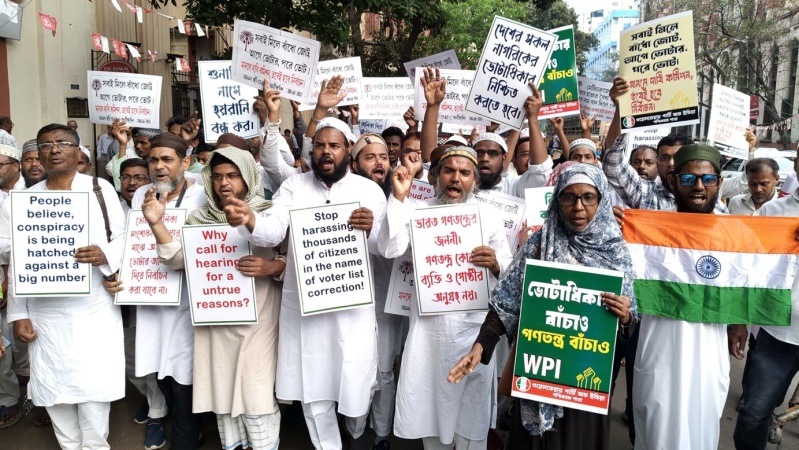
Alam and Suprabuddha are among more than nine million names to have been culled from West Bengal’s voter roll. Millions more were deleted nationwide just before a clutch of state elections across India that will decide whether the ruling Hindu-nationalist Bharatiya Janata Party (BJP) can make inroads in state houses in the country’s south and east, where it has traditionally struggled to gain power.
The BJP says the voter list clean-up is vital for removing duplications, the names of the deceased and other discrepancies, and preserving the integrity of India’s democracy. Critics say the Election Commission of India (ECI), which is meant to be an independent body, is acting at the behest of the BJP to advance its majoritarian agenda and weaken representation of India’s Muslim minority.
That’s made the voter roll controversy particularly combustive in West Bengal, where almost a third of the 90 million-strong population are Muslim and where the BJP has been making inroads in recent years.
Days before polls opened, Alam was told his name was no longer on the voter roll because officials had found a “logical discrepancy” in the 15-year age gap between his mother and him in the records.
The suggestion of a discrepancy is an insult, says the former soldier, who served in India’s brief 1999 war with neighbor and arch-rival Pakistan.
“In early 1963, my grandfather married off his fourteen-year-old daughter, and I was born in December at the end of that year,” he said.
“Where is my fault in this? So is there a doubt I am not my mother’s child? Was I picked up from somewhere?”
Suprabuddha Sen, 88, was not even told why he had lost the voting rights he’d held for decades.
It hurt even more given his personal links to the foundation of India’s democratic system following independence from British colonial rule in 1947.
His grandfather’s illustrations of Indian history and culture adorn India’s constitution; the iconic four-lion emblem that is the government’s official letterhead and is found on the cover of each Indian passport was designed by one of his students under his supervision.
“I can’t remember a time when we haven’t voted,” said his wife Deepa Sen – who was also removed from the voter roll without explanation.
Suprabuddha told CNN he had submitted his graduation records, government pension documents, even an expired passport – but that officials did not budge.
“After that I don’t know what else I can give them.”
According to the Sabar Institute, a public policy and research group, about 2.4 million of the names deleted from the voting list in West Bengal are deceased, leaving around 6.7 million names.
Data on how many of those belong to eligible voters is hard to come by, but CNN heard from more than a dozen voters who said they had been struck off the list and were unable to get back on due to unclear rules and reluctant local officials.
“The BLO (officials who staff the polling booths) can’t even give us a reason,” said Mabud Hussain, a sweet seller in Murshidabad district.
“They say there is nothing they can do, and that whatever will happen is now in the Supreme Court’s hands.”
“As far as we can understand here, they are especially targeting Muslim people and excluding them, despite their name being there, and having all documents, they are being excluded. Only they know what they are doing… we cannot understand it.”
According to the Sabar Institute, among the names removed from West Bengal’s voting list, 34% are Muslims, a group that makes up 27% of the state’s population.
India’s Supreme Court has ruled that while those struck off from the voter list have the right to appeal, the election timetable in West Bengal should not be delayed.
“This is a political gimmick, the election commission is working at the behest of the BJP government,” Sajid Rahman, a social activist with the Association for Protection of Democratic Rights (APDR), said.
The BJP says it is not interfering with the work of the ECI. CNN has reached out to the ECI and India’s Home Ministry for comment.
In a speech last December, Home Minister Amit Shah hinted there were other factors driving the electoral roll clean-up.
“Infiltrators cannot decide who will be the prime minister and chief minister of the country,” he said in parliament, adding that authorities would “detect, delete, and deport” any illegal immigrants.
The BJP has already pushed a campaign to expel illegal “infiltrators” – mostly from neighboring Muslim-majority Bangladesh, with which West Bengal shares close cultural and linguistic ties.
That rhetoric has stoked fears that having been stripped of the right to vote, questions over one’s Indian citizenship may come next.
In the Murshidabad district that borders Bangladesh, that fear is already apparent. In Mathurapur village, 243 of its 800 voters have been deleted from the voting list, according to a local booth official.
“They want to take away our citizenship that’s what people are saying, that’s why we are afraid,” said Noorfa Bibi, a housewife and resident of Mathurapur who says she was also removed from the list.
“Will they return our citizenship if it gets taken away or will we be stripped of it gradually?”
After they and their family appealed to the Supreme Court, Suprabuddha – the grandson of the illustrator – and his wife had their names restored to the voter list.
The results from the polls are due in early May, but millions will remain in limbo, not knowing if their rights to vote, or belong to India, are secure.
“We are well connected, we have all these documents,” Suprabuddha said. “But what about the people who don’t have those connections?” (CNN)