ADAD
ADAD
Updating your news feed...
NEWS EXPRESS is Nigeria’s leading online newspaper. Published by Africa’s international award-winning journalist, Mr. Isaac Umunna, NEWS EXPRESS is Nigeria’s first truly professional online daily newspaper. It is published from Lagos, Nigeria’s economic and media hub, and has a provision for occasional special print editions. Thanks to our vast network of sources and dedicated team of professional journalists and contributors spread across Nigeria and overseas, NEWS EXPRESS has become synonymous with newsbreaks and exclusive stories from around the world.


























Loading banners
Loading banners...

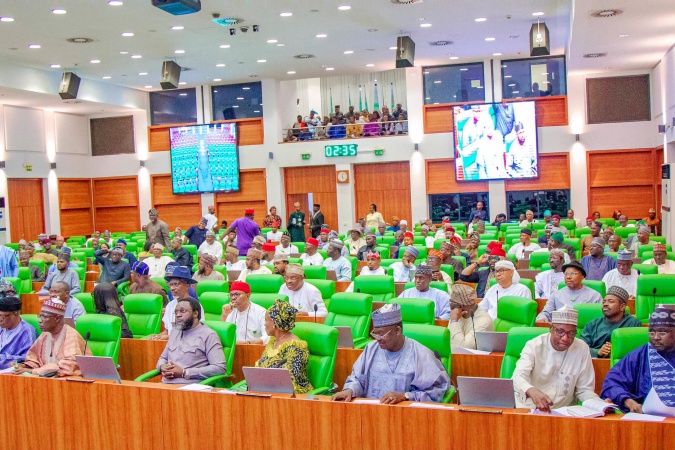
File: House of Representatives
The House of Representatives has further amended the Electoral Act, proposing the termination of pre-election dispute in respect to gubernatorial, National and the state Houses of Assembly at the Court of Appeal.
The new amendment to the Electoral Act provides that all pre–election matters relating to National and State Houses of Assembly, as well as governorship polls shall commence at the Federal High Court and terminate at the Court of Appeal.
On the other hand, pre-election matters relating to the presidential election, shall commence at the Court of Appeal and end at the Supreme Court.
The proposed legislation, which is sponsored by the Deputy Speaker, Benjamin Kalu and four others was passed, at yesterday’s plenary, after it was taken through first and second reading, committee consideration and third reading.
According to the synopsis of the proposed legislation, titled “Bill for An Act to Amend the Electoral Act, 2026, to provide for jurisdiction for pre-election matters; and related matters,” it is intended to provide clarity and uniformity in the jurisdiction of pre-election matters arising from party primaries among others.
“Specifically, the Bill amends Section 29(5) of the Principal Act to expand the jurisdiction for filing suits by aspirants challenging false information submitted by candidates.
“It allows such actions to be instituted either at a court in the Federal Capital Territory or in the jurisdiction where the cause of action arose, thereby improving access to justice and reducing procedural bottlenecks.
“Furthermore, the Bill introduces a new Section 29A to comprehensively regulate the jurisdiction and adjudication of pre-election matters. The proposed provision clearly delineates the courts vested with original jurisdiction over different categories of pre-election disputes.
“It provides that: Pre-election matters relating to National Assembly, State Houses of Assembly, and Governorship elections shall be commenced at the Federal High Court, with appeals lying as of right to the Court of Appeal.
“Pre-election matters concerning Presidential elections shall be commenced at the Court of Appeal, which shall exercise original jurisdiction, with further appeals lying to the Supreme Court,” it stated.
Chairman, House Committee on Electoral Matters, Bayo Balogun, while leading debate on the proposed legislation, noted that ‘overall, the Bill aims to streamline the adjudication of pre-election disputes, reduce forum shopping, ensure speedy dispensation of justice, and strengthen Nigeria’s electoral legal framework in line with constitutional provisions.”
Similarly, the House also passed another bill, proposing alteration to the Electoral Act, 2026, to introduce “ flexible, reliable, and technology-driven modes for the service of election petition processes, with a view to modernizing electoral adjudication and enhancing the efficiency of election dispute resolution in Nigeria.”
The proposed legislation, which was also sponsored by Kalu and four others, was taken through first and second readings, committee consideration and third reading, at Wednesday’s plenary.
According to the synopsis, “the Bill amends Section 29(8) of the Principal Act to mandate candidates, at the point of submission of nomination forms, to provide not only a verifiable physical address within the State of contest but also functional electronic contact details, including email address, telephone number, or any other form of electronic communication.”
It stated that the objective is to ensure that parties to election petitions can easily be reached through multiple verifiable channels.
According to the bill, service by electronic means shall be deemed effective, once there is a proof of transmission, “which may include delivery confirmations, server-generated records, or other credible evidence of dispatch.”
It added “the Bill further amends the First Schedule to the Act by revising the provisions on service of election petitions. It requires petitioners to provide both the address supplied by the respondent under Section 29(8) and any other known address for service, with such details deemed sufficient for the purpose of effecting service of processes.
“Significantly, the Bill expands the legally recognized modes of service to include electronic transmission. It provides that service of election petition processes shall be deemed valid if effected personally, by registered post, or through electronic means such as email, SMS, or other digital communication channels linked to the respondent.” (Daily Sun)