ADAD
ADAD
Updating your news feed...
NEWS EXPRESS is Nigeria’s leading online newspaper. Published by Africa’s international award-winning journalist, Mr. Isaac Umunna, NEWS EXPRESS is Nigeria’s first truly professional online daily newspaper. It is published from Lagos, Nigeria’s economic and media hub, and has a provision for occasional special print editions. Thanks to our vast network of sources and dedicated team of professional journalists and contributors spread across Nigeria and overseas, NEWS EXPRESS has become synonymous with newsbreaks and exclusive stories from around the world.















Loading banners
Loading banners...

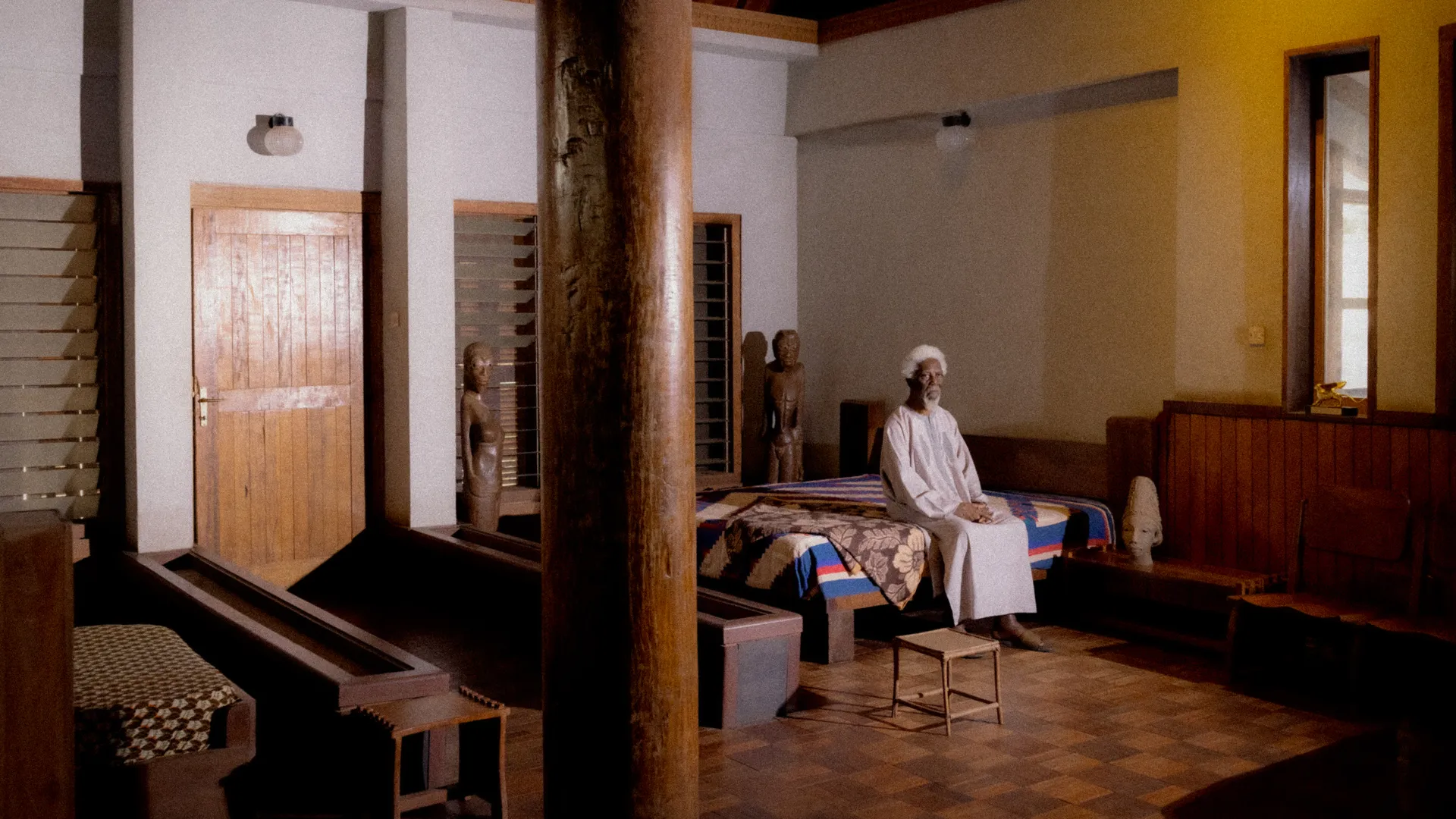
Demas Nwoko sits for a portrait in the bedroom
At 90 years old, Nigerian architect Demas Nwoko’s legacy extends beyond his art—it’s embedded in the walls of his rural sanctuary in Idumuje-Ugboko, a historic town in the north of Nigeria’s Delta State. To get there, one must drive through a landscape marked with red laterite, palm groves, and low, spreading trees that cast uneven shadows. Houses rise modestly from the earth, some coated in clay, others bare, revealing sunbaked brick and timber. Bold geometric patterns mark some walls, and carved wooden doors hint at the pride of their makers. Off of a curved path, Nwoko’s home comes into view.

Palm groves hang low over sun-baked streets in Nigeria’s Delta State.

Traditional shutter windows made of local timber line the surrounding homes’ mud-brick facades.

Demas Nwoko's home is built entirely with his own hands. The exterior is clad in blocks of laticrete, a material Nwoko developed when laws prohibited the use of local laterite soil.
Nwoko was raised in the royal household of Idumuje-Ugboko as the son of Obi Nwoko II, a traditional ruler. Now 90, he has been described as many things—artist, master builder, sculptor, architect, designer, teacher—yet to reduce him to a label is to miss the point. His varied pursuits form a unified creative legacy that continues to shape generations of artists far beyond the borders of Nigeria.
Nwoko first found architectural inspiration at the Idumuje-Ugboko palace, and in the surrounding structures built by his father—both of which are rooted in the neighboring Benin City’s design tradition. Across the Yorubaland region (which spans southwestern Nigeria, Benin and Togo), Nwoko notes this style was usually reserved for palaces, but in Benin, it was domestic. “It was a model I knew from childhood,” he says. Nwoko’s early career spanned theater and scenography—he later taught drama at the University of Ibadan—though he always knew he’d honor the design tradition of his home. “By then, I had already decided I was going to promote the architecture of Benin [in my work],” he says. “I had examined it up and down; there is no architecture like it.”
.jpg)
The conical square roof is made with local timber, laid by Nwoko himself.
Nwoko’s own home, built in 1978, bears clear traces to the structures in the ancient Benin City: ridged exterior columns at the entrance echo the fluted walls of the Oba’s Palace (home to the ruler of Benin City), while the pitched, overhanging roof—a signature across his projects—nods to traditional houses in the southeast of the country. Nwoko designed and built every element of the home himself using traditional methods and local materials.
Modeled on the New Culture Studios in Ibadan, Nwoko’s ever-evolving arts and culture center (which began as his personal studio and residence), the home’s exterior is clad in blocks of laticrete—a material he developed when laws prohibited the use of local laterite soil. By mixing the soil with cement, he created a material rooted in tradition, but adapted to modern regulations. “There is nothing wrong with mud,” Nwoko says, before citing three-story homes across Yorubaland built with the readily available material. “A building is not viable if it doesn’t make use of local materials.”

Natural light is kept deliberately low in the home.

The central impluvium hangs above an indoor courtyard.
Inside, the home exudes a sacred silence, broken only by the low hum of a television. The open space is composed of distinct zones: the dining area features stained-glass panels reminiscent of Nwoko’s earlier works, such as the Dominican Chapel in Ibadan, and is flanked by his signature interlocking wooden chairs, which are crafted without a single nail. “That is our way of living: open plan, no rooms,” Nwoko says. “The house is modeled in a similar way, so you can move through it very freely.”

Another indoor courtyard offer views of the surrounding landscape.
Natural light is kept deliberately low, emanating largely from the central impluvium (a fiberglass–lined funnel that carries a controlled stream of rainwater from the roof into the house) that hangs above an indoor courtyard. For Nwoko, the impluvium is a defining feature of the home, and one which embodies the architecture of the tropics. “Architecture is about geography,” he says. “You have no business replicating the architecture of one geography in another. The purpose of designing any building, or habitat, is to protect the human being.”

Nwoko’s sculptures live in their own rooms.

Photographs are framed on natural timber shelving .
Upstairs, Nwoko draws on the Igbo architectural tradition of a “conical square,” a pitched roof anchored by a single structural pillar at the center. Since the 1970s, Nwoko’s home has remained largely unchanged, the only later addition being a second floor that acts as his private quarters. “It is an ageless building,” says Bofu Nwoko Ugbodaga, the designer’s daughter and senior partner at their architectural firm, New Culture Designs. “Every choice ever made here was intentional.”

Carved from solid pieces of wood, Nwoko's sculptures are stark, confident, and full of expression.

A Demas Nwoko sculpture fits perfectly on a shelf in the artists home.

The conical square ceiling in Nwoko's home.
Nwoko’s momentum carries on, and he has recently inaugurated a new church tower. He is also working on a new book about tropical architecture. Working alongside younger collaborators, the creative pluralist is forging ahead. “The least I can do is to help as much as I can," he says simply. “As long as there is work to do, how do I stop?”