 ADAD
ADAD
Updating your news feed...
NEWS EXPRESS is Nigeria’s leading online newspaper. Published by Africa’s international award-winning journalist, Mr. Isaac Umunna, NEWS EXPRESS is Nigeria’s first truly professional online daily newspaper. It is published from Lagos, Nigeria’s economic and media hub, and has a provision for occasional special print editions. Thanks to our vast network of sources and dedicated team of professional journalists and contributors spread across Nigeria and overseas, NEWS EXPRESS has become synonymous with newsbreaks and exclusive stories from around the world.





















Loading banners
Loading banners...

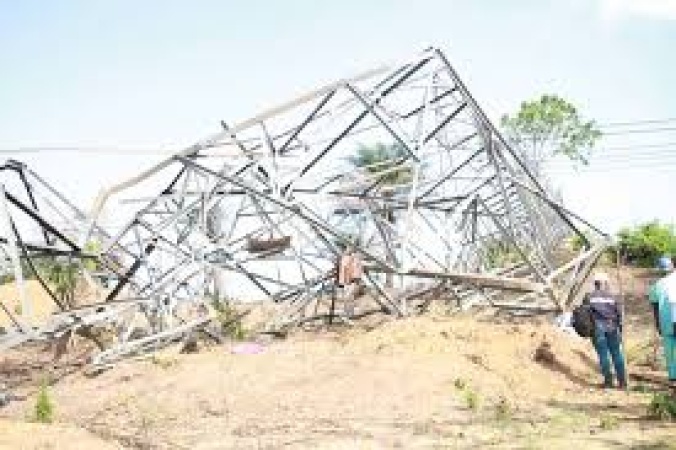
File photo of a vandalized Telecom tower
Criminal networks have turned Nigeria’s telecom towers into open-air warehouses for theft, looting 656 critical power assets across 14 states in 2025 alone and keeping up the pace in early 2026.
The Nigerian Communications Commission (NCC) data showed the haul included 152 generators and 504 batteries stolen from mobile sites last year.
At the same time, thieves made off with diesel in 1,344 separate incidents and cut fibre cables so often that operators recorded an average of 1,100 fibre cuts every week by late 2025.
The 14 hardest-hit states, Delta, Rivers, Cross Rivers, Akwa Ibom, Ogun, Ondo, Edo, Lagos, Kogi, FCT, Kaduna, Niger, Osun and Kwara, have become the main battlegrounds.
In these places, armed gangs and opportunistic looters regularly raid active sites for anything they can sell: power cables, rectifiers, feeder cables, batteries, solar panels and diesel.
The damage is not slowing. In January and February 2026, thieves stole another 64 batteries and 17 generators. Cable theft jumped to 160 cases in January this year from 74 a year earlier, and 151 cases in February from 73. Diesel theft added 222 more incidents in the same two months.
Gbenga Adebayo, chairman of the Association of Licensed Telecommunications Operators of Nigeria, called the thefts a direct brake on progress. “These are not mere materials. They are the backbone of our digital economy, security systems, and national communications grid,” he added.
Operators have poured money into network upgrades and optimisation after government policy support last year. Yet every stolen generator or cut fibre cable wipes out those gains.
MTN Nigeria, the country’s largest telecom player, revealed it committed up to N1 billion last year to deploy new infrastructure across the country.
The goal: ease rising network congestion, lift service quality and expand capacity to match Nigeria’s fast digital growth.
Yahaya Ibrahim, MTN’s chief technical officer, described the painful contrast. On one side is massive capital injection; on the other, constant infrastructure damage.
Ibrahim told BusinessDay that this dual reality poses serious challenges to Nigeria’s digital transformation.
“We have committed about N1 billion last year to expand and modernise our network. This includes hardware, fibre cables, power systems, and services for executing installations nationwide,” Ibrahim said.
The money targets higher network capacity, upgraded switching centres, wider LTE coverage and relief for crowded urban areas.
Yet the gains are under constant attack. MTN alone faced 397 fibre cuts in May 2025, a sharp jump from a monthly average of just 35 at the end of 2024. “In some countries, you can go a whole year without a single fibre cut. Here, we had nearly 400 in one month. It is completely unsustainable,” Ibrahim lamented.
To stay ahead of the chaos, MTN budgets roughly N7 billion every year just for fibre relocation. “This is money we could be spending on new deployments, but instead we are constantly repairing what was already done,” Ibrahim said.
MTN has built its network with three-route redundancy for switching centres and fibre loops, so traffic can automatically shift when one line fails. The company is also rolling out artificial intelligence and automation for faster fault detection and response.
In a pilot project, MTN is testing AI-powered vibration sensors on underground fibre. These sensors can distinguish between rodents, heavy trucks or foot traffic and pinpoint the exact location of a threat. “It is a game changer,” Ibrahim said.
Ibrahim praised the current NCC leadership for being responsive but called for stronger government action to protect telecom assets now classified as Critical National Infrastructure.
“Stronger laws are needed, but beyond enforcement, awareness and civic responsibility are key. Investments like ours are vital, but they must be protected. Every fibre cut, every stolen battery, every locked tower sets us all back. We need a collective effort to secure the backbone of our digital future,” he advised.
On his part, telecom expert Kehinde Aluko put a number on the pain. In 2023, repairs and backup systems already cost the industry about N14 billion.
Fibre damage spiked 900 percent in January 2026 compared with the end of 2024. In May 2025 alone, theft and cuts triggered 88 major network outages. “Vandalism is the leading cause of dropped calls, slow internet and total service outages,” Aluko said.
The extra costs are now eating into operators’ return on investment and making it harder to keep expanding service.
The federal government declared telecom infrastructure critical national infrastructure last year to give it extra legal protection.
The NCC board chairman, Idris Olorunimbe, during a recent tour of sites in Lagos, said the number of incidents has started to fall and that a new accountability rule will soon force anyone who damages a tower during construction or road work to pay for the repairs.
But fresh 2026 numbers tell a different story. Theft is not only continuing, but it is also spreading faster in the key states.
For Nigeria’s $76 billion telecom sector, the message is clear. Criminal networks have found a low-risk, high-reward business model: strip the towers at night, sell the parts the next day, and leave the digital economy to deal with the outages.
Until enforcement catches up, the 14 states under siege will keep paying the price in lost calls, lost data and lost trust. (BusinessDay)



