
ADVERTISEMENT

ADVERTISEMENT

ADVERTISEMENT

ADVERTISEMENT


















Loading banners


NEWS EXPRESS is Nigeria’s leading online newspaper. Published by Africa’s international award-winning journalist, Mr. Isaac Umunna, NEWS EXPRESS is Nigeria’s first truly professional online daily newspaper. It is published from Lagos, Nigeria’s economic and media hub, and has a provision for occasional special print editions. Thanks to our vast network of sources and dedicated team of professional journalists and contributors spread across Nigeria and overseas, NEWS EXPRESS has become synonymous with newsbreaks and exclusive stories from around the world.
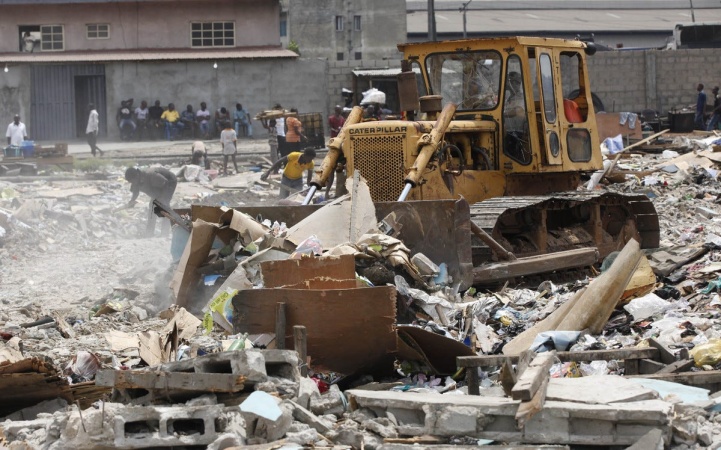
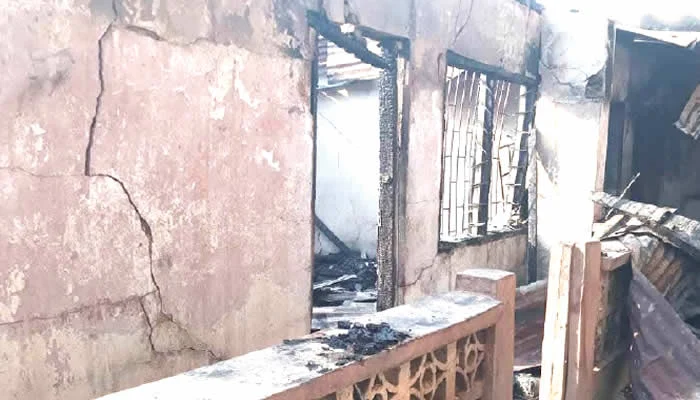
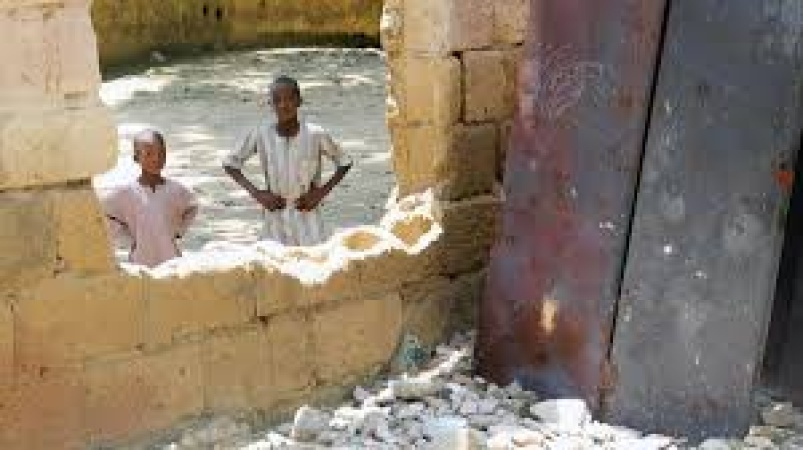
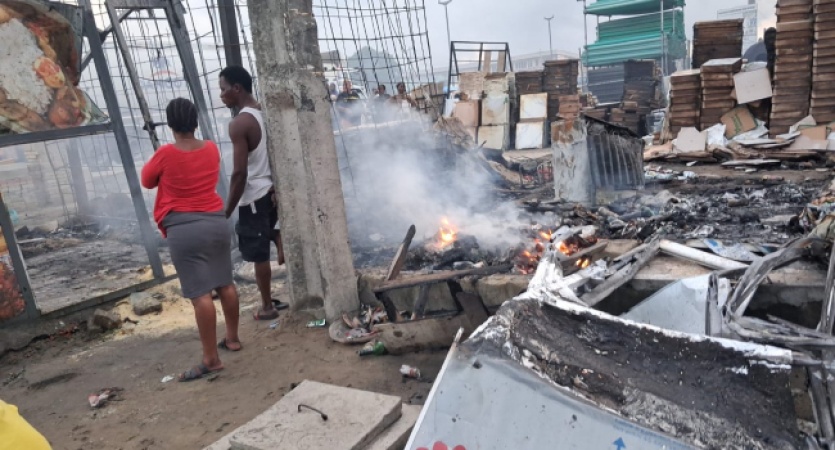
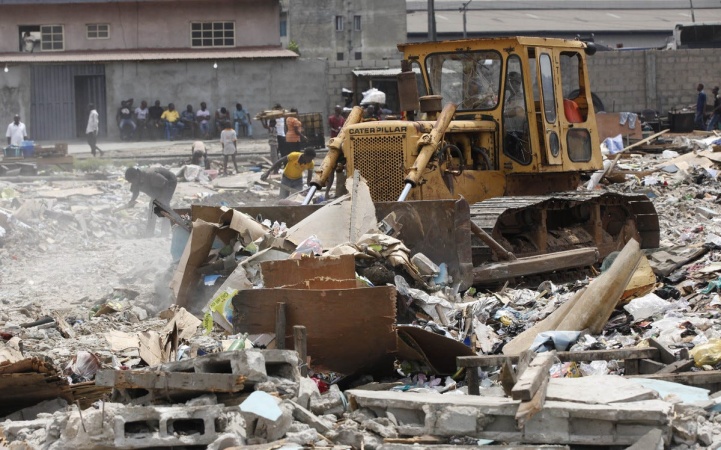
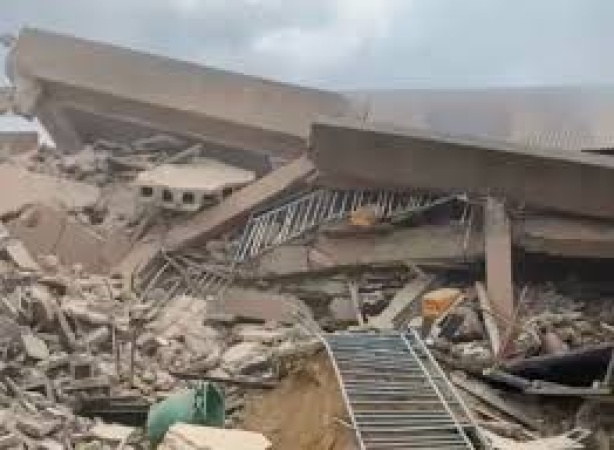
Demolished buildings
The forced eviction, demolition of homes in Ilaje Otumara and Baba Ijora in Lagos Mainland Local Council and the takeover of the land has become a cause of debate over alleged land grabbing activities in Lagos.
Many victims of the demolition, which occurred on March 7 and 10, 2025, remain homeless till now aside battling with harsh living conditions.
And one year after the demolition was carried out, while government authorities had framed the action as part of urban renewal efforts, the auctioning of the land for private estate development with government agencies unperturbed reflects a deeper pattern of displacement driven mostly by economic interests that some claimed is presently going on in different communities of Lagos.
The residents of Otumara said that for many years they voted but their votes never turned to improved infrastructure within the communities. They added that through community efforts, they tried to improve the state of their environment despite every election circle, politicians, especially those of the ruling party in the state, come to their communities to seek for their votes with a pledge to improve the infrastructure, but once election is over, that is the last they often hear about improving the lots of the communities.
Providing a detailed background of what evictees had gone through over the years, one of the community leaders and spokesperson, Jude Ojo, a pastor in Redeemed Christian Church of God, said that they are one of dozens of waterfront communities in Lagos that formed an alliance in 2016 to demonstrate and eventually bring action against the Lagos State government under the administration of Akinwumi Ambode, which resulted in a precedent judgment from the Lagos State High Court that forced evictions such as were carried out in Otodo Gbame from 2016-17 violate the right to dignity enshrined in Section 34 of the 1999 Nigerian Constitution.
He stated that the permanent injunction against displacement without prior consultation and resettlement that also came out of this case protects Ilaje Otumara and other waterfront informal settlements to today.
According to him, since mid-2021, Ilaje Otumara has been positively engaging with LASURA around a planned partnership with the community to carry out regeneration in which residents were meant to be part and parcel.
“In late 2021, the community set up a regeneration committee to engage with LASURA and potential developers; in mid-2022, the community conducted its own census, numbering 2,808 households with a population of at least 12,313 residents. In March 2023, Governor Babajide Sanwo-Olu campaigned to Otumara based on the promise that this project would continue; and just after the election, the community conducted an opinion survey to identify the upgrading priorities of residents and feed into an expected participatory planning process.
“Since mid-2023, however, the reverse course on this positive progress has become increasingly evident, starting with the forced eviction of Oworonshoki communities that had been included in the initial planning for the Kosofe Model City Plan, and continuing with the demolition of Orisunmibare in Apapa in February 2024, Otto communities in March 2024, and Oko Baba and parts of Aiyetoro communities in September 2024.”
He recalled that on Tuesday, February 11, 2025, the Lagos State Building Control Agency (LASBCA) entered into Ilaje Otumara and neighboring Baba Ijora communities in Lagos Mainland and arbitrarily marked hundreds of homes and business for imminent removal within a period of just two days. “That same day, residents protested to the Lagos Mainland Local Council where the chairwoman pledged support for the community. On February 12, 2025, residents mobilized to Alausa for a large peaceful demonstration appealing to the Governor of Lagos State and the House of Assembly to look into and stop the threatened eviction; the same day, residents went round to deliver letters to all the ministries and agencies responsible for urban development and ended up over the next two weeks meeting severally with the General Manager of LASBCA, and when LASBCA doubled down on its threat, further meetings with the General Manager of the Lagos State Urban Renewal Agency (LASURA), the Permanent Secretary of the Ministry of Physical Planning and Urban Development and, finally, the Special Advisor to the Lagos State Governor on Urban Development, who assured the community that they would not be evicted and pledged to instead continue partnership for regeneration.
“Flying in the face of these assurances, on the morning of Friday, March 7, 2025, with no prior warning, LASBCA officials, police, and so-called “area boys” armed with machetes descended on the two communities with a Kick Against Indiscipline (KAI) “Black Maria” mobile detention vehicle and as many as five excavators, beating residents and quickly beginning to demolish the entirety of both communities from various directions, paying no heed to whether a building had previously been marked or not on March 8 and 9 2025, destroying nearly the entirety of both communities, allowing widespread vandalism and looting, and leaving thousands of residents displaced and sleeping outside.”
Ojo added that it was surprising that an elected government would displace over 15,000 residents of two communities without bothering to provide alternatives to them. Yet, during electioneering campaigns, politicians come to the community to canvass for votes, adding that Sanwo-Olu campaign team came during the last elections promising that the communities will go through urban regeneration on a win-win basis.
Speaking on the issue, a public affairs analyst, Damilola Solomon stated that it is ironic that some people are using their connection to government to trample on people, including rendering them homeless.
“It is a pity that we are all going to leave this world with nothing despite we do all manner of sorts just to acquire wealth. Rendering thousands of people homeless just because you want to grab their land for economic returns and those in government including the elected watch or look away is insane. We are all humans and we would return to our maker one day without taking anything along. So, why all these desperations and wickedness that we get involved in?”
Afolabi Esther Abiola, a landlady and school-owner in the community, with seven tenants and multiple apartments, now squat with her mother in Magbon area of Badagry. “I feed on family and friends. I have a daughter in university which I don’t want her to drop out. Things are hard and very tough.”
On his part, Alfa Ajibade, a landlord whose house at 34 Church Street, Ilaje, was destroyed, said: “It was like heavens were fallen. We were still in the month of Ramadan, police, teargas, guns, touts. It was war.” His household has been forced to scatter, his livelihood as an imam and Arabic tutor wiped out, and his family now lives in separate locations. “My first wife is managing with her senior sister, who gave us a room to squat with the children. My second wife is at Ogolonto, Ikorodu. Life is now terrible to live.”
Collins Okereke said their building that was demolished was where he and his siblings were born. He claimed his mother passed away as a result of the demolition because she could not cope with the pressure of being displaced. “My mother’s corpse is in the mortuary. I stay in Orile now with my immediate family, and my siblings are scattered all over the place.”
Alimaje Joseph has been living in Otumara since 1984. He said: “When my husband died, we were living in barracks, so when I collected my pension, I used it to build two houses there for my children because I had no one to support me. At that time, my kids were still small and couldn’t help. I am now homeless, staying on the roadside.”
Bright John, a groundnut seller, gave birth to a boy on March 7, the day the demolition started and since then John said living has been horrible with her new born baby. Like many members of the community who are still living in makeshift structures within Otumara, when it rains at night she uses nylon to cover herself and baby.
According to her, she was discharged from the hospital two days after delivery, stayed with a woman who pitied her for two months before she constructed a makeshift house that she cannot standup while inside.
A lawyer who has followed the matter, Mariam Alo, noted that the Ilaje Otumara community, which existed at the heart of Ebute Metta for over 150 years, was forcefully evicted despite sustained engagements with government agencies, including the Lagos State Urban Renewal Agency (LASURA), on the possibility of upgrading the settlement.
“This eviction occurred in spite of a subsisting court judgment that protects Ilaje Otumara, alongside other island and waterfront communities, from forced evictions carried out without adequate notice. The same judgment affirms that the mass displacement of residents from their homes and livelihoods, with little or no notice, constitutes a violation of the right to dignity of the human person.
“Legal safeguards are clearly in place to prevent such actions. It is also understood that ongoing legal proceedings are challenging the legality of the eviction. However, development activities have commenced on the same land in question.
“This situation is not without precedent. Similar patterns have been observed in past evictions, including that of the Otodo Gbame community. Such developments raise serious concerns about the disregard for judicial authority and the protections it affords citizens.
The courts are widely regarded as the last hope of the common person. When court orders and protections are not respected, it calls into question the effectiveness of legal remedies and the broader commitment to the rule of law,” Alo said. (The Guardian)


