 ADAD
ADAD
Updating your news feed...
NEWS EXPRESS is Nigeria’s leading online newspaper. Published by Africa’s international award-winning journalist, Mr. Isaac Umunna, NEWS EXPRESS is Nigeria’s first truly professional online daily newspaper. It is published from Lagos, Nigeria’s economic and media hub, and has a provision for occasional special print editions. Thanks to our vast network of sources and dedicated team of professional journalists and contributors spread across Nigeria and overseas, NEWS EXPRESS has become synonymous with newsbreaks and exclusive stories from around the world.
























Loading banners
Loading banners...

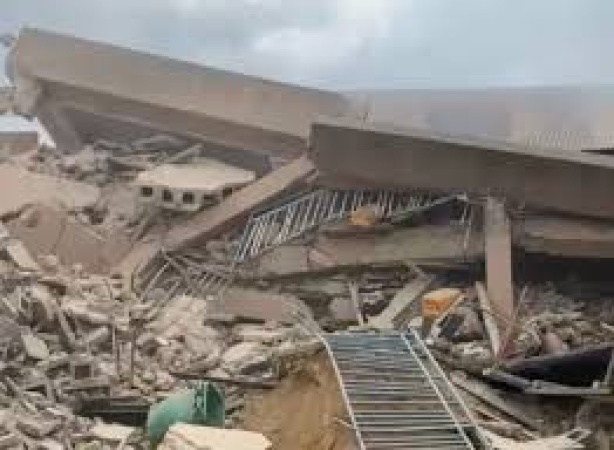
Collapsed Yemco College
Weeks after the collapse of a four-storey building housing Yemco Nursery, Primary and Comprehensive College at 11, Adu Street, Ogba, in Ojodu Local Council Development Area of Lagos State, the rubble, already cordoned off by relevant building authorities in the state, remains the only sad reminder of a place that was once a beehive of activities.
Looking deserted, with residents this time around suspicious of every strange movement around the neighbourhood, it was obvious that the community where the school building once stood tall and its adjoining areas are yet to recover from the incident of Monday, March 9, 2026.
A visit to the site of the collapsed building, where a yet-to-be-established number of students and staff of the school escaped death by a whisker, showed that several buildings in the area have been marked for demolition by the Lagos State Building Control Authority (LASBCA).
From Osaye, Odekunle, Okunowo and Oye streets, buildings showing signs of distress have been marked for failing structural integrity tests by officials of LASBCA.
Interestingly, except for some movements of trucks, obviously there to clear what remains of the once imposing school, the whole community looked deserted. The few passersby and residents met by Saturday Tribune in the area on that sunny day were not ready to exchange any courtesies with strangers, a development the correspondent initially found curious. It was later learnt that this might be connected with apprehension among residents over the decision of the government to mark some buildings in the community in the aftermath of the unfortunate incident.
But while there is apprehension among residents and property owners regarding the fate that awaits them and their properties, there are bigger anxieties among parents whose wards and children in the school may have the rest of their academic programme for the year disrupted.
For instance, contrary to assurances by the state government that it would meet the school management with the aim of having a useful engagement with authorities regarding this, it was learnt that some of the affected students are still at home, idling away.
While it was easier to squeeze water out of stone than to get information about the affected students or even the whereabouts of the school management, a resident, Mrs Uju Ifeanyi, who eventually volunteered information in this regard, confirmed that despite assurances by the state government, many of the students, especially those whose parents cannot afford to enroll them in alternative schools, are still at home.
According to Uju, whose neighbour has some children in that school, most parents are waiting for the end of the second term to secure admission for their wards in the third term of the academic calendar.
She said, “One of my neighbours has her children enrolled in the school. But since the building collapse, her children have not been attending school. They are always at home during school hours and her excuse was lack of wherewithal to enroll them in another school.
“She said she had just paid the fee for the second term when the tragic event occurred. She therefore decided to keep her children at home until the end of the second term when they will be enrolled in another school for the third academic session.”
Findings among residents showed that the above case cited by Uju is not an isolated one.
While some of the parents who could afford it had gone ahead to enroll their children in other schools, the same could not be said of others, especially those yet to fulfill their financial obligations to the school before the building collapsed.
But with the latest revelation, is the government abandoning the affected students and parents to their fate? What has become of the assurances the Ministry of Education earlier gave that it would ensure alternative arrangements were made by the school for the affected students? Is time not running out, especially for the senior students supposed to be neck-deep in their preparations for their final exams?
Giving an update on the incident some time ago, the state Commissioner for Basic and Secondary Education, Mr Jamiu Alli-Balogun, stated that the school was government-approved with no record of operating in a defective structure. He had assured that government was discussing with the school’s management to secure temporary accommodation.
This, he explained, would enable the students to continue with their studies and complement same with virtual learning, pending further directives.
The commissioner had reassured parents and guardians, as well as members of the public, of government’s commitment to the safety and wellbeing of learners and school personnel across the state.
Interestingly, responding to Saturday Tribune’s enquiry on the fate of the students and whether the ministry was no longer keen on keeping its word, a top official at the ministry explained that government is leaving no stone unturned in ensuring the students’ academic calendar is not disrupted.
According to the highly reliable source, those in the senior class are currently engaged in virtual learning and are preparing for the West African Senior School Certificate Examination (WASSCE), while arrangements have been made with a school in the neighbourhood, on mutual understanding, to allow them complete the term there.
He explained that the school would be relocating to a new site by next term after the structure must have been assessed by relevant building authorities in the state and pronounced fit for use.
He added that those at home might be students who were unable to meet their financial obligations to the school before the building collapsed.
“It is possible that those still at home are those who were yet to pay for this term before the incident,” the source said.
While this explanation may have assuaged the feelings of the concerned public and direct victims of the incident, the one given by the building authorities for marking some buildings in the area can be said to have heightened the apprehension of residents and property owners rather than dousing it.
There are palpable fears among these individuals that the government may roll in bulldozers at any time to clear such marked buildings, citing threats to public safety.
But the agency’s Director of Public Affairs, Mr Adu Adegoke, described the markings as part of the agency’s regulatory procedures.
He said affected property owners had been served notices to conduct non-destructive integrity tests to ascertain the structural stability of their buildings, adding that the tests are mandatory to prevent future building collapses.
An expert in the built sector, who would not want his name in print, expressed belief that there is no basis for such apprehension.
“It is the norm that when you have this type of case, buildings that are nearby and not looking structurally sound are usually marked. It should, however, be noted that such a mark should not be seen as a ‘death sentence’. It simply means an integrity test should be conducted on such a building, and if given a clean bill of health, the mark will be removed,” he stated.
Also speaking on the development, the Building Collapse Prevention Guild (BCPG) has called for the mandatory installation of early warning systems in buildings.
The incident, the guild argued, has become a reference point in renewed advocacy for proactive safety measures.
Officials of the BCPG, Ojodu Cell, including the Coordinator, Prince Abiodun Adegoke, General Secretary, Dom Ibeh, and Public Relations Officer, Femi Ishola, said the incident underscores the urgent need for early detection mechanisms in buildings.
They explained that most buildings show warning signs before collapse, including concrete spalling, visible cracks in walls or columns, bulging surfaces, unusual vibrations, and deflection of structural elements.
“Observing these early signs provides a crucial window for intervention,” the officials said.
They added that the Yemco incident, which occurred just days before the sixth anniversary of the 2019 Ita-Faaji school building collapse, reinforces the importance of proactive safety systems.
According to the BCPG, early warning signs such as cracks and spalling were observed in the Ita-Faaji building before it collapsed, killing about 20 pupils and injuring several others.
In contrast, the timely evacuation at Yemco Schools prevented casualties, highlighting the life-saving potential of early detection and response.
The group also pointed to advancements in technology, noting that modern building monitoring systems now incorporate Internet of Things (IoT)-enabled sensors embedded in structural components.
These devices continuously track stress, movement and deformation, triggering alarms when safety thresholds are exceeded.
“As soon as beams deflect, columns weaken, or abnormal vibrations are detected, alerts are sent to occupants and building managers to enable immediate evacuation,” they said.
The experts urged occupants to remain vigilant and report early warning signs, while prioritising the installation of such systems in high-occupancy buildings, including schools, hospitals, and residential complexes.
They called for strict enforcement of periodic structural integrity tests, particularly for ageing buildings.
The guild stressed that a thorough investigation into the Yemco collapse is necessary to determine its causes and prevent a recurrence.
It also urged the state government to urgently address concerns over a distressed three-storey building at a popular school in Fadeyi, Yaba.
The BCPG reaffirmed its commitment to working with government agencies and stakeholders to promote safer construction practices and reduce the incidence of building collapse across the country.
While the latest incident offers the opportunity of a second chance for stakeholders involved, unlike the Ita-Faaji school building collapse of 2019 where some parents and guardians were left to mourn their dead, the state will only heave a sigh of relief when foolproof measures are in place to ensure that incidents of building collapse are reduced to the minimum. (Saturday Tribune)



