
ADVERTISEMENT

ADVERTISEMENT

ADVERTISEMENT

ADVERTISEMENT

Loading banners

NEWS EXPRESS is Nigeria’s leading online newspaper. Published by Africa’s international award-winning journalist, Mr. Isaac Umunna, NEWS EXPRESS is Nigeria’s first truly professional online daily newspaper. It is published from Lagos, Nigeria’s economic and media hub, and has a provision for occasional special print editions. Thanks to our vast network of sources and dedicated team of professional journalists and contributors spread across Nigeria and overseas, NEWS EXPRESS has become synonymous with newsbreaks and exclusive stories from around the world.
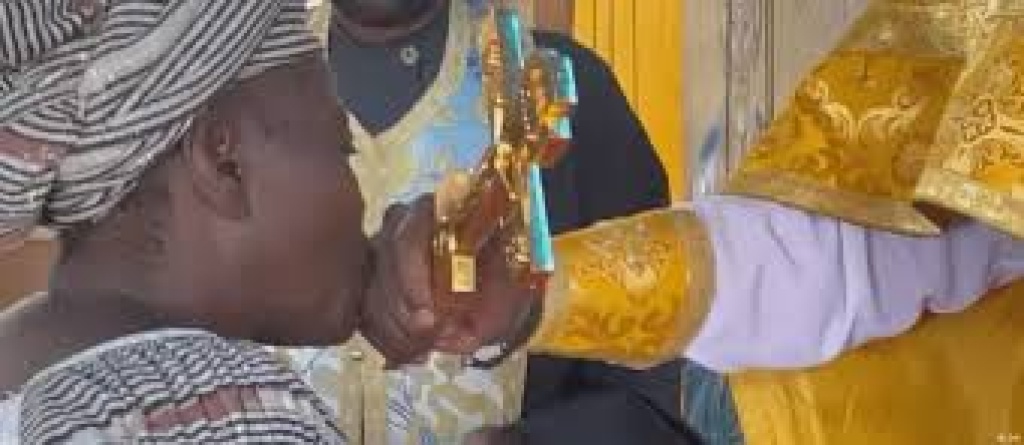
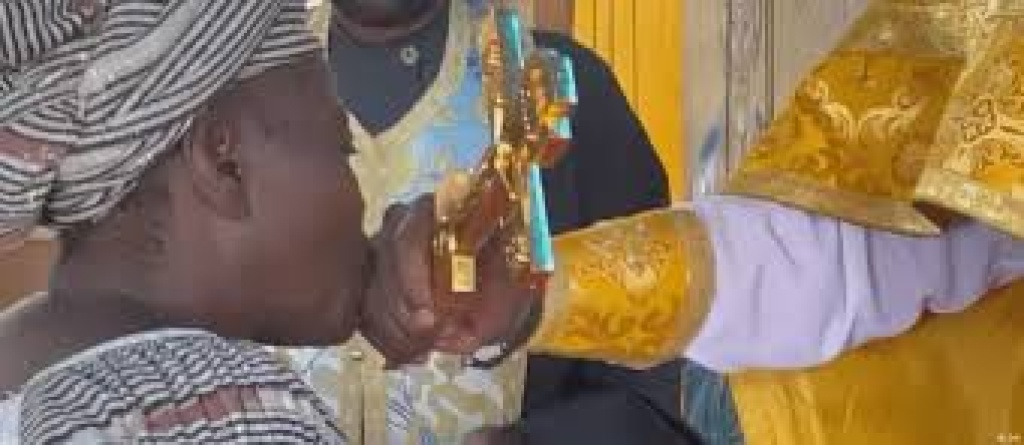
For the past three years, believers in the Central African Republic have been gathering for Russian Orthodox services at the small parish of Saint-Andre de Bimbo near the capital, Bangui.
Patrick, 38, is one of them. He was a member of the Roman Catholic Church before converting to the Russian Orthodox Church. “I joined this church because I like the teachings of the Bible, the way they speak to us, and how they provide spiritual guidance through prayer,” Patrick told DW.
“Since making this transition, I feel that a positive change is taking place in my life,” Patrick said. “I feel at home in my new church, my new faith, and I will continue on this path.”
Thirty-five-year-old Olive is also happy to be a member of this new congregation. “I liked the style of the sermon in the Orthodox Church because they teach well,” she said. “We all worship the same God, and I feel at home with the sermon and the way people interact in this church,” Olive told DW.
Liturgy in Russian, with interpreters
Even though the liturgy is conducted in Russian, the congregants still get the message. “That’s no problem, because there are interpreters who help us understand what is being said in Russian.”
Saint-Andre de Bimbo is led by Father Marcel Voyemawa. He, too, is a convert. He was formerly a priest of the Greek Orthodox Church and has since joined the Russian Orthodox Church.
The Orthodox churches are geographically organized into patriarchates; Africa was considered part of the Patriarchate of Alexandria and thus belonged to the Greek Orthodox Church. However, Voyemawa defends the theological authenticity of his new church on the pro-Russia radio station Lengo Songo—which is currently under EU sanctions.
“Here we have true dogmatic theology. The Orthodox Church consists of autocephalous (independent) churches, each of which has its own local tradition. What distinguishes them is above all the language of worship,” Voyemawa told DW.
Voyemawa said the Russian Orthodox Church was grounded in universal apostolic values and thus in harmony with the teachings of Jesus’ disciples. “Going everywhere—that is the universality of the Church, the apostolate. That is what defines the Orthodox faith and the Nicene-Constantinopolitan Creed, which the Church and the Church Fathers have faithfully preserved.”
The small parish of Saint-Andre de Bimbo is just one of many parishes where the Russian Orthodox Church has gained a foothold. It is steadily expanding its presence in Africa: According to the Church, there are 350 parishes across more than 30 countries on the continent.
In countries such as South Africa, Tanzania, Uganda and Kenya, places of worship are being built whose interiors resemble those of churches in Saint Petersburg and have little in common with domestic religious traditions.
Church as Russia’s ‘soft power’ in Africa
Experts advise caution regarding the figures published by the Orthodox Church. Regina Elsner is a Roman Catholic theologian and professor of Eastern Church Studies and Ecumenism at the Ecumenical Institute of the Faculty of Catholic Theology at the University of Münster.
Elsner told DW that, in recent years, fewer new churches have likely been established on the continent than the Russian Orthodox Church claims; however, the church itself has a strong interest in publicizing its growing membership. “The Russian Orthodox Church must clearly be viewed as part of Russia’s soft power,” Elsner said, adding that it does not mean that the entire Church always represents only state interests. But since the 1950s, the Church has worked closely with the state in many areas.
Since then, the church has built a broad international presence through parishes, church structures and representation at international bodies — such as the United Nations (UN) and the European Union (EU) in Geneva and Strasbourg, respectively, Elsner said.
“In Africa, the Russian Orthodox Church has been present for many years, primarily within Russian diplomatic missions,” Elsner said. “Since 2022, this presence has been expanded with its own ecclesiastical structure and the claim to be the only true Orthodox Church for the African continent.”
Elsner said the influence of the Orthodox Church was less a matter of direct Russian propaganda and more a subtle promotion of Russian interests. “First, Russia and the Russian Orthodox Church have been active defenders of persecuted Christians in many African countries for many years,” Elsner emphasized. Hardly any other country has advocated so strongly for this cause on the international stage, which has earned the Russian side great sympathy among persecuted Christians.
Linked to this is the church’s stance against so-called liberal Western colonialism: “The Russian Church exploits and reinforces widespread reservations about democracy and the human rights policies of Western countries, particularly among the religious population and among existing African churches, and in this way, it can legitimize support for a Russian presence,” Elsner said.
Russian Orthodox Church’s history in Africa
Even though she estimates the number of congregants to be rather small, Elsner sees “geopolitical relevance in its presence” and believes that it could also have a very strong influence on the balance of power in an international context. The expansion of the Russian Orthodox faith competes with the Greek Orthodox Church in Alexandria, Egypt. According to Elsner, the Patriarchate of Alexandria dates back to the third century and is responsible for all of Africa.
Up to 2019, the Exarchate of Alexandria had maintained good relations with the Russian Orthodox Church; there had been a strict separation within the Orthodox world. The small parishes were mainly established in North Africa and Kenya and had remained untouched for centuries.
That was set to change in 2019: At that time, Patriarch Theodore II of Alexandria recognized the independent Orthodox Church of Ukraine, whereupon the Synod of the Russian Orthodox Church broke off Eucharistic communion with the episcopate of the Church of Alexandria. “For Moscow, this was tantamount to an annexation,” Elsner said.
The Russian Orthodox Church, led by Kirill I, represents Russian ideology abroad; government ministries are closely networked with the church, and Vladimir Putin’s government benefits strategically from this.
Natallia Vasilevich, a Belarusian theologian and political scientist, told DW that the expansion of influence is primarily a personal concern of Leonid Gorbachev, who formerly led the Exarchate in Africa.
“His rise was closely linked to the general Russian presence on the continent, including the networks surrounding Yevgeny Prigozhin, founder of the private military company Wagner,” Vasilevich said.
“Against this backdrop, he sought to expand the influence of the Moscow Patriarchate in Africa under the guise of a church mission, as well as his own influence In Africa,” she said. The formal pretext for this intervention was the Patriarchate of Alexandria’s decision to recognize the Orthodox Church in Ukraine.
Representatives of the Russian Orthodox Church chose the simpler, more aggressive path against the Church of Alexandria; they directed their efforts against the church itself and targeted its clergy, congregations and infrastructure, Vasilevich said. “In practice, this meant luring existing Orthodox priests and congregations away from the Church of Alexandria rather than building something new.” For example, granting refuge to clergy in conflict with their bishops. This is not genuine missionary work, but a strategy of opportunism, she said.
Vasilevich said one thing was certain: “These activities of the Russian Orthodox Church on the continent are deeply destructive to African Orthodoxy. They exploit the financial weakness of African congregations and lure clergy and congregations away with material incentives, which actually leads to tensions within the congregations.” (DW)
•The Russian Orthodox Church’s influence is growing in African countries, such as the Central African RepublicImage: DW


