






















Loading banners


NEWS EXPRESS is Nigeria’s leading online newspaper. Published by Africa’s international award-winning journalist, Mr. Isaac Umunna, NEWS EXPRESS is Nigeria’s first truly professional online daily newspaper. It is published from Lagos, Nigeria’s economic and media hub, and has a provision for occasional special print editions. Thanks to our vast network of sources and dedicated team of professional journalists and contributors spread across Nigeria and overseas, NEWS EXPRESS has become synonymous with newsbreaks and exclusive stories from around the world.
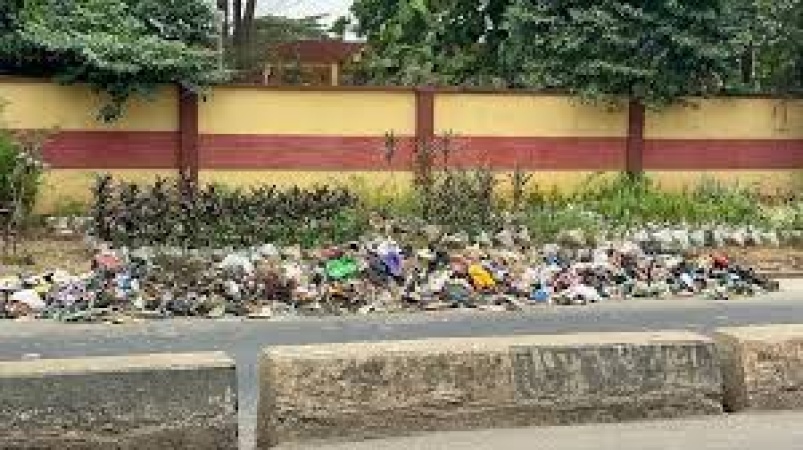
Waste littered at the front of a secondary school in Agege
For over a month, broken trucks and filled dumpsites have stalled waste collections by the Lagos Waste Management Authority (LAWMA), leaving streets filthy, stinking, and drainage channels clogged. In this report, BusinessDay Investigations examines the breakdown between LAWMA and PSP operators, and why residents paying for a public health service are left living with growing heaps of waste and the financial flows within Lagos’ waste management system. SODIQ OJUROUNGBE writes.
At about 6:30 a.m., before commercial buses begin blaring honks and roadside traders roll out their wares, 42-year-old Bose Akinyemi steps outside her bungalow in a densely populated part of Alimosho Local Government Area with a tightly knotted black nylon bag in her hand.
She pauses at her gate, scans the street, and sighs. The collection point at the junction, once cleared weekly, has grown into a layered mound of decay. Torn sachets of water, disposable diapers, rotting vegetables, broken styrofoam food packs and hardened leftovers.
The stench lingers long after she retreats indoors. Across her street, neighbours have begun dumping waste directly into the gutter, hoping there will be a ‘miraculous’ rainfall to wash it away.
Speaking with our correspondent about the filthy condition of her street, Akinyemi said refuse has not been collected from her community and other neighbouring areas for more than a month.
She explained that the Private Sector Participant (PSP) operator in charge of the area blamed the situation on the breakdown of all LAWMA vehicles, which has made waste collection impossible.
Akinyemi said she pays her waste bill regularly to the assigned PSP operator under the supervision of the Lagos Waste Management Authority.
She added that at night, stray dogs and scavengers tear open the bags of refuse, scattering the waste into nearby gutters and worsening the mess.
“With the drains now clogged, even a light rainfall leaves stagnant pools of murky water trapped beneath the heap.
“The stench seeps into our living rooms and bedrooms, lingering long after doors and windows have been shut, making daily life unbearable. For more than a month, they have not come. But they are still collecting their money,” she said.
Different community, same problem
About nine kilometres away in Agege Local Government Area, commercial bus driver Deyemi Olujimi shared a similar frustration.
Standing beside his compound, he pointed to what was once a designated waste collection spot, now overflowing into the adjoining street. The heap has narrowed the road, forcing vehicles to slow to a crawl.
Olujimi explained that residents on his street make monthly payments of N3000 each for waste evacuation, yet the PSP truck that previously came weekly has become a rare sight.
As a result, he revealed that neighbours now take turns pushing wheelbarrows filled with refuse to distant streets where trucks occasionally show up.
He added that some residents have resorted to illegal dumping under the cover of night.
Recalling when waste collection was consistent, he said, “Every week, once or twice, you would hear the truck horn. Now, nothing. They say the trucks have broken down. They say the dumpsites are full. But why are we still paying?”
As heaps of refuse continue to pile up, similar scenes are unfolding across Alimosho Local Government and parts of Agege, where waste collectors have reportedly failed to show up in several communities.
Findings by BusinessDay Investigations showed that what began as isolated complaints from residents now appears to reflect a wider problem, with mounting waste becoming a common sight in affected neighbourhoods.
Communities stink from heaps of refuse
On February 24 & 25, our correspondent visited various communities in Alimosho and Agege, where heaps of refuse now sit permanently at the front of residential buildings following prolonged abandonment by waste collectors.
Along the corridor from Iyana Ipaja to Ikotun, more than seven major points were sighted where refuse had spilt beyond designated collection spots and onto the roadside, forming dark, rotting mounds that have become part of the landscape.
Black nylon bags burst open under the sun, their contents spilling out and mixing with sand and stormwater residue, releasing a sour, putrid smell that lingers heavily in the air.
A clogged gutter in a community in Alimosho
Alimosho LG, our correspondent visited Liasu Road, Aluko, Ilewe, NNPC, Council, Temidara, Ikunna and Malas.
One thing was common in all these areas: residents deliberately arranged piles of waste close to their gates in the hope that whenever PSP trucks arrive, evacuation will be swift.
Drums, waste bags, sacks, and a host of other means of keeping waste were seen, filled to the brim and overflowing at the front of many houses in the areas visited, some tied up tightly in a desperate attempt to contain the smell.
Observation by BusinessDay showed that much of the refuse appeared to have been thrown out for weeks.
Our correspondent observed that the drainages within these areas have been blocked by refuse and are no longer flowing.
Piles of refuse left abandoned in front of buildings in Alimosho communities
In several stretches, plastic waste and decomposing food have blocked drainage channels completely, trapping foul-smelling water and raising concerns about flooding when the rains intensify.
Speaking with some residents, they said the PSP responsible for taking the waste has refused to come for more than a month.
The residents also stated that this is not the first time communities in Alimosho have experienced such prolonged delays in picking up their waste.
They cited instances of similar occurrences in November 2025, where waste was not picked up for more than two months, forcing them to live with the stench and the risk of being exposed to contaminated diseases.
A community leader at Aluko, Benjamin Adefowora, said waste collectors not coming to pick their waste as and when due, despite consistent monthly payment, is becoming a recurring problem in the axis.
He lamented that the Community Development Associations have engaged LAWMA, but they keep giving untenable excuses for such delays.
In Agege, the pattern is even more pronounced. More than ten places along the Agege-Ipaja road have been converted to mini dump sites, with refuse piles spreading across sidewalks and edging into the road.
It was observed that these waste sites have gradually formed in open spaces. At the front of Orile-Agege Comprehensive High School, our correspondent sighted heaps of waste emitting a strong, offensive smell that hangs over the area.
While in the community, a LAWMA truck was sighted passing through the area, but residents said, despite that, the waste littering the community is not picked up, leaving them to endure the persistent odour.
Megacity’s waste ambition meets street reality
With an estimated population of over 20 million people, Lagos state generates between 13,000 and 14,000 metric tonnes of solid waste daily, according to figures from the LAWMA.
This translates to more than 4.7 million tonnes annually, making it one of the largest waste streams in sub-Saharan Africa.
Successive administrations have acknowledged this pressure on infrastructure and repeatedly framed waste management reform as central to public health, environmental protection and the city’s global image.
The Lagos State Government has publicly stated that it is pursuing reforms aimed at repositioning the waste sector, modernising collection systems, strengthening regulation of PSP operators, and advancing its ambition of building a cleaner and more sustainable megacity.
These plans include partnerships designed to promote circular economy models, expand material recovery, and introduce waste-to-energy solutions, alongside initiatives to process organic waste and reduce emissions linked to open dumping and landfill congestion.
Despite these policy pronouncements and structural reforms, findings by BusinessDay Investigations showed that many communities still lack access to consistent waste collection even when they pay for it.
Inside Lagos’ waste payment chain
Under Lagos’ waste management framework, households and businesses are billed by PSP operators licensed and supervised by LAWMA.
Findings showed that payments are mandatory. Residents who default risk warnings, service denial, or, in some cases, business premises being sealed.
Across the communities visited, residents confirmed that average monthly bills hover around N3,000 per household. For small shop owners, charges often run into tens of thousands of naira monthly, depending on classification.
The structure, residents explained, is straightforward, involving PSP operators collecting directly from households and remitting agreed obligations within the regulatory framework established by the Lagos State Government. On paper, it is a defined payment-to-service chain designed to ensure seamless waste evacuation across the state.
From Iyana-Ipaja to Ikotun, more than five PSP offices were sighted by the roadside, their signboards visible along busy corridors where piles of waste now compete for attention.
Residents told our correspondent that these are the places they make payments for their monthly environmental services fee.
It was gathered that LAWMA oversees licensing, compliance and broader waste disposal logistics, including access to dumpsites and the coordination of trucks meant to clear mounting refuse.
Huge revenues, failing evacuations
Alimosho alone, widely regarded as the most populous LGA in Nigeria, has an estimated population exceeding 1.2 million people.
The sheer density of households packed into its sprawling neighbourhoods, from roadside tenements to gated mini-estates, means that waste generation is constant and unavoidable, piling up daily in quantities that demand an efficient and predictable evacuation system.
Even if only 250,000 households are captured within the PSP billing net in that axis, and each pays an average of N3,000 monthly, that amounts to N750 million per month from households alone.
This projection by BusinessDay Investigations is based on conservative assumptions and excludes thousands of additional dwellings that may also be paying within the same corridor.
Annually, that figure climbs to approximately N9 billion from one LGA, excluding commercial operators such as markets, eateries, event centres and small manufacturing outfits that typically pay significantly higher tariffs.
In Agege, with an estimated population of over 450,000 residents and a minimum of 90,000 billable households at N3,000 monthly, this suggests about N270 million monthly, or over N3.2 billion annually, excluding businesses that generate higher waste volumes and pay correspondingly higher fees.
Taken together, conservative projections by this paper suggest that waste billing in only these two LGAs run into billions of naira yearly.
Unofficial lifeline in neglected communities
Despite this huge financial advantage from these areas, residents have continued to lament ineffective operations in the axis, arguing that the scale of revenue collected does not appear to reflect the quality or consistency of service delivery on the ground.
Although the Lagos State Government has on various occasions insisted on the ban of cart pushers as part of efforts to formalise waste management and eliminate indiscriminate dumping, findings by BusinessDay Investigations show that this ban has become increasingly difficult to enforce in areas where PSP trucks rarely arrive to pick up refuse.
The ban on cart pushers, reinforced by environmental law and reiterated by state officials, remains in place because the government considers them unauthorised waste collectors and contributors to improper disposal practices.
Despite repeated government prohibitions, including warnings that residents should not patronise them, our correspondent sighted at least four cart pushers operating within the Alimosho axis.
It was observed how these informal operators navigated alleys and compounds in wooden carts reinforced with metal sheets, hauling away heaps of waste that had been left to ferment under the sun.
Residents revealed that these cart pushers often charge as little as N300 per cement bag of refuse.
One resident, simply identified as Bose, described how the unofficial service has become a reluctant necessity.
She said, “They are the only ones responding. LAWMA trucks don’t come. The stink gets unbearable, flies are everywhere, and only these pushers show up when the waste starts to smell.”
Broken vehicles and filled dumpsites
Some of the key concerns raised by several residents during the visits were the persistent excuse from PSP operators, and the LAWMA office in the area was broken-down vehicles and filled dumpsites.
During BusinessDay’s visit to these communities, two LAWMA vehicles were spotted by the roadside, abandoned and visibly inoperable.
Residents said these trucks had been in the same location for days, sometimes weeks, and noted that this has long been a recurring problem in the area.
A motorcyclist in the area, John Adeyemi, explained how breakdowns often occur mid-route, and the trucks remain unattended for days.
“This is a common thing here,” he said, gesturing at one of the LAWMA’s trucks along Liasu road.
When BusinessDay Investigations visited the LAWMA branch office at Council Bus stop, posing as a resident, staff acknowledged the complaint of weeks-long delays in refuse collection.
A woman at the office, who did not disclose her name, claimed they had resolved the mechanical issues affecting many trucks, but added that the reason for not clearing the refuse in some of the communities was that the dumpsite was filled.
Despite this assurance, a broken LAWMA truck was observed en route to the office, contradicting the claim that all vehicles were in good condition.
The woman promised that the refuse would be cleared the following day; however, when our correspondent reached out to residents two days later, nothing had been done.
Hidden dangers of uncollected garbage
Exposure to uncollected waste poses serious health risks for residents in areas like Alimosho and Agege, where decomposing refuse, blocked drains, and stagnant water create ideal conditions for disease.
Studies show that living close to piles of waste and dumpsites significantly increases the likelihood of illness through multiple pathways, from vector borne disease to respiratory and gastrointestinal infections.
A recent peer reviewed study titled “An Evaluation of the Impact of Illegal Dumping of Solid Waste on Public Health in Nigeria: A Case Study of Lagos State” outlines the spectrum of health problems associated with exposure to illegally dumped refuse in Lagos and similar urban contexts.
According to the research, residents near waste accumulation sites report higher rates of vector borne diseases such as malaria, skin infections, gastrointestinal illnesses like cholera and diarrhoea, respiratory tract infections including bronchitis and asthma, and even cardiovascular issues linked to hazardous chemical exposure.
The authors of this study noted that open refuse heaps provide breeding grounds for mosquitoes, flies and rodents, all of which act as vectors for disease transmission.
This is especially concerning in densely populated neighbourhoods where stagnant runoff from dumps enters drainage channels, contaminating soil and water sources used daily by families.
In the same vein, the World Health Organisation (WHO) highlights that uncontrolled waste left in urban environments contributes to polluted air and water, breeding of disease vectors, and releases hazardous chemicals that contaminate soil and food chains.
WHO specifically points to elevated risks for children, pregnant women, and other vulnerable populations who live closest to solid waste.
Corroborating the studies, environmental and health experts warned that exposure to uncollected waste can trigger respiratory and lung problems, including irritation of the eyes, nose, throat, coughing, sneezing, and shortness of breath.
They stressed that indiscriminate dumping not only spreads disease but also contaminates food sources.
According to them, animals like goats and cows feed on waste piles, introducing microplastics and other pollutants into the human and animal food chain, while blocked drains increase flooding and mosquito breeding.
Dr. Kunle Adetona, a public health physician at the Federal Medical Centre, Idi-Aba, Ogun State, said toxic chemicals and pollutants from waste can cause serious health issues such as skin problems, cancer, birth defects, and contribute to the spread of disease-carrying pests.
“Inadequate waste management is linked to the prevalence of typhoid and malaria in communities,” he noted.
He added that contamination of groundwater and soil can have long-term environmental and health impacts.
Also, Dr. Femi Idowu-Adegoke, President of the Lagos Recyclers Association, explained that decomposing organic waste and open defecation release foul odours that affect residents’ health and contribute to global warming.
The co-founder of Ecoviridis Environmental Technology also stressed that polluted soil and water from overflowing waste can impact children’s respiratory health and increase the prevalence of waterborne and airborne diseases in affected areas.
He emphasised that residents must take responsibility for managing their waste sustainably.
“Without community participation, the burden cannot fall solely on the government. People must stop dumping indiscriminately and take charge of their streets, canals, and compounds,” he noted. (BusinessDay)