Updating your news feed...
NEWS EXPRESS is Nigeria’s leading online newspaper. Published by Africa’s international award-winning journalist, Mr. Isaac Umunna, NEWS EXPRESS is Nigeria’s first truly professional online daily newspaper. It is published from Lagos, Nigeria’s economic and media hub, and has a provision for occasional special print editions. Thanks to our vast network of sources and dedicated team of professional journalists and contributors spread across Nigeria and overseas, NEWS EXPRESS has become synonymous with newsbreaks and exclusive stories from around the world.























Loading banners
Loading banners...

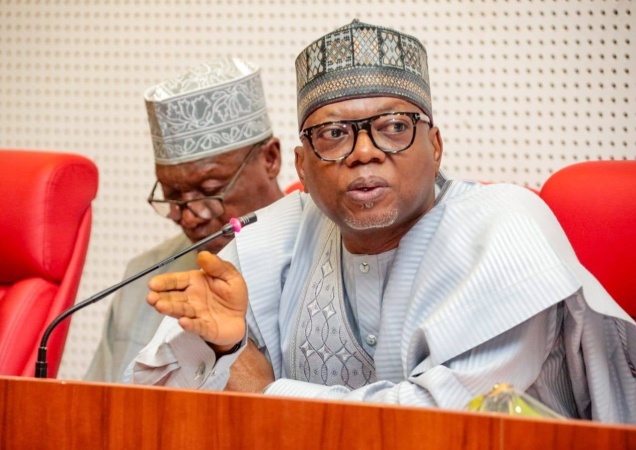
Chairman of the Senate Committee on Finance, Sani Musa
By NEFISHETU YAKUBU
The Senate on Thursday rejected the envelope budgeting system and called for a return to performance and priority-based fiscal framework that would enhance realistic implementation.
The senators stated this during the budget defence session of the Finance Ministry and an interactive meeting with the Economic Team in Abuja.
In his opening remarks, Chairman of the Senate Committee on Finance, Sen. Sani Musa, said the current envelope budgetting system was ineffective and required urgent reform.
Musa noted that the committee was troubled by persistent weaknesses in budget performance among ministries, departments and agencies appearing before lawmakers to defend their allocations.
He cited delayed fund releases, under-execution of capital projects, weak revenue remittances and poor alignment between approved appropriations and actual fiscal performance as instances.
The senator noted that such patterns have widened fiscal deficits, weakened public service delivery and steadily eroded the credibility of the nation’s budgetting framework.
Musa stressed the need for the lawmakers to raise critical macro-fiscal questions regarding borrowings approved to finance appropriation gaps in the 2024 and 2025 budgets.
He added that the committee was demanding a comprehensive fiscal impact assessment of the loans within the medium-term expenditure framework and debt sustainability analysis.
According to him, borrowings must drive productivity, infrastructure development, revenue growth and long-term expansion rather than merely providing short-term fiscal relief.
He argued that the incremental allocation model, described as the current envelope system, had outlived its relevance and hindered strategic national prioritisation.
Musa maintained that Nigeria must transition to a performance and priority-based budgetting framework tied to measurable outcomes and clearly-defined development goals.
He observed that countries, including the United Kingdom, Canada, Australia, South Africa and Indonesia had embraced outcome-based budgetting to strengthen fiscal discipline.
The chairman insisted that Nigeria could not pursue global competitiveness while operating a budgeting structure largely driven by assumptions instead of verifiable performance benchmarks.
He, however, commended President Bola Tinubu and the Economic Management Team for the bold reforms undertaken so far.
Responding, the Minister of Finance acknowledged that there was significant room for improvement in the nation’s payment methods and overall budgetary system.
Edun explained that a key feature of the current payment structure was the direct disbursement of funds to beneficiaries, eliminating intermediaries and third-party channels.
Also speaking, the Minister of Budget and National Planning, Abubakar Bagudu, noted that though Nigeria was not yet where it ought to be, the economic reforms of the president was impacting positively.
The News Agency of Nigeria (NAN) reports that the Chairman of Nigeria Revenue Service, Dr Zacch Adedeji, alongside representatives of the Central Bank of Nigeria (CBN) and NNPC, accompanied the minister.
NAN further reports that officials of Nigeria Customs Service were also present, with each agency providing detailed insights into its operations and fiscal performance. (NAN)