Updating your news feed...
NEWS EXPRESS is Nigeria’s leading online newspaper. Published by Africa’s international award-winning journalist, Mr. Isaac Umunna, NEWS EXPRESS is Nigeria’s first truly professional online daily newspaper. It is published from Lagos, Nigeria’s economic and media hub, and has a provision for occasional special print editions. Thanks to our vast network of sources and dedicated team of professional journalists and contributors spread across Nigeria and overseas, NEWS EXPRESS has become synonymous with newsbreaks and exclusive stories from around the world.
















Loading banners
Loading banners...

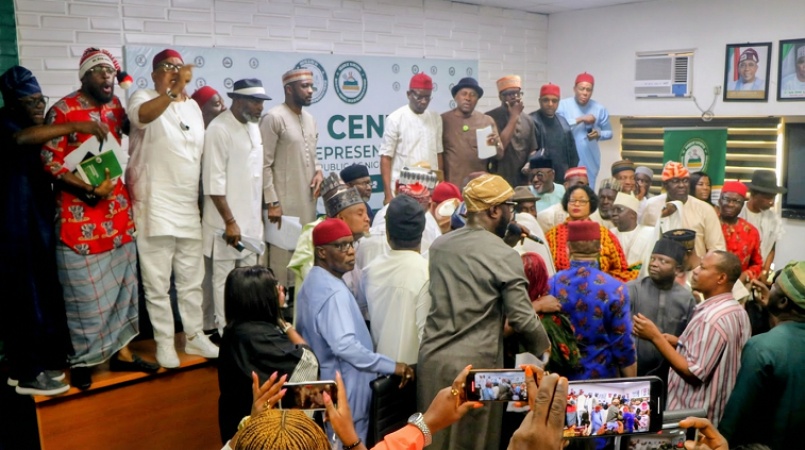
Senators voting Tuesday for the amended Electoral Act
Nigeria’s 2027 elections took shape yesterday as the National Assembly retained manual transmission as a fallback in the event of electronic failure, despite fierce opposition. This handed the ruling APC majority control over disputed transmission rules, setting the stage for legal battles and political confrontation.
After a chaotic plenary session, the House of Representatives passed the Electoral Act (Amendment) Bill, 2026, reversing its earlier decision on the mode of transmitting election results and party primaries.
The controversy in the Green Chamber centred on Section 60(3), which deals with the electronic transmission of results, as well as proposed amendments to the election timetable and the nomination of candidates by political parties.
In the upper legislative chamber, the plenary was characterised by rare turbulence, as senators clashed in a stormy showdown over the electronic transmission of election results and concerns that the 2027 general elections could coincide with Ramadan and Lent.
Like the House, the Senate began proceedings by rescinding its earlier passage of the Electoral Act 2022 (Repeal and Re-Enactment) Bill, 2026, before passing it again.
What began as a technical correction quickly escalated into sharp exchanges, procedural disputes and a physical division on the floor of the Red Chamber — underscoring the political sensitivity of reforms that will shape the 2027 polls.
Lawmakers from the ruling party demonstrated the weight of their numerical superiority by voting to retain the manipulation-prone Form EC8A as the primary document for collating election results at polling units.
Reactions quickly followed the controversial amendment to the ballot collation process, as Civil Society Organisations returned to the National Assembly for the second day of protests, demanding that lawmakers make real-time electronic transmission of election results mandatory in the proposed Electoral Act (Amendment) Bill, 2026.
Elder statesman and founder of the All Progressives Grand Alliance (APGA), Dr Chekwas Okorie, told The Guardian that the outcome of the amendment, which ran counter to what Nigerians wanted, was predetermined. He said federal lawmakers should be held liable if anything untoward happens to Nigeria’s corporate existence and democracy.
Highlights of the sitting included reducing the notification period for elections from 360 to 300 days and restricting straw polls to either the direct or consensus affirmation method.
In the Senate, where the issue of revising the dates announced by the Independent National Electoral Commission (INEC) for the 2027 polls was to be debated, lawmakers announced a recess, stating that the move was based on stakeholder input and consultations with the commission.
Histrionics ensued after a motion for rescission and recommittal was moved by the Senate Leader, Opeyemi Bamidele, who argued for a pause to enable fresh amendments that would allow INEC to adjust its timetable.
Moving the motion, Bamidele cited the Senate Standing Orders, noting that Order 526 of the Senate Rule Book stipulates that “it shall be out of order to attempt to reconsider any specific question upon which the Senate has come to a conclusion during the current session, except upon a substantive motion for rescission.”
He reminded lawmakers that the bill had been passed during an emergency sitting the previous week. He added that following the passage of the bill, INEC had published the notice of election and announced a timetable scheduling the presidential and National Assembly elections for February 2027.
While noting that concerns about the timeline were not limited to one faith, Bamidele said: “Stakeholders within the Muslim communities had reached out to INEC to say that the proposed date of February 2027 would conflict with the Ramadan exercise for 2027.
“Let me also add that even the Christian Lenten period is partly in February, dovetailing into March 2027.”
He pointed out that the 360-day notice requirement stipulated in Clause 28 of the bill constrained INEC’s flexibility. He stressed that INEC had briefed the National Assembly leadership that, in view of what was passed — requiring not later than 360 days’ notice before the election — time was already running out.
“By way of rescission and recommittal, it is our intention today to jettison what we earlier passed and then recommit the bill for consideration to enable us pass a clause that will make it possible for INEC to reschedule its timetable.”
After the debate, Senate President Godswill Akpabio put the question to a voice vote, and the ayes prevailed. The Senate then dissolved into the Committee of the Whole for clause-by-clause reconsideration.
Supporting the motion, Chairman of the Senate Committee on INEC and Electoral Matters, Simon Bako Lalong, dismissed claims that the INEC Chairman deliberately fixed the election date to coincide with Ramadan.
Lalong said: “Mr President, I rise to support the presentation made by the Senate Leader… all the reasons given are correct because all of us worked on this document for over two years.
“Let me also correct the impression making the rounds that the current INEC Chairman deliberately fixed this date, knowing fully well that it will coincide with Ramadan.
“For the benefit of those who were here in 2019, it was the former INEC Chairman who reeled out the timetable from 2019 to 2030… so this timetable is not new.”
He maintained that legislative amendments were the appropriate remedy when conflicts arise, stressing, “When it coincides like this, there are provisions made through amendments… so I stand to support the presentation.”
The debate over Clause 60(3), which stipulates manual transmission of results where electronic transmission fails due to network challenges, prompted another closed-door session that lasted about 45 minutes.
When plenary resumed, the clause split the chamber, as Senator Enyinnaya Abaribe led the opposition to the proviso, demanding a formal division to test the will of the Senate.
He objected to retaining manual transmission as a fallback, arguing that Form EC8A should not become the sole basis for result collation in the event of technical failure. At that point, Akpabio indicated that the demand for division had earlier been withdrawn — prompting immediate protests from opposition lawmakers.
Deputy Senate President Barau Jibrin invoked Order 52(6), arguing that it would be procedurally improper to revisit an issue already decided. His contribution sparked fresh tension, as the chamber became rowdy, with a brief face-off between Abaribe and Senator Sunday Karimi further heightening the atmosphere.
Senate Leader Opeyemi Bamidele, who intervened, reminded colleagues that his earlier rescission motion had reopened the bill for fresh consideration, thereby validating Abaribe’s request.
Following further deliberations, Akpabio directed Abaribe to formally move his motion under Order 72(1).
When the chamber divided, senators physically indicated their positions: 15 lawmakers opposed retaining manual transmission during network failure, while 55 voted in favour.
The majority prevailed, and Clause 60(3) remained intact.
Technical corrections and high stakes
Beyond the headline issues, lawmakers cited multiple drafting inconsistencies in the legislation — including discrepancies in the Long Title and several clauses such as 6, 9, 10, 22, 23, 28, 29, 32, 42, 47, 51, 60, 62, 64, 65, 73, 77, 86, 87, 89, 93 and 143 — which required harmonisation.
A technical committee comprising leaders from both chambers and legal drafting experts was convened to address the anomalies before final passage.
By the end of the session, the Senate had both corrected the procedural pathway for INEC to adjust its timetable and reaffirmed the contentious fallback provision on manual transmission.
The Electoral Act remains the backbone of Nigeria’s democratic architecture — governing timelines, procedures and the integrity of result management.
Yesterday’s high drama in the Red Chamber reflected the enormous stakes ahead of 2027: balancing technology with logistics, legal certainty with flexibility, and electoral integrity with religious inclusivity.
House in stormy sessions
The crisis began when Francis Ejiroghene Waive (APC, Delta) moved a motion, pursuant to Order Nine, Rule 1(6) of the Standing Orders, to rescind the Electoral Act (Amendment) Bill that had been passed earlier on December 23, 2025.
The earlier version had made real-time electronic transmission of results to the Independent National Electoral Commission (INEC) Result Viewing (IReV) portal mandatory.
Waive explained that a technical harmonisation committee comprising members of both chambers and legislative drafters had identified inconsistencies and unintended consequences in the bill, necessitating fresh consideration.
The motion triggered an uproar, forcing the House into a closed-door executive session.
Chaos over Clause 60
Upon resumption, the House dissolved into the Committee of the Whole, chaired by Deputy Speaker Benjamin Kalu. Initial attempts to consider the clauses in batches were resisted by opposition lawmakers, who demanded clause-by-clause scrutiny and insisted that each clause be debated individually.
Some members also protested the non-availability of copies of the bill under consideration, arguing that proceeding without the document would undermine due legislative scrutiny. In a bid to restore order, the Deputy Speaker ruled: “The Parliament always wins. The chair cannot ignore your concerns.”
After several minutes of heated exchanges, Kalu yielded to the lawmakers’ demands and agreed to consider the bill clause by clause.
The House eventually adopted a revised Section 60(3), aligning with the Senate’s position by retaining electronic transmission while adding a proviso for manual fallback in the event of communication failure.
The section now reads: “The Presiding Officer shall electronically transmit the results from each polling unit to the IReV portal, and such transmission shall be done after the prescribed Form EC8A has been signed and stamped by the Presiding Officer and/or countersigned by the candidates or polling agents, where available, at the polling unit.
“Provided that if the electronic transmission of the result fails as a result of communication failure and it becomes impossible to transmit the result contained in Form EC8A signed and stamped by the Presiding Officer and countersigned by the candidates or polling agents, where available, at the polling unit, the Form EC8A shall remain the primary source for collation and declaration of the result.”
Raising a point of order, Minority Leader Kingsley Chinda (PDP, Rivers) moved for exclusive electronic transmission without any fallback clause, arguing that the manual Form EC8A is susceptible to manipulation. However, his proposal was defeated by a majority of “nays.”
Similarly, an amendment by Ugochinyere Ikenga (Imo), seeking to prioritise electronically transmitted results in the event of discrepancies, was also rejected.
Amid shouts of “they have collected money” and “APC ole,” members of the minority caucus staged a walkout in protest.
Minority complaints
Briefing journalists after the plenary, Chinda insisted that the minority opposed “any clause that will give room for rigging or untoward acts.”
“Our position is clear. Elections shall and should be transmitted electronically. Where there is a conflict between the manual Form EC8A and electronically transmitted results, the electronic result should prevail. These were rejected not on merit but on party lines,” he said.
He also faulted changes to the mode of party primaries, arguing that political parties should retain full discretion to adopt direct, indirect or consensus methods.
Also addressing journalists, House Spokesperson Akin Rotimi defended the process that led to the passage of the Electoral Bill, 2026, insisting that the proper parliamentary procedure was followed despite the rowdy scenes that trailed the deliberations.
Rotimi described the sitting as “historic”, explaining that the emergency session became necessary to accommodate fresh considerations that were outside the scope of the earlier conference committee report.
According to him, while a joint harmonisation committee of the Senate and the House had concluded reconciliation of differences in the bill, new amendments required the House to first rescind its earlier passage before reconsidering the legislation.
“When you have a conference committee, it can only consider provisions already passed by both chambers. Nothing new can be introduced at that stage. But because there were evolving realities and further consultations, particularly around INEC’s timetable and public feedback, the House had to rescind the earlier version to allow those amendments to be properly captured,” he said.
While maintaining that the harmonisation committee had met extensively and completed its work, the spokesman added that leadership consultations informed the final provisions adopted during plenary. He dismissed suggestions that the House breached its rules or lacked quorum during proceedings.
“This is a parliament of records. We had a quorum. The processes were fully aligned with our Standing Orders,” he asserted.
On the controversial proviso inserted into Section 60(3), which retains manual Form EC8A as a fallback where electronic transmission fails, Rotimi said the clause was merely a safeguard.
“If results are transmitted electronically without issues, there is nothing to fear. The proviso only applies where transmission fails due to communication challenges. It is a fail-safe mechanism,” he noted.
He urged Nigerians not to view the amendment through a partisan lens, stressing that the quest for free, fair and credible elections cuts across party lines. He added that the ruling party wants credible elections just as much as the opposition.
“What played out on the floor is part of parliamentary democracy — members expressing differing views. At the end of the day, the majority carries the day.”
Rotimi further disclosed that with the third reading concluded and Votes and Proceedings adopted, a clean copy of the bill would be prepared and transmitted to President Bola Tinubu for assent.
He added that the Electoral Act remains a living document subject to future amendments based on lessons from subsequent election cycles.
“The responsibility now is for all stakeholders, including the media, to properly educate Nigerians on the full scope of the amendments,” he said.
In another significant amendment, the House reduced the period within which INEC must issue a notice of election.
Section 28(1) now provides that the Commission shall publish notice of election not later than 300 days before the date appointed for the election. Under the 2022 Electoral Act, the timeline was 360 days.
The House also amended Section 84 on the nomination of candidates.
The new provision states that political parties shall nominate candidates through direct primaries or consensus, thus effectively removing indirect primaries, which were recognised under the 2022 Electoral Act. Previously, Section 84(2) allowed political parties to adopt direct, indirect primaries or consensus.
Meanwhile, there was pandemonium on Tuesday when personnel of the Nigeria Police Force threw canisters of teargas at protesters at the main entrance of the National Assembly.
Trouble started when some protesters who had besieged the National Assembly to express their grievances attempted to forcefully gain entrance into the building.
Following the incident, protesters, especially women, were seen scampering for safety, with some falling over one another and causing panic.
Implications
In his reaction to the retention of manual collation of results, Okorie said it was clear that the ruling party, with its overwhelming majority in the National Assembly and among state governors, was in a state of panic about the anticipated verdict of the people who will cast their votes next year.
“And so, they are using their numbers in the National Assembly to subvert the popular opinion of stakeholders, because these electoral reforms have gone through all sorts of processes, including public hearings.
“Memoranda have flowed into the National Assembly from all quarters, especially INEC itself, which will conduct the election, and all made recommendations that influenced the House of Representatives’ position that Nigerians now prefer to what is happening in the Senate.
“It has become obvious that the Senate is very susceptible to manipulation and control by the Executive arm. As such, they are doing what they are doing. My advice to them is to know that if anything happens to destabilise the corporate existence of Nigeria as a result of the obnoxious provisions in the Electoral Act, they should hold themselves responsible,” Okorie warned.
He added that Nigerians would not allow a repeat of what happened in 2023, stressing that the heightened awareness and consciousness, coupled with the anger of many Nigerians living below the poverty line, would compel citizens to insist that their votes count and are properly recorded.
CSOs threaten court case
Earlier, protesters led by ActionAid Nigeria and other civic groups said their demand was clear: unconditional electronic transmission of results from polling units to the Independent National Electoral Commission’s portal.
The demonstration followed an earlier protest held last week over concerns that the Senate’s version of the amendment bill diluted provisions for real-time transmission, unlike the House of Representatives’ version, which civil society groups have endorsed.
Addressing the crowd, the Country Director of ActionAid Nigeria, Andrew Mamedu, insisted that the issue was non-negotiable, stating, “Real-time electronic transmission of results. Mandatory. Without any condition.”
Mamedu explained that while reforms have reduced irregularities in voter accreditation, the major vulnerability now lies in the transmission of results. He noted that manipulation often occurs at that stage and must be decisively addressed in the amended law.
Drawing a global parallel, he said Nigeria had no excuse for not adopting the technology.
“India has 980 million registered voters and they are able to run electronic voting and electronic transmission even though there is no network. They don’t do it with a network, but they are able to execute it and get their results,” he said.
Mamedu urged citizens to question their senators and members of the House of Representatives about their positions on mandatory electronic transmission, describing it as a simple and reasonable demand.
On his part, the Convener of Lawyers in Defence of Democracy and Human Rights, Okere Nnamdi, said the protest represented a “people’s parliament” united behind the House version of the bill. He called on the harmonisation committee of both chambers to adopt the House proposal in its entirety.
“We are calling on the committee of the House of Representatives and the Senate to harmonise the two versions of the bill and adopt in totality the House of Representatives’ version of the 2026 proposed amendment bill,” he said.
“If anything short of the House of Representatives’ version is finally endorsed and accepted by the President, I assure you that there will be over 1,000 litigations — public interest cases — against the 2026 Electoral Bill,” Nnamdi warned, stressing that civil society groups would challenge the law in court if the final version fell short of the House proposal.
The Chief Executive Officer of TAF Africa, Jake Epelle, who spoke on behalf of persons with disabilities, said credible elections were impossible without real-time transmission of results.
“No real-time transmission means no credible election. Enough is enough,” Epelle said, adding that citizens would continue to use their voices to demand electoral integrity.
He emphasised that the struggle was about protecting Nigerians’ democratic rights and ensuring that elected officials reflect the genuine will of the people.
The protesters maintained that mandatory electronic transmission would promote transparency, create a level playing field for political actors and restore confidence in Nigeria’s electoral system.
They also vowed to sustain pressure on lawmakers as the National Assembly works to harmonise the Senate and House versions of the amendment bill.
House to probe alleged teargas use on protesters at National Assembly
HE House of Representatives has said it will investigate reports of the alleged use of teargas on protesters who gathered at the National Assembly to express their views on issues surrounding the proposed amendments to the Electoral Act.
In a statement issued yesterday by the House Spokesman, Akin Rotimi, the lawmakers expressed concern over the incident and reiterated that the right to peaceful and lawful assembly is guaranteed under the 1999 Constitution (as amended).
The House described the right to protest as a fundamental pillar of democratic governance and an essential channel for citizens to participate in the legislative process, particularly on critical national matters such as electoral reforms.
While acknowledging the constitutional responsibility of security agencies to maintain law and order and protect lives and property within and around the National Assembly Complex, the House stressed that such duties must be carried out with professionalism, restraint and full respect for citizens’ fundamental rights.
According to the statement, the House Committee on Media and Public Affairs will engage relevant authorities and conduct a thorough review of the circumstances that led to the alleged use of teargas.
“Where necessary, appropriate steps will be taken in line with the oversight mandate of the House to ensure accountability and to prevent any recurrence,” the statement read.
The House reaffirmed its commitment to being “the People’s House not only in word but in action”, adding that its doors remain open to Nigerians who choose to engage the Parliament peacefully and lawfully on matters of national importance.
“At the same time, we encourage all protesters to remain within the ambit of the law and to avoid any form of incitement, provocation or conduct capable of escalating tensions.
“We must collectively strengthen the culture of civil protest in our democracy, ensuring that the exercise of rights is matched by a shared commitment to order, responsibility and mutual respect.
“Constructive civic engagement strengthens our democracy, and the House will continue to promote an environment where citizens can express their views responsibly, safely and within the bounds of the law,” Rotimi added.
Mamora warns against trivialising electronic transmission debate
A FORMER Senate Minority Leader, Olorunimbe Mamora, has cautioned political actors and democratic institutions against trivialising the contentious debate over real-time electronic transmission of election results, warning that the issue is delicate enough to destabilise the country’s democratic system if not carefully resolved.
Mamora urged key stakeholders to urgently seek a lasting solution to the controversy, noting that public trust in Nigeria’s electoral process is already fragile.
His remarks followed the National Assembly’s decision to insist that electronic transmission of results run concurrently with manual collation — a position that contrasts with the demand by many Nigerians and opposition lawmakers for full real-time electronic transmission.
Reacting to the outcome of the lawmakers’ meeting, Mamora said the legislature’s stance has placed the Independent National Electoral Commission (INEC) in a difficult and sensitive position ahead of the 2027 general elections.
According to him, the electoral umpire must exercise heightened vigilance to ensure that the next polls are as close to flawless as possible.
He acknowledged that the persistent agitation for electronic transmission stems from deep-seated distrust in the traditional method of result collation.
“The most important aspect of any democracy is voting and the transmission of results. This is where Nigerians have lost confidence, hence the overwhelming demand for electronic transmission,” Mamora said.
However, he warned against assuming that technology alone would eliminate electoral disputes, noting that even advanced democracies, including the United States, maintain backup systems to address possible glitches.
“Real-time electronic transmission also has its challenges, particularly in areas with technical disruptions,” he said, stressing that every technological system ultimately depends on human operators.
Mamora emphasised that the greater burden now rests on INEC to design and implement a process that is transparent, credible and resistant to manipulation.
“This is crucial to bridging the trust deficit Nigerians have in our electoral system,” he added.
He also called on the National Assembly to go beyond legislation and collaborate more closely with INEC to ensure that adequate safeguards and institutional frameworks are in place to guarantee credible elections in 2027.
On suggestions that the new legislative position could be challenged in court, Mamora was dismissive.
“Such efforts may prove futile,” he said, maintaining that the National Assembly followed due process in passing the Act.
His intervention underscores the growing national anxiety over electoral reforms and the high stakes involved as Nigeria moves towards another pivotal general election cycle. (The Guardian)