 ADAD
ADAD
Updating your news feed...
NEWS EXPRESS is Nigeria’s leading online newspaper. Published by Africa’s international award-winning journalist, Mr. Isaac Umunna, NEWS EXPRESS is Nigeria’s first truly professional online daily newspaper. It is published from Lagos, Nigeria’s economic and media hub, and has a provision for occasional special print editions. Thanks to our vast network of sources and dedicated team of professional journalists and contributors spread across Nigeria and overseas, NEWS EXPRESS has become synonymous with newsbreaks and exclusive stories from around the world.






















Loading banners
Loading banners...


Failure to properly align strategy, people, and resources has been largely blamed for collapse of Nigerian businesses.
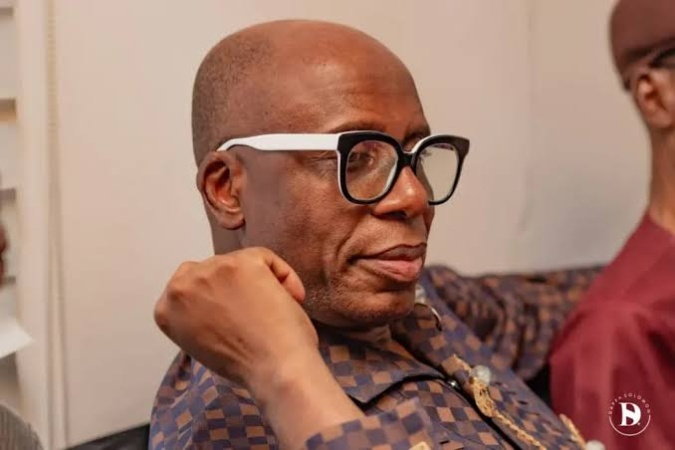
Silva Opuala-Charles, professor of economics and financial management expert, who dropped the bombshell in Port Harcourt, said such businesses risk collapse, irrelevance, and loss of competitive advantage.
Silva Opuala-Charles, President of Garden City Premier Business School, gave the warning at a lecture with theme: ‘Strategy Alignment: People, Processes and Resources” at a Mandatory Continuing Professional Development (MCPD) webinar organised by the Institute of Strategic Management of Nigeria (Chartered), where he described strategic alignment as the missing link between bold plans and real value creation.
“When the purpose of a thing is not known, abuse is inevitable,” he said, quoting leadership expert Myles Munroe. He cautioned organisations against pursuing strategies they neither understand nor align with their operating environment.
According to the economist, former banker, and onetime commissioner of finance in Bayelsa State, strategy goes beyond documentation and boardroom presentations.
“Strategy is creativity plus value. Creativity is exploration—leaving the known to the unknown. That is what Shell and Chevron did when they came to Nigeria to look for oil. Shell spent over 50 years before oil was discovered. That is strategy.”
He explained that strategic alignment determines whether an organisation merely survives or achieves market leadership.
“Strategic alignment is first about survival. Even in recession, you don’t want to close shop or lose customers. That is the minimum objective,” he said.
He went on: “The maximum objective is competitive advantage—performing above the market average.”
Citing Nigeria’s corporate leaders, Opuala-Charles pointed to Dangote Group’s dominance in cement and the strong profitability of banks such as Zenith and GTBank. “When a company is doing far above the industry average, that tells you it has competitive advantage,” he said.
Describing alignment as the bridge between strategy and value, he stressed that alignment ensures every unit of an organisation moves in the same direction.
“Alignment is what makes strategy successful. It ensures marketing, finance, human resources, and operations are all moving together. Whenever there is a gap between strategy and value, alignment is what is missing,” he said.
Drawing from renowned scholar, Peter Drucker, Opuala-Charles said alignment bridges strategy formulation and execution. “Your assumptions about strategy must be close to reality. Strategy is not speculation; it must be practical,” he said.
He also referenced Chan Kim and Renée Mauborgne’s Blue Ocean Strategy, noting that alignment must cover value proposition, profit proposition, and people proposition.
“Customers must see value, pricing must attract volume while controlling costs, and employees must be motivated to execute the strategy,” he said.
On lessons from global corporates, the professor cited former General Electric CEO Jack Welch, who insisted GE businesses must be either number one or number two in their markets. “That unrelenting focus is alignment—breaking down silos so everyone moves with speed and simplicity toward a shared vision.”
He warned that lack of alignment often leads to disruption and failure, citing global examples.
“Where are companies like BlackBerry, Nokia, and Kodak today? They failed to align with environmental and technological changes, and they were disrupted,” he said.
On technology, culture and innovation as survival tools, Opuala-Charles described technology as non-negotiable for modern organisations.
“If strategy does not align with technology, survival in the next four years will be very difficult,” he warned, noting that digital transformation accelerates growth exponentially.
“Data is money,” he said, and went on to say that is why fintech companies today are bigger than traditional banks. He said everything is going digital, and that organisations that ignore this reality would be left behind.
He also identified organisational culture as a critical determinant of success. “Culture is the operating system of an organisation. If you remove culture, the organisation collapses, just like removing iOS from an iPhone. Culture can eat strategy for breakfast if behaviours were misaligned.
Using Dangote Group as a case study, Opuala-Charles said the conglomerate’s success reflected disciplined alignment across strategy, structure, and resources.
He cited its focus on vertical integration, import substitution, and supply-chain control, as well as expansion into oil, gas, fertiliser and other sectors.
“Nigeria has talked about diversification since 1962, but Dangote achieved it as a private individual,” he said.
He went on: “That tells you what deliberate alignment and long-term vision can achieve.”
Beyond corporate Nigeria, Opuala-Charles extended his critique to governance, arguing that misalignment between leadership and citizens undermines development.
“Nigeria has beautiful plans and strategies, but what is missing is alignment. When leaders are not aligned with the people, value cannot be delivered,” he added.
He concluded that strategic alignment was essential for long-term sustainability.
“Alignment is the fundamental factor for survival and growth. It accelerates execution, improves profitability, enhances employee engagement and positions organisations for the future.
“If you refuse to realign when the environment changes, disruption is inevitable,” he further warned. (Business Day)



