ADAD
ADAD
Updating your news feed...
NEWS EXPRESS is Nigeria’s leading online newspaper. Published by Africa’s international award-winning journalist, Mr. Isaac Umunna, NEWS EXPRESS is Nigeria’s first truly professional online daily newspaper. It is published from Lagos, Nigeria’s economic and media hub, and has a provision for occasional special print editions. Thanks to our vast network of sources and dedicated team of professional journalists and contributors spread across Nigeria and overseas, NEWS EXPRESS has become synonymous with newsbreaks and exclusive stories from around the world.


























Loading banners
Loading banners...

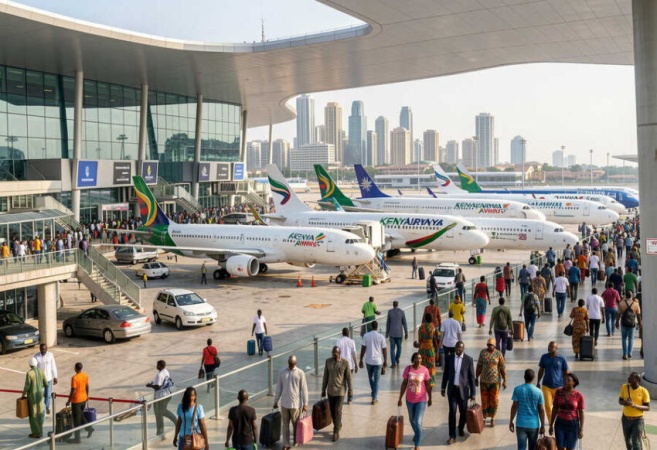
AI generated photo
Kenya’s expanding air connectivity is rapidly transforming it into Africa’s leading aviation hub, and now, Tanzania joins Uganda, Ethiopia, South Africa, and Rwanda in benefiting from this revolution. As Kenya solidifies its position as the continent’s air travel epicenter, the enhanced flight routes are not only improving regional mobility but also unlocking unprecedented economic potential. With direct connections linking major African capitals, Kenya is enabling smoother business transactions, increasing tourism flows, and fostering a stronger, more integrated African market. This connectivity is providing travelers with more accessible routes for both business and leisure, driving growth in key sectors and positioning the region for long-term prosperity.
Kenya’s aviation sector is rapidly evolving, transforming the country from a regional gateway into one of Africa’s most dynamic air travel hubs. Historically known as a bridge between East Africa and global destinations, Kenya is now positioning itself as a pivotal player in regional and continental air travel, driven by expanding connectivity that is fostering tourism, trade, and economic growth.
In 2023, Kenya recorded 2.3 million international passenger departures, accounting for 40 percent of the total passenger traffic. According to data from IATA Direct Data Solutions (DDS), a significant portion of these travelers flew to destinations across Africa, which captured 37 percent of outbound traffic. Europe and the Middle East followed with 28 percent and 13 percent, respectively. This trend is expected to grow further, with intra-African travel from Kenya projected to rise by more than 10 percent by 2025. This marks a growing importance of Kenya as a hub for regional air travel.
While long-haul connections to Europe and the Gulf remain critical, intra-African flights now dominate Kenya’s international network. Popular routes such as Nairobi to Entebbe, Addis Ababa, Dar es Salaam, Kigali, and Johannesburg have become the busiest. Airlines like Safarilink, with its Nairobi–Kisumu–Entebbe service, simplify regional travel by offering direct connections, cutting down travel time and boosting cross-border mobility. Furthermore, the national carrier’s extensive codeshare agreements with other international airlines expand connectivity across Africa, the Middle East, and Asia, offering seamless travel across continents.
This increase in regional connectivity is not just about convenience—it plays a significant role in strengthening economic ties. The rise in direct flights fosters trade, business collaborations, and cultural exchange among major African capitals, bringing previously distant markets closer together. Enhanced mobility enables African nations to exchange goods, services, and expertise in ways that were previously hindered by limited connectivity.
Kenya’s domestic air network has also become essential for internal mobility and tourism. Airlines now serve previously underserved regions, including Mandera and northern Kenya, opening new travel markets. Other carriers, such as Jambojet, Fly540, Skyward Airlines, Renegade Air, and Safarilink, connect Nairobi to various destinations like Mombasa, Kisumu, Eldoret, Malindi, Meru, Ukunda, and Vipingo Ridge. These routes not only reduce travel time but also support the growth of Kenya’s local tourism industry by linking safari parks, coastal retreats, and cultural destinations with urban centers.
Domestic routes are increasingly facilitating multi-destination travel. They allow tourists to explore Kenya’s diverse tourism offerings, including wildlife conservancies, beach resorts, cultural attractions, and investment zones. This expanded access has encouraged longer stays, contributing to the growth of local economies and the creation of more jobs, particularly in hospitality, transportation, and related services.
Kenya’s travel agents have played a crucial role in translating this connectivity into economic benefits. The Kenya Association of Travel Agents (KATA) has become a central force in the country’s travel industry. Representing a growing network of agencies across Kenya, KATA advocates for policies that strengthen the sector. The association also provides its members with essential training in digital distribution, retailing, and cybersecurity, helping them meet the demands of modern travelers while taking advantage of the expanding domestic and regional routes.
KATA members are key players in curating multi-destination travel packages, forming partnerships with airlines and international tourism organizations to offer seamless travel experiences. Additionally, KATA’s advocacy ensures that travel agents have a voice in policy-making decisions on issues like commission structures, aviation regulations, and tourism policies. This involvement helps shape an environment where travel agents can continue to thrive while promoting Kenya as a top destination for both leisure and business.
Kenya’s aviation transformation is also supported by significant infrastructure investments. Wilson Airport, which serves as a hub for domestic and regional flights, is undergoing extensive upgrades to increase its capacity and improve passenger amenities. These improvements include expanded apron space, enhanced terminal facilities, and the installation of advanced safety and navigation systems, allowing the airport to handle rising traffic volumes. This renovation is part of a broader effort to modernize Kenya’s entire airport network, including upgrades to Jomo Kenyatta International Airport, which is expanding its terminal capacity and cargo handling capabilities.
These infrastructure upgrades support the growth of Kenya’s tourism and business sectors. The expanded air links allow tourists to combine city visits, safari tours, and beach holidays in a single itinerary, which encourages longer stays and higher tourism revenues. For business travelers, quicker and more direct routes facilitate smoother conferences, meetings, and investment missions, promoting Kenya as a key business hub in East Africa.
The importance of further infrastructure development cannot be overstated. Investments in airports and air traffic management systems ensure that Kenya can keep pace with growing air traffic volumes. Improved air links foster trade, stimulate the local economy, and create jobs across multiple sectors, including hospitality, logistics, and services. For Kenya to maintain its position as a leading aviation hub, continuous investment in infrastructure, competitive pricing, and regulatory reforms will be necessary.
Kenya’s location at the crossroads of East, Central, and Southern Africa, combined with initiatives such as the Single African Air Transport Market, solidifies its role as a central aviation hub. The ongoing development of regional air routes, coupled with strategic partnerships and investments, is enhancing Kenya’s ability to connect markets that were once isolated.
Kenya’s expanding air connectivity, now including Tanzania alongside Uganda, Ethiopia, South Africa, and Rwanda, is revolutionizing Africa’s future by boosting regional trade, enhancing tourism, and unlocking vast economic potential through seamless travel and stronger intercontinental ties.
Kenya’s aviation network is not just a collection of flight routes—it is a catalyst for economic integration, regional development, and cultural exchange. The country’s expanding air connectivity, alongside infrastructure improvements and the support of the travel industry, is positioning Kenya as a key player in Africa’s tourism, commerce, and broader economic growth. (TTW)