
ADVERTISEMENT

ADVERTISEMENT

ADVERTISEMENT

ADVERTISEMENT





















Loading banners


NEWS EXPRESS is Nigeria’s leading online newspaper. Published by Africa’s international award-winning journalist, Mr. Isaac Umunna, NEWS EXPRESS is Nigeria’s first truly professional online daily newspaper. It is published from Lagos, Nigeria’s economic and media hub, and has a provision for occasional special print editions. Thanks to our vast network of sources and dedicated team of professional journalists and contributors spread across Nigeria and overseas, NEWS EXPRESS has become synonymous with newsbreaks and exclusive stories from around the world.
Tenants and accommodation seekers are no longer finding it funny as rent consumes more than half of their income. DAYO AYEYEMI reports.
This is not the best time for tenants in major Nigerian cities, as they are groaning under the excessive rental payment, despite the nation’ s economic hardship and low purchasing power.
From Abuja to Lagos, Oyo to Ondo States, tenants and accommodation seekers are experiencing the same tide, fingering callous landlords and estate agents among contributing factors.
The new rents are driving accommodation crazy while landlords have not shied to cite high cost of building materials and general inflation for rise in rental values.
Lamenting seriously, Olubukola Ozone Olanrewju, who took to social media, said that house rent in Lagos has become “absolutely unreasonable” and a serious cause for concern.
With the way things are going right now, he expressed concern that the average individuals would not be able to afford a roof over their head in the next couple of years.
“How much are people even earning that regular rooms are now in the millions?” he queried.
He said that rents for a small bedroom, popularly known as self-contained has risen to N1.5 million; and one-bedroom flat costs N3 million in Ogudu, Ajah, Ogba and Gbagada, among others.
“Then comes the extra charges: agency fee. caution fee, legal fee. agreement fee and service charge.
“By the time you finish paying all this nonsense, you’ve added almost half the rent. You’re looking for N2 million rent, but you need close to N3 million to move in. If that’s not a hoodlum’s behaviour, I wonder what is,” he fumed.
He also decried the attitude of some landlords towards the accommodation-seeking residents, saying they have taken profiling of tenants to a new level
“Landlords have taken profiling to the next level. They don’t want to give you a room unless you belong to a certain class that guarantees them you won’t struggle with subsequent payments.
“If you’re not working for a multinational company or you can’t show serious proof of income, forget it; They’ll tell you the house is no longer available, even when it’s sitting there empty,” he said.
With this kind of behaviour from both estate agents and landlords, Olanrewaju said it has become harder for people to get accommodation.
“The whole thing has created a vicious cycle. It’s harder for people to get houses. People, who already have accommodation are refusing to move out because they know moving equals financial hurricane. So, they’d rather stay where they are and keep swallowing whatever horse poo they’re being fed there. And because nobody is moving, available houses are more scarce, which in turn, drives prices even higher. It’s a crisis,” he said.
He called on the Lagos State government to do something about the scarcity of affordable accommodation and excessive rents by landlords and agents.
“This is a call for help. Because at this rate, very soon, only the rich will have roofs over their heads, and the rest of us will be sleeping under bridges or simply return to our villages.
“This is not sustainable. Housing needs serious attention and some kind of regulation, and it needs it now,” he said.
Also, a lady in Akure, Kemisola, has decried the astronomical rent increase in the Ondo state capital.
She said the situation has been made worse by estate agents, who, for selfish reasons, are increasing the burden on tenants and accommodation-seeking individuals.
She expressed surprise at reason behind a one-bedroom apartment going for N600,000 in Akure.
She said by the time the estate agents add their commission and agreement, the total package is N1 million.
She said: ‘What are we doing in Akure? Where is the work? Except the civil service and peasant farming, where is the industry, where are the multinational companies in Akure? Are we not going to eat again, send our children to school after paying our rents?
Another resident, a student at the Federal University of Technology Akure, living off campus, who identified himself simply as “David” said he was on Christmas break, when the landlord called that his rent, for a room apartment, had been increased from N140,000 to N200,000 without prior notice.
He said that the landlords in the area are aware that the university’s hostels cannot go round, due to students’ population, hence the astronomical rent increase.
Tenants protest
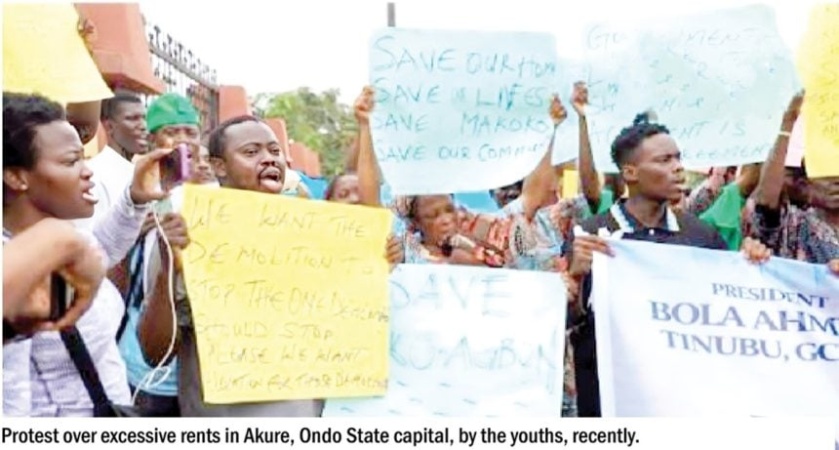
To register their grievance, tenants and many residents in Akure took to the streets two weeks ago over the excessive rents and commission fees by estate agents.
Armed with placards bearing various inscriptions and chanting solidarity songs, the youths appealed to the state government and other relevant stakeholders to urgently address the situation.
They said the increasing cost of accommodation has made decent housing unaffordable for many young residents and civil servants, forcing some to live in substandard conditions and pushing others towards homelessness.
Findings show that rents for a room and parlour self-contained around FUTA and Aule cost between N550,000 and N600,000.
Reacting to the issue raised by protesters, a member of the Ondo State House of Assembly representing Akure South Constituency 1, Hon. Olajide Oguntodu, promised to raise the matter on the floor of the House.
He assured residents that he would initiate legislative action to address arbitrary rent increases and unethical practices in property transactions, including sponsoring a bill to regulate house rent and establish a regulatory agency in the state.
Government interventions
Taking the bull by the horns, the Lagos State Government is in the process of passing into law, The Lagos Tenancy, to regulate a residential landlord-tenant relationships, capping rent advances at one year for yearly tenants and six months for monthly tenants.
It mandates written agreements, rent receipts, proper eviction notices (six months for yearly), and prohibits “self-help” forced evictions. The proposed 2025 regulations aim to cap sitting monthly tenants at three months. It’s designed to protect tenants from exploitation by providing rights to secure tenure and habitable conditions.
It has it that combined legal and agent fees should not exceed 10 percent of the annual rent.
In Ibadan, Oyo State government has commenced formal stakeholder engagements with estate agents to address the escalating cost of rent and curb the exploitative practices of intermediaries within the state’s housing sector.
The initiative, the Nigerian Tribune gathered, is aimed at establishing a sustainable regulatory framework that balances the interests of property owners, agents, and tenants.
According to a statement by the Commissioner for Information and Civic Orientation, Dotun Oyelade, the government met with the Estate Rent and Commission Agents’ Association to discuss the standardisation of professional fees.
The Commissioner for Lands, Housing, and Urban Development, Mr Williams Akin Funmilayo, led the government delegation, noting that the administration has received a rising volume of complaints regarding arbitrary rent hikes, excessive inspection fees, and non-standardised commission charges.
While Mr Funmilayo clarified that the state does not intend to impose direct price controls on rents set by property owners, he emphasised that the government holds a constitutional mandate to regulate professional practices that adversely affect the welfare of residents.
The ministry requested the estate rent and commission agents’ association to submit a comprehensive proposal outlining acceptable commission structures and ethical standards.
Experts speak
Experts in the real estate sector have predicted that one of the major trends that would play out in the Nigerian real estate investment market in 2026 is strong rental yield and steady appreciation in mid-to-upper segments of the market.
The yields and appreciation, which will happen in growth corridors of major cities like Lagos, Abuja, and Port Harcourt, are expected to hit 8 to 18 percent per annum.
In Lagos, for instance, the growth corridors that hold promise for the rental yield and steady appreciation are Lekki Phase 1, Ajah and Sangotedo, while areas like Ibeju-Lekki, Epe and Ikorodu promise high long-term capital appreciation driven by industrial and infrastructure projects, and land banking. Investors here expect to get as much as 10-35 percent return on their investment.
According to the analyst, the property market in Lagos is driven by a massive housing deficit and high urbanisation.
Meanwhile, the Housing Development Advocacy Network (HDAN) has expressed deep concern over the persistent and alarming rise in house rents across Abuja and Lagos, a trend that is fast becoming a full-blown housing emergency.
In a statement signed by the Executive Director, Housing Development Advocacy Network (HDAN), Festus Adebayo, the group called on federal and state governments, housing authorities, and relevant regulatory institutions to urgently enforce and strengthen existing tenancy and rent control laws to curb arbitrary rent increases and excessive advance rent demands.
The group wants the authorities to scale up the provision of affordable rental housing through effective public–private partnerships, and regulate short-let and serviced apartment developments to protect long-term housing supply.
It called on government to: Expand access to affordable mortgages and transparent rent-to-own schemes to reduce pressure on the rental market.
Invest in urban transport and basic infrastructure to make satellite towns viable and affordable alternatives.
Failure to act decisively, the group said, would deepen housing insecurity and undermine the social and economic sustainability of Nigeria’s major cities.
“The rising rent crisis in Abuja and Lagos must be treated as a policy priority and social emergency, not a normal market adjustment,” it said, urging government at all levels to engage stakeholders across the housing value chain and implement sustainable solutions that balance the interests of tenants, developers, and property owners, while safeguarding the right of Nigerians to decent and affordable shelter.
In recent months, HDAN said that tenants in both cities have been subjected to sudden rent increases ranging from 30 to over 70 percent, often without any corresponding improvement in housing quality, infrastructure, or basic services.
For many households, rent now consumes more than half of their income, pushing families into financial distress and forcing difficult choices around healthcare, education, and overall wellbeing.
The causes of this crisis are clear: rapid urban population growth without commensurate housing supply, rising construction and maintenance costs driven by inflation, weak enforcement of tenancy laws, excessive demand for advance rent, and the increasing conversion of residential homes into short-let and luxury apartments. Unfortunately, tenants are bearing the brunt of these systemic failures.
“Housing is not merely a commodity to be left entirely to market forces; it is a social good and a foundation for dignity, productivity, and urban stability. When workers—civil servants, teachers, healthcare professionals, artisans, and young entrepreneurs—are priced out of cities, the long-term consequences include longer commuting times, reduced productivity, informal settlements, and widening inequality,” it said. (Nigerian Tribune)


