
ADVERTISEMENT

ADVERTISEMENT

ADVERTISEMENT

ADVERTISEMENT
.webp&w=640&q=75)






.webp&w=256&q=75)
Loading banners


NEWS EXPRESS is Nigeria’s leading online newspaper. Published by Africa’s international award-winning journalist, Mr. Isaac Umunna, NEWS EXPRESS is Nigeria’s first truly professional online daily newspaper. It is published from Lagos, Nigeria’s economic and media hub, and has a provision for occasional special print editions. Thanks to our vast network of sources and dedicated team of professional journalists and contributors spread across Nigeria and overseas, NEWS EXPRESS has become synonymous with newsbreaks and exclusive stories from around the world.
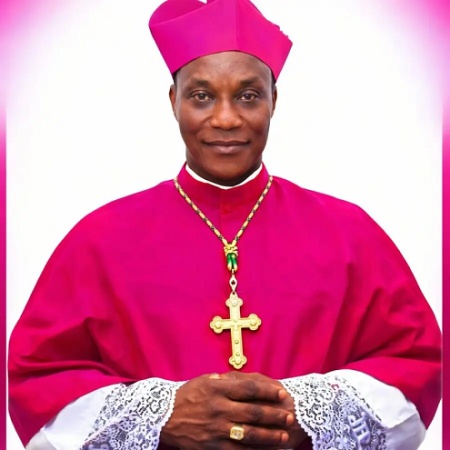
Late Bishop Emeritus John Okeoghene Afareha
By Fr. OKHUELEIGBE OSEMHANTIE ÃMOS
Today, at about 4:00 p.m., Sacred Heart Cathedral, Warri, will slip into that solemn ecclesial posture known to the Church as statio ad vigilias, that is, the funeral vigil. It is not merely an evening gathering; it is the Church standing watch beside one of her shepherds. Candles will be lit, the Paschal mystery quietly proclaimed, psalms will rise and fall in antiphonal cadence, and the body of Bishop Emeritus, Most Rev. Dr. John Okeoghene Afareha, will rest within the Cathedral that once echoed his episcopal voice.
The vigil marks the first liturgical threshold of an episcopal exequy. According to the Ordo Exsequiarum Episcopi, the Church does not rush a bishop to burial. She pauses. She remembers. She prays the Office for the Dead, listens again to the Word he once preached, and commends him, not sentimentally, but sacramentally, to the mercy of God. The presence of the College of Bishops at this vigil is itself a ritual statement: the episcopate buries its own.
With dawn on the following day comes the Funeral Mass, the Missa Exsequiarum Episcopi, celebrated in the same Sacred Heart Cathedral. This is the Church at her most articulate. The cathedral becomes what it truly is: ecclesia mater, the mother church of the diocese, gathering presbyters, deacons, consecrated persons, and the lay faithful around the altar of sacrifice. The coffin, draped simply yet eloquently, will be positioned before the sanctuary, oriented toward the altar, as befits one who lived and died configured to Christ the High Priest.
It is here that the Church teaches also by restraint. Bishop Afareha will not be enclosed in three coffins, cypress, lead, and oak, for that stratified burial belongs exclusively to the Roman Pontiff, whose office bears a universal and singular symbolism. He will not be clothed with or relieved of the pallium, for he was not a Metropolitan Archbishop. That ancient band of lamb’s wool, conferred by the Pope as a sign of metropolitan jurisdiction and communion with the See of Peter, has no place in these rites. Nor will the fractio anuli, the ritual breaking or disabling of the episcopal ring, be performed, for he did not die in sede. Having relinquished governance canonically, his ring remains unbroken, a quiet testimony to a ministry honorably completed rather than juridically terminated.
These absences do not diminish the grandeur of the rites; they refine their truth. Episcopal dignity does not depend on layered coffins, pallia worn, or rings broken. It resides in the character indelebilis of episcopal ordination, the fullness of the priesthood once conferred and never erased. A bishop remains a bishop in retirement, in frailty, and in death.
The rites will therefore speak where words fail. The crozier, the symbol of pastoral governance, will rest beside the coffin, no longer grasped, for the shepherd has laid down his staff. The mitre, sign of teaching authority, will be placed, not in triumph, but in repose, proclaiming that the bishop has finished his course. Incense will rise in dense clouds during the final commendation, as the principal celebrant performs the solemn thurification, honoring the body that once bore the fullness of the priesthood and invoking the prayer of the Church ascending before God.
And then comes the moment that bends time and awakens memory: the opening of the episcopal crypt of Sacred Heart Cathedral.
Cathedral crypts are not routinely opened; they are opened only when history knocks. Each reopening is a theological act, a reminder that the episcopate is a living succession, not a collection of isolated tenures. The crypt, long sealed in silence, receives again the body of a successor of the Apostles. Its reopening signifies continuity, successio apostolica made visible in stone and space. It is the Church saying, once more, that bishops do not disappear into anonymity; they are gathered into the lineage of those who taught, sanctified, and governed before them.
Uncommon to many is the fact that bishops are buried with the insignia of their order: the mitre upon the head, the crozier laid beside the body, the Book of the Gospels placed upon the coffin, silent witnesses to teaching authority exercised and now surrendered. The funeral liturgy itself follows the Ordo Exsequiarum Episcopi, a text rich in scriptural and patristic resonance, deliberately distinct from that of priests or lay faithful. In these rites, the Church does not mourn; she remembers who she is.
Before the committal, In Paradisum will be intoned, that ancient chant that has escorted bishops, priests, monks, martyrs, and missionaries for centuries: “May the angels lead you into paradise; may the martyrs receive you at your coming.” It is one of the most moving moments in Catholic ritual life, where chant, incense, silence, and earth converge. Here, the Church releases her bishop into God’s keeping.
Thus, Warri Diocese is not merely hosting a funeral. It is enacting ecclesiology and reliving eschatology. From the vigil to the requiem, from the thurification to the sealing of the crypt, every gesture proclaims that the death of a bishop is not a private loss but a public, sacramental event. The world may see crowds and vestments; the Church sees something deeper: a shepherd returning to the Lord of the flock, and a diocese inscribing another chapter into its sacred memory.
In these rites, the Church does not simply bury a man. She hands over a bishop to his Maker.
Eternal rest grant unto him, O Lord, and let perpetual light shine upon him.
•Fr. Dr. Okhueleigbe Osemhantie Ãmos is a priest of the Catholic Diocese of Uromi and a Lecturer at CIWA, Port Harcourt, Nigeria.


