 ADAD
ADAD
Updating your news feed...
NEWS EXPRESS is Nigeria’s leading online newspaper. Published by Africa’s international award-winning journalist, Mr. Isaac Umunna, NEWS EXPRESS is Nigeria’s first truly professional online daily newspaper. It is published from Lagos, Nigeria’s economic and media hub, and has a provision for occasional special print editions. Thanks to our vast network of sources and dedicated team of professional journalists and contributors spread across Nigeria and overseas, NEWS EXPRESS has become synonymous with newsbreaks and exclusive stories from around the world.


Loading banners
Loading banners...

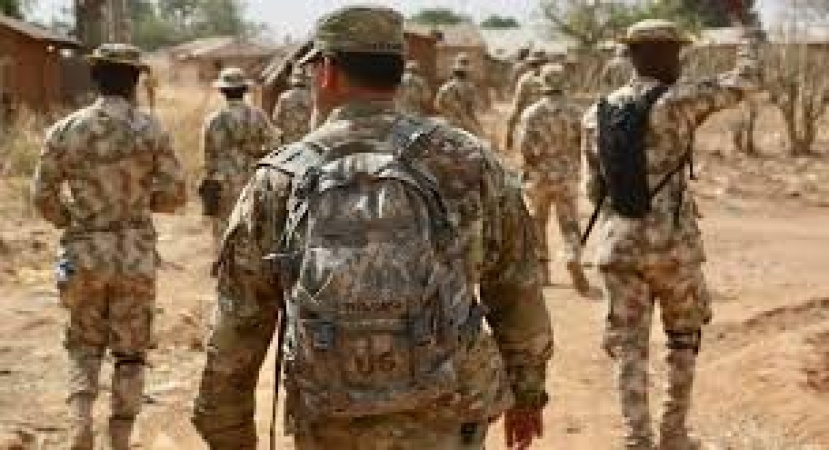
US troops
The deployment of a contingent of United States military advisers, which arrived in the country recently, is causing debates controversies among some groups, ethnic nationalities and others.
The US military advisers, it was gathered, are essentially in the country to provide behind-the-scenes advice and technical support in the area of intelligence gathering, interpretation and application in the fight to counter the widespread, worsening and deepening attacks by Sahelian terrorists, ranging from ISWAP, Lakurawa and Ansaru to Boko Haram.
While groups like the Middle Belt Forum (MBF), Northern Christian Elders Forum and several other notable personalities commended the deployment of the US team of military advisers, the Coalition of Northern Groups condemned the move even as the Northern Elders Forum (NEF) has kept sealed lips on the development.
For beleaguered communities that had borne the traumatic impact of frequent and more daring murderous attacks by the terrorists, who turned extensive swaths of Nigeria’s territory into their fiefdoms or ungoverned areas, the announcement that the United States would deploy military personnel in the country felt like cold water given to a thirsty person on a hot, dry day. It was eagerly received by them. It was a significant indication that the quest to combat insurgency, banditry and rising insecurity in country was about to assume an international dimension.
The announcement by US African Command, which came few weeks after the United States military carried out a daring Christmas Day bombardment of terrorist hideouts in Sokoto, seemed to reinforce the sense that Nigeria’s security war had entered a new phase with global partners becoming more directly involved.
Speaking during a virtual press briefing, General Dagvin Anderson, Commander of the United States Africa Command (AFRICOM), confirmed that the US would send a small contingent of military personnel to Nigeria. Anderson had explained that the decision followed high-level engagements between both countries and was part of a broader strategy to strengthen regional security cooperation.
“We are looking at working in West Africa,” he said. “A great example of that is the partnership we have had with Nigeria. I attended the Aqaba Process meeting in Rome late last year, hosted by the Prime Minister of Italy and the King of Jordan, which focused specifically on the terrorist threat in West Africa.”
According to him, that meeting provided an opportunity for direct engagement with President Bola Tinubu, where both leaders agreed on the need for deeper collaboration in tackling regional insecurity.
“That has led to increased collaboration between our nations, including a small US team that brings unique capabilities to augment what Nigeria has been doing for several years,” Anderson added.
The announcement triggered public debate, and several individuals raised questions about the sovereignty of the country. Seeking to clarify the situation, and given its sensitivity, the Federal Government speaking through the Minister of Defence, General Christopher Musa, made it clear that the US personnel would not be involved in direct combat operations. Rather, he said, they would function strictly as advisers, providing intelligence support and specialized training to Nigerian forces.
“These are not combat troops,” Musa emphasized. “They are here to assist us with intelligence gathering, capacity building and technical support as part of existing bilateral cooperation.”
The government’s explanation apparently did not win over the National Coordinator of the Coalition of Northern Groups (CNG), Comrade Aliu Jamilu Charanchi, who warned that the action could inflame political tensions in the country.
Charanchi said his group unequivocally condemned the deployment of U.S. military troops on Nigerian soil, describing it as a direct affront to Nigeria’s sovereignty and a dangerous concession of the nation’s independence.
He posited that no responsible nation with full control of its destiny should outsource its security or permit foreign boots on its territory under any pretext.
“We caution the federal government that such actions risk undermining public confidence, inflaming political tensions, and entangling Nigeria in external strategic interests that may neither reflect nor protect the welfare of our people,” he stressed.
Nigeria’s security problems, he emphasized, demand patriotic leadership, strengthened local institutions, and home-grown solutions not external intervention that compromises the dignity and autonomy of the country.
Leaders of impacted communities weigh in
In multiple reactions, leaders of some groups and notable personalities whose people are at the epicentre of the insurgency and on-going wholesale attacks endorsed the deployment of the US military advisers.
President of Middle Belt Forum (MBF), Dr Bitrus Pogu, described it as a welcome development that would help to liberate the Middle Belt from the shackles of the far north.
Dr Pogu said he was not surprised, given that the government had previously cooperated in terms of allowing the US to fire missiles to take out terrorists.
“We know that there are lots of conspiracies within our security forces, and they also know that, given the fact that they have been monitoring what is happening in Nigeria.
“In some period, it will require a third workforce, and I believe those who have come in will cooperate with friendly and trusted groups within the military, helping them in up-to-date training and techniques to be able to root out insurgency in Nigeria.
“Those opposed to that would say that Nigeria is a sovereign nation. Yes, but, has the country been able to defend its people? Since 2009 that Boko Haram started, has the country been able to defeat them? We need assistance and we thank God that it has come in whichever form.
“For us in the Middle Belt, it is a welcome development. Let’s get rid of insurgency so that we can live as a peaceful people in our country; so that our people who have been displaced from their ancestral lands will go back to their lands and live normally,” Pogu said.
On why the core north is not comfortable with the development, Pogu said that the far north would always oppose anything they feel is against their interest, noting that subduing people and using all techniques for political dominance, whether religion, or whatever techniques is okay for them.
This new development, he emphasised would reverse whatever they have done, and whatever they think they have achieved, adding: “Let’s start from where Boko Haram began in the Northeast. There are thousands of people from Gwoza Local Government Area of Borno State, who are in Cameroon. Majority of these people are Christians and the government of Borno has been ensuring that these people never come back. For what?
“It is for political reasons, and they feel Christians are not their priority. Now, in this kind of situation, certainly they won’t be happy.
“Remember the statement of the lady minister from Katsina. She said that any ticket that does not include the Fulani, the Hausa, and the Kanuri will face problems. So, as far as they are concerned, these are the only tribes who are supposed to be first class in this country. Any other one is second class, third class, or whatever.
“The coming of the Americans will help to destroy these insurgents, which the far north is using, and everybody will be brought to a level ground. The far north is benefiting because of the intervention of the British.”
Northern Christian elders happy over deployment
Chairman of the Northern Christian Elders Forum, Elder Sunday Oibe, affirmed that Nigeria needs collaboration in the area of security to counter the activities of bandits and terrorists across the country.
Oibe said: “The deployment of military troops in Nigeria by the US shouldn’t be an issue of surprise to any Nigerian. US President Donald Trump sometimes last year promised that American boots would be on the ground if the activities of bandits against Christians and Nigerians did not abate.
“It’s my belief that every Nigeria is happy with the coming of the American soldiers if their coming will put an end to the evil activities of these criminal elements in our society. Anything that can put an end to the criminal activities of these bad people is a welcome development
“Also, do bear in mind that the boots of American soldiers cannot touch the soil of Nigeria without the knowledge and agreement of the Nigerian government. We have been shouting that the government needed help and now that the help has come, why are some people sad? Is it because the sources of their business will soon crippled? Nigeria needs collaboration in the area of security to counter the activities of Bandits and terrorists in Nigeria”. Elder Oibe said.
A security and international affairs expert, Dr. Ody Ajike, said the US military deployment has changed the nation’s defence, security, and political complexions, and Nigeria will not be the same going forward. He said that the US deployment has many implications, pointing out the British handed over Nigeria at independence to the Fulani who have deeply destroyed this country.
The US, he noted, has always had military advisers working with Nigerian Armed Forces.
His words: “But we have never had strategic autonomy in our national defence and security. The US deployment reveals that strategic defect. This further rolls back our political sovereignty. We cannot determine our issues alone going forward though we have never in the past decided our national challenges alone without external interference. All the coups we have experienced, including the last political coup against President Jonathan, had external dimensions.
“One other formidable implication is that, this may lead to a regime change. The US understands that terrorism is on a roll and our government has not shown the capacity of taming this evil.
“Strategically, they have subtly intervened in Nigeria to obstruct Russia and China from exerting influence in Nigeria. This is under the pseudo-pretence of Christian solidarity and insecurity. That deployment will grow in the long term because it’s a veiled occupation of our country to further US geopolitical interest.
“This US military deployment has changed our defence, security, and political complexions. It elicits further US interventions in our domestic affairs and Nigeria will not be the same going forward.”
While acknowledging Nigeria’s right to seek foreign military cooperation, such arrangements must comply with constitutional provisions, said former Chairman of the Nigerian Bar Association (NBA), Ikeja Branch, Dave Ajetomobi, when he commented on the US move to support Nigeria’s fight against terrorism.
Ajetomobi noted that several countries currently host American troops under established defence agreements, citing the long-standing presence of U.S. forces in parts of Europe and Asia through the North Atlantic Treaty Organisation (NATO).
However, he expressed concern over what he described as the lack of transparency surrounding the deployment in Nigeria, stressing that such military arrangements should not be carried out secretly.
“By our laws, such arrangements must be sanctioned through a resolution of the National Assembly,” he said, adding that Nigerians might not have been aware of the development if the American authorities had not made it public.
He argued that the circumstances surrounding the deployment raise questions, suggesting that the Federal Government may have been pressured into accepting the arrangement due to prevailing challenges in the country.
“It is not impossible that the U.S. leadership may have bullied the Federal Government into accepting it. Unfortunately, given the current issues confronting the country, the government may not have had much choice,” he stated.
Ajetomobi also recalled that for years, members of the National Assembly, including Senator Ali Ndume, alongside other political figures, had urged the Federal Government, particularly during the administration of former President Muhammadu Buhari, to seek foreign assistance in combating insecurity.
He said the government could rely on such past calls to justify the decision, but he warned Nigerians to be cautious.
“Knowing the nature of U.S. foreign policy, this could turn out to be a Greek gift,” he said.
US deployment not illegal invasion
A Lagos-based legal practitioner and rights activist, Maduka Onwukeme, characterized the deployment as a product of bilateral security agreements between both countries, insisting that the presence of foreign troops does not amount to an illegal invasion.
Onwukeme said the deployment is rooted in longstanding military cooperation between Nigeria and the United States, particularly following the September 11, 2001 attacks in the US, which led Washington to enter into several bilateral and multilateral security agreements across the world in pursuit of its global war on terrorism.
He said Nigeria and other African countries became part of this framework with the establishment of the United States Africa Command (AFRICOM). Onwukeme recalled that while it was once suggested that Nigeria should host AFRICOM, the late President Umaru Musa Yar’Adua rejected the proposal over concerns that it could translate into the establishment of a permanent US military base in the country.
He noted, however, that the rejection did not halt military cooperation between both nations, especially in the area of counter-terrorism.
He called on the Federal Government to be more transparent about the scope and extent of US military involvement in Nigeria’s security affairs, stressing that while security matters are sensitive, adequate institutional oversight remains crucial.
Onwukeme urged the National Assembly, particularly its Committees on Defence, to be fully briefed on the nature of the security cooperation between Nigeria and the United States and to provide effective oversight to ensure that Nigeria’s sovereignty and national security are not compromised.
Former Permanent Secretary, Ministry of Foreign Affairs, Ambassador Bulus Lolo, has said it was too early to predict the outcome of the deployment of United States military to Nigeria.
Speaking with Sunday Sun, Lolo, a former Nigerian Ambassador to Ethiopia, the African Union (AU) and the United Nations Economic Commission for Africa (UNECA), also said the American Government could not have deployed its military to Nigeria without the authorisation of the Nigerian Government.
Lolo further recalled that after Nigeria was designated as a Country of Particular Concern, it reached out to the United States over the security challenges in the country.
“It introduces a new dimension to Nigeria’s security overall where America has never had its troops on ground in Nigeria. But where you have American troops, it only means there is also a strategic interest that goes with it. Now, it can cut both ways wherein the deployment can be a plus or minus for us.
“If having American troops will enhance our capabilities and capacities, then it is a most welcome development; if it will address the insecurity we are facing.
“American troops are not going to be everywhere around the country, so it depends on where they are going to be deployed. So, it is too early to say anything because it is just the beginning. But looking at other places where American forces have been deployed, one would not rush to say it has dramatically changed the dynamics on ground,” Lolo said.
Also speaking, a former Permanent Secretary, Ministry of Foreign Affairs, Ambassador Joe Keshi, said the deployment of United States forces to Nigeria was not new.
Keshi, a former Nigerian Consul-General in Atlanta, United States, explained that the country has had United States military’s presence in Nigeria.
“They have been around to do training for our soldiers, although, one or twice, it didn’t go too well,” Keshi said, recalling that one of the problems a former Chief of Army Staff had with the then president was that as Chief of Army Staff, he was not happy to have the US military on ground in Nigeria.
“So, these ones are going to be involved in helping to beef up the military, but they are not going to fight. I think they are going to help strengthen one thing or the other for the Nigerian military and offer advice, offer intelligence, support and the rest of it,” Keshi also said.
Keshi added that the country shouldn’t be shy of getting help and cooperation from those who can help the nation to beef up the military’s strength.
He acknowledged that the United States was already supplying Nigeria with arms and ammunition.
“So, these guys are there to also help you. They have some more sophisticated ones that they are giving to you. Their job is to help train your officers to know how to use the equipment.
“I have no negative feelings about their being here for the simple reason that in one way or the other, the Nigerian Government must find a way to permanently end this insecurity situation. It has gone on for too long; lives have been lost and it is time we stop the killing as I have always said,” Keshi said. (The Sun)



