
Updating your news feed...
NEWS EXPRESS is Nigeria’s leading online newspaper. Published by Africa’s international award-winning journalist, Mr. Isaac Umunna, NEWS EXPRESS is Nigeria’s first truly professional online daily newspaper. It is published from Lagos, Nigeria’s economic and media hub, and has a provision for occasional special print editions. Thanks to our vast network of sources and dedicated team of professional journalists and contributors spread across Nigeria and overseas, NEWS EXPRESS has become synonymous with newsbreaks and exclusive stories from around the world.

























Loading banners
Loading banners...

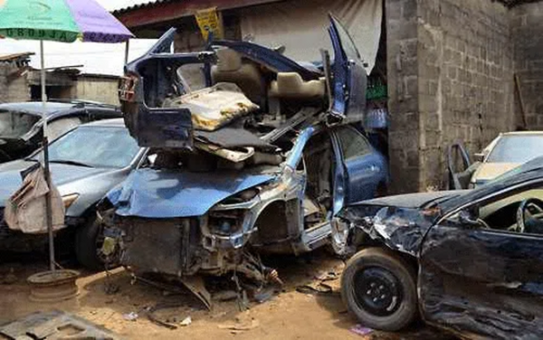
From 2026, Nigerians buying or registering vehicles will be required to pay a mandatory recycling fee as the Federal Government moves to overhaul the country’s automotive industry.
The policy, approved under the End-of-Life Vehicle programme, is designed to formalise vehicle disposal, curb the influx of unroadworthy imports, and unlock a recycling market projected to generate over ₦150 billion annually.
Beyond revenue, the reforms are expected to create jobs, protect the environment and mark a major turning point in Nigeria’s auto sector.
1. Recycling fee begins in 2026
The Federal Government plans to introduce a mandatory vehicle recycling fee at the point of vehicle registration starting from 2026.
2. Policy approved under End-of-Life Vehicle (ELV) programme
The initiative is part of a comprehensive End-of-Life Vehicle programme already approved for implementation by the government.
3. Revenue projection exceeds ₦150bn annually
Government estimates show the programme could generate over ₦150 billion every year by formalising vehicle recycling.
4. Fee will fund safe vehicle disposal
The recycling fee will be used to ensure environmentally sound disposal and recycling of vehicles that are no longer roadworthy.
5. Modelled after global best practices
The policy mirrors systems in developed countries where buyers pay upfront for end-of-life vehicle disposal during registration.
6. Public resistance expected initially
Authorities acknowledge the policy may face pushback from Nigerians when it is first introduced.
7. Over 85% of old vehicle parts are reusable
Studies show that most components from end-of-life vehicles can be reused or recycled, supporting a circular economy.
8. Informal auto parts market to be formalised
Nigeria’s popular “Belgian parts” market will be better structured under the new recycling framework.
9. Job creation across multiple sectors
The recycling ecosystem is expected to create thousands of jobs in dismantling, refurbishing, logistics and resale.
10. Used vehicle imports surged in 2025
Passenger vehicle imports rose to about ₦1.01 trillion in the first nine months of 2025, reflecting renewed demand.
Related News
11. Tokunbo vehicles remain dominant
The fairly used vehicle segment continues to drive Nigeria’s auto market despite high costs and import dependence.
12. Pre-export certification becomes mandatory in 2026
All used vehicles imported into Nigeria must undergo certification before export to prevent dumping of end-of-life vehicles.
13. Exporters will bear certification costs
The cost of pre-export certification will be paid by foreign exporters, not Nigerian buyers.
14. Nigeria currently lacks import safeguards
The absence of certification requirements has made Nigeria a dumping ground for unroadworthy vehicles.
15. Push for EV and CNG vehicle conversion
Government plans include converting petrol and diesel vehicles to electric vehicles (EVs) and compressed natural gas (CNG).
16. Training and certification underway
NADDC has begun training regulators and industry players in EV maintenance and CNG retrofitting.
17. Formal EV and CNG certifications by 2026
National Occupational Standards and certification programmes are expected to commence by 2026.
18. Local vehicle design gaining momentum
Nigerian engineers and universities are developing tricycles, buses and electric shuttle vehicles.
19. Component manufacturing is a priority
Nigeria spends more on importing vehicle components like tyres and batteries than on complete vehicles.
20. Auto Industry Bill in the works
Government plans to convert the National Automotive Industry Development Plan into an Act of Parliament.
21. 2026 seen as a turning point
Authorities describe 2026 as a pivotal year for Nigeria’s automotive industry reform and modernisation. (The Nation)




