ADAD
ADAD
Updating your news feed...
NEWS EXPRESS is Nigeria’s leading online newspaper. Published by Africa’s international award-winning journalist, Mr. Isaac Umunna, NEWS EXPRESS is Nigeria’s first truly professional online daily newspaper. It is published from Lagos, Nigeria’s economic and media hub, and has a provision for occasional special print editions. Thanks to our vast network of sources and dedicated team of professional journalists and contributors spread across Nigeria and overseas, NEWS EXPRESS has become synonymous with newsbreaks and exclusive stories from around the world.






Loading banners
Loading banners...

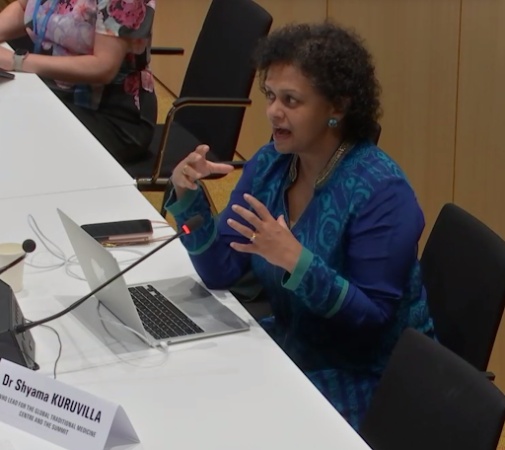
Dr Shyama Kuruvilla, Director, WHO Global Traditional Medicine Centre
By KEMI AKINTOKUN
With half of the global population lacking access to essential health services, the World Health Organisation (WHO) is scaling work on traditional medicine as part of efforts to meet global demand and health needs.
Dr. Shyama Kuruvilla, Director of WHO Global Traditional Medicine Centre, said this during a virtual media briefing ahead of the second edition of the WHO Global Summit holding from Dec. 17 to Dec. 19 in New Delhi, India.
Kuruvilla said traditional medicine is now a global reality, noting that about 90 per cent of WHO member states report its use amongst 40 to 90 per cent of their populations.
She said earlier this year, all WHO member states adopted the WHO Global Traditional Medicine Strategy 2025 to 2034, which guides work on evidence, regulation, systems integration, and multi-stakeholder collaboration rooted in community engagement.
“With half the world’s population lacking access to essential health services, traditional medicine is often the closest or only care available for many people, and for many others it’s a preferred choice because it is personalised and holistic.
“It’s bio-culturally aligned and it supports overall well-being rather than only treating specific disease symptoms.
“There is also an extensive and diverse global workforce that provides traditional medicine services from community-based healers to university-educated clinicians and researchers.
“Global demand is rising due to chronic diseases, mental health needs, stress management, and the search for holistic, personalised, meaningful care,” she said.
The Director said concerns about safety and efficacy associated with traditional medicine could be addressed.
She noted that WHO’s role is to help countries ensure it is safe, evidence-informed, and equitably integrated into systems, just like any other medicine.
“It is clear that advancing traditional medicine is an evidence-based ethical and environmental imperative, and the global summit aims to foster the conditions and collaborations required for traditional medicine to contribute at scale to the flourishing of all people and our planet.”
The Director said WHO is launching global goods, including a traditional medicine global library that already has over 1.6 million scientific publications and records, as well as a global research priority roadmap based on regional consultations.
She said the summit would be a turning point, highlighting government leadership, civil society action, systemic global gaps, and opportunities for multilateral collaboration, as well as innovation in all countries.
Also, Dr Sylvie Briand, WHO Chief Scientist, said millions of people worldwide use some form of Traditional, Complementary, and Integrative Medicine (TCIM), offering a wide range of treatments and approaches applied in different circumstances.
Briand said the diversity is an asset that represents countless potential solutions to health problems.
She highlighted the challenges it poses for science, noting that science’s role is to apply rigorous methods to assess the safety, usefulness, and efficacy of drugs, treatments, and approaches.
She said: “Evidence-based medicine relies on standardised methods and reproducible results across different contexts.
“In other words, when a medicine works in one country, we expect it to work for patients in another. But why is it so difficult to standardise TCIM? First, because of the immense variety of methods, drugs, and approaches.
“TCIM often treats each patient as unique, considering not only the current condition, but also the overall health and environment, while many traditional practises are transmitted orally, rather than taught in formal schools, leading to personalised approaches that vary by healer.”
The scientist noted that AI can screen millions of compounds, helping to understand herbal products’ complex structure and extract relevant constituents to maximise benefits and minimise adverse effects, just as artemisinin revolutionised malaria treatment.
She said WHO had developed a global research agenda for traditional medicine, providing a roadmap that guides investment, prioritises research, and ensures ethical principles and human rights are respected.
Briand disclosed that global investment in traditional medicine research remains very low, noting that more investment should be committed to TCIM to meet current prevailing health challenges, such as mental health, chronic diseases, and inequities in access to care.
“By increasing investment and aligning efforts through the research agenda, we can unlock the full potential of TCIM to complement modern medicine and improve health outcomes worldwide.”
She said WHO had taken a major step forward by publishing a special issue of its bulletin dedicated to TCIM, spanning topics from original research papers to indigenous peoples’ rights and respectful knowledge exchange.
According to her, the landmark publication reflects WHO’s commitment to advancing science while honouring cultural heritage. (NAN)