Updating your news feed...
NEWS EXPRESS is Nigeria’s leading online newspaper. Published by Africa’s international award-winning journalist, Mr. Isaac Umunna, NEWS EXPRESS is Nigeria’s first truly professional online daily newspaper. It is published from Lagos, Nigeria’s economic and media hub, and has a provision for occasional special print editions. Thanks to our vast network of sources and dedicated team of professional journalists and contributors spread across Nigeria and overseas, NEWS EXPRESS has become synonymous with newsbreaks and exclusive stories from around the world.





















Loading banners
Loading banners...

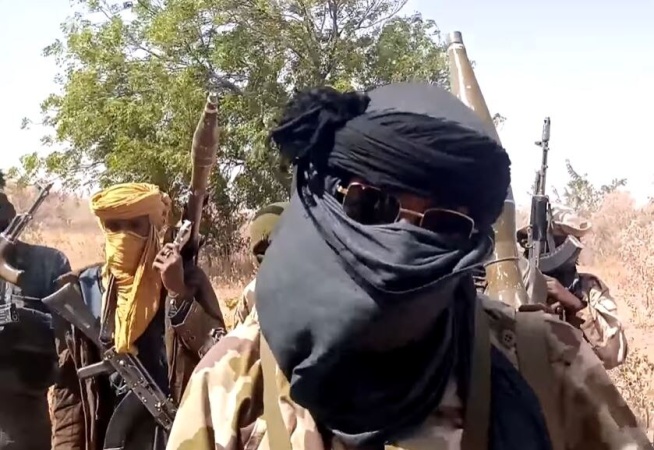
Dangerously-armed bandits
By Fr. OKHUELEIGBE OSEMHANTIE ÃMOS
Nigeria stands today on the edge of a widening chasm; a nation trapped in a cycle of terror that has grown so familiar that it now competes with our daily routines. Banditry has ceased to be an episodic disturbance; it has become a grim architecture of fear that frames the lives of millions. Schools are no longer sanctuaries of learning but potential battlegrounds; churches, once havens of prayer, have become vulnerable entry points for marauders; homes, the last refuge of dignity, now tremble at the rustle of leaves at night. What we face is not mere insecurity but a slow, methodical dehumanisation.
From time to time, bands of armed men sweep through communities with a cold efficiency that mocks every claim of state authority. They scoop up children whose innocence should be wrapped in safety; they seize teachers, school heads, and church leaders whose only fault is service; they drag them into forests where daylight is meaningless and where the thin air is saturated with dread. Families left behind oscillate between helpless prayers and agonising silence, never knowing whether their loved ones are alive, tortured, or buried in unmarked soil.
Yet, whenever the state manages to retrieve a handful of victims, the nation is instructed to celebrate. Officials wear triumphant expressions; headlines trumpet the word “rescue” as if that single act wipes away the brutality that preceded it. But it is not sufficient to rescue them. The real story unfolds in the shadows—stories that never make it into official statements.
No one tells us how the reclaiming happens. No one explains the negotiations, the compromises, or the unspoken prices. No one accounts for the teachers who resisted and were shot on the spot. No one remembers the school heads who lacked the stamina to survive the forced marches. No one acknowledges the church workers who were executed because they had no bargaining value. Their deaths vanish into the folds of bureaucratic silence, reduced to footnotes in a nation that has grown numb to its own tragedies.
The rescued return, but in what condition? A child who has trekked through hostile terrain, listened to gunshots at close range, watched adults collapse from hunger, and lived at the mercy of drugged gunmen does not simply resume life. A teacher who has spent nights tied to a tree does not walk back into a classroom with equilibrium. Parents who have spent weeks negotiating with shadows carry invisible wounds that will not heal. Trauma is not a chapter that ends with reunion; it is a lifetime disorder that creeps into sleep, memory, relationships, and trust.
The public never sees these ruins. The state does not speak of them. Society does not inquire. We applaud the return of bodies and ignore the destruction of souls.
The post-traumatic damage is incalculable. Many of the abducted are not physically or mentally strong enough to endure the reckless trekking, exposure, and deprivation forced upon them. Some die quietly after their return, felled by complications that owe their origin to the forest. Some never regain psychological balance. Others lose interest in schooling, faith, or human interaction. Their future fractures at the point of abduction, yet the nation pretends they have merely “resumed life.”
To present rescue as victory is a national self-deception. The true measure of progress is not the number of abductees retrieved but the number of communities safe from the threat. Until Nigeria prevents abductions, dismantles the networks, dries up the supplies, secures rural spaces, strengthens intelligence, and restores accountability, we will continue to oscillate between grief and shallow celebration.
We must confront the harsh truth: the forest is still a republic of criminals, a parallel authority that dictates its own rules while the nation responds with periodic statements and ceremonial outrage. It is a dangerous illusion to think we are winning because the kidnapped occasionally return.
It is not sufficient to rescue them; let us stop the banditry. Only then will schools cease to be ambush points, churches reclaim their sanctity, homes recover their calm, and children dare to dream again.
• Fr. Okhueleigbe Osemhantie Amos, PhD, is of the Catholic Institute of West Africa (CIWA), Port Harcourt, Nigeria.