Updating your news feed...
NEWS EXPRESS is Nigeria’s leading online newspaper. Published by Africa’s international award-winning journalist, Mr. Isaac Umunna, NEWS EXPRESS is Nigeria’s first truly professional online daily newspaper. It is published from Lagos, Nigeria’s economic and media hub, and has a provision for occasional special print editions. Thanks to our vast network of sources and dedicated team of professional journalists and contributors spread across Nigeria and overseas, NEWS EXPRESS has become synonymous with newsbreaks and exclusive stories from around the world.





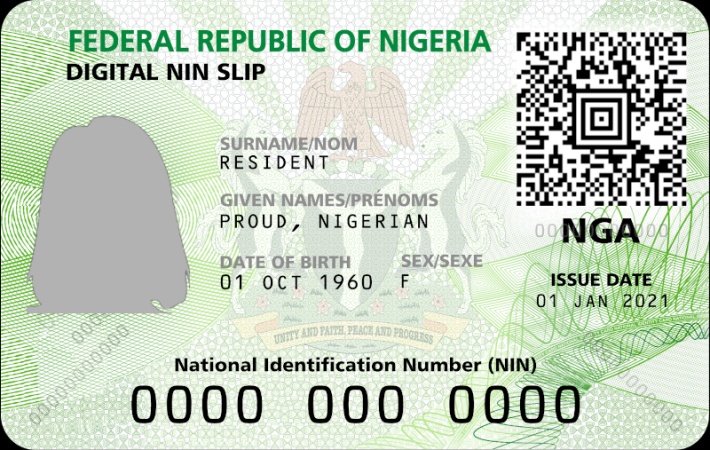
Sample of the digital National Identity Card with NIN on it
The National Identity Management Commission (NIMC) said the number of Nigerians and legal residents with the National Identity Numbers (NINs) has hit 120.04 million, but cases of insecurity reported across the country have equally ballooned.
With more than half of the country?s population now having their data and identities captured in the NIMC and by extension security agencies? database, the cases of insecurity have yet to reduce, forcing many Nigerians to question the rationale behind NIN (SIM) registration and capturing.
They are saying the rising spate of kidnapping and killings in the country is casting doubt on whether the NIN policy is being utilised for the purpose for which it was introduced.
Media reports have indicated that between January and April more than 100 persons were kidnapped across states and the Federal Capital Territory (FCT).
to 2025, 2,242 persons were reportedly abducted in 2020; 4,987 in 2021; 2,076 in 2022; 3,063 in 2023 and about 2,206 in 2024.
Within the period under review, bandits and kidnappers killed a total of 11,042 persons across the country: 837 in 2020; 4,169 in 2021; 2,310 in 2022; 2,586 in 2023 and 1,110 in 2024 and about 30 this year, according to media reports available to this reporter.
These are aside from the reported killings of 1,569 persons by Boko Haram insurgents in the North East within the period: 747 in 2020; 260 in 2021; 192 in 2022; 268 in 2023; 120 in 2024 and 35 this year.
This is despite the fact all the mobile lines and active SIM cards have been linked to their owners? NINs. The total number of active mobile lines in Nigeria stands at 155 million.
lecom operators in the country have said the security agents rather than the operators should be asked why many kidnappers and bandits using registered SIM cards to commit crimes have not been apprehended.
Speaking recently at a colloquium on ?A Legislative Agenda: The Nigerian Communications Act 2003?, organised by the House of Representatives Committee on Communications and the Nigerian Communications Commission (NCC) in Lagos, the chairman of Association of Licensed Telecommunications Operators of Nigeria (ALTON), Engr. Gbenga Adebayo, said the telcos have always been providing needed and necessary information to security agents when they ask.
?The security agents should be asked what they do with the information we provide for them whenever they ask. We provide geo-location information and other necessary information when they demand it,? Adebayo said.
Adebayo was responding to a question from members of the Committee on Communications who accused the operators and NCC of not doing enough on using SIM/NIN registration to stop kidnapping.
But Adebayo said the security agents should be blamed, not NCC or telecom operators.
The ALTON said a lot of things happen behind closed doors on SIM/NIN registration, as regards using it to solve kidnapping, that he would not want to disclose in public.
This same statement by telcos had been made by former Minister of Communication and Digital Economy, Prof. Isa Ibrahim Pantami, last year.
The former minister said the failure by the security agencies to utilise the generated data from the SIM-NIN synchronisation had encouraged kidnapping, banditry and other criminalities.
?The NIN-SIM policy has been working. However, the relevant institutions fighting criminality are to be requested to ensure they utilise it effectively when crime is committed,? Pantami said.
He said the policy was not the problem, but the non-utilisation by the relevant agencies.
?Lack of utilising it is the main problem, not the policy. While in office, I know three instances where the policy was utilised, and it led to the success of their operations.
?On the lack of utilisation, I am more worried than anyone as my life was threatened by criminals for reintroducing it, including on the BBC Hausa and national dailies. I resisted and ensured its implementation.
?If it is not being utilised by the relevant institutions in charge of securing lives and property, then I am more frustrated than any person as I sacrificed my life and ignored all threats to life,? he said.
However, NIMC has faulted those who have questioned the NIN registration?s usefulness in terms of solving the country?s security challenges. ?Those who are saying that don?t know about how security process works. And they don?t know the details about how NIN works too.
?All I can tell you is that NIN has been solving insecurity issues in the country,? a top official of NIMC told our reporter on phone.
The official, who pleaded anonymity because she has not been cleared by her bosses to make public statement, said the arrest of the two bandits and kidnappers? kingpins on their way out of the country to perform Hajj in Saudi Arabia recently by security agents was actually facilitated by having their NIN captured in the database.
?You know, a lot of people, especially the youths on social media just think they can comment on anything about this country. There are a lot of things we are doing underneath with security agencies on identities of some wanted criminals. We don?t tell you this because it is a security thing and its best handled discreetly. Do you know that the arrested of two criminals by the DSS recently while trying to fly out of the country for the Muslim pilgrimage was actually made easy by having their identities captured in NIN database? Nobody will come out to tell you this?, the NIMC?s official said.
The Director General of NIMC, Engr. Anisole Coker-Odusote, said last week that NIMC had continued to expand its infrastructure capacity to serve Nigerians better in the last 24 months.
NIMC said the launch of the National Identity Management Commission (NIMC) NIN Authentication (NINAuth) for secure and seamless identity verification and authentication is one of the ways to make NIN serve its security-solving aim.
The commission said this is why President Bola Ahmed Tinubu directed the use of NIN Authentication for verification and authentication across Ministries, Departments and Agencies (MDAs).
A statement signed by the commission?s Head of Corporate Communications, Dr. Kayode Adegoke, said the NIN authentication approval is in line with the NIMC?s mandate of regulating a reliable National Digital Identity for citizens and legal residents to affirm their identity.
The launch of the ?NIN Authentication (NINAuth),? a cutting-edge suite of services that include web, API and mobile verification, is designed to enhance data security, protect privacy, and simplify access to government services.
He said the NIMC NINAuth application is the official service for integration with the commission?s backend infrastructure.
The NIMC?s spokesman said the innovation reaffirmed the agency?s commitment to advancing secure and efficient digital identity management, ensuring a more accessible, transparent, and secure identity verification system in Nigeria.
Security, IT experts speak
A security expert, Lai Ajose, said the security agencies have access to NINs, as well as the technology to track criminals, as the criminals normally use victims? SIM cards to make calls demanding ransom.
Another security expert, Abdullahi Garba, called on the regulatory agencies to be serious and make things work for the citizenry.
He said, ?In some other countries, you cannot operate a phone or anything towards that direction without proper documentation from day one. But here is a place where people cut corners. People are not doing what they are supposed to do.
?There is a limitation for the security agencies in pursuing criminals through the bush unless we are ready to incur collateral damage. It is a multifaceted thing. We blame our telecommunication companies and the law enforcement agencies.?
An information technology expert, Martin Nwoga, who spoke with one of our reporters, said the federal government should allow telecommunication companies to use the Lawful Interception Management System (LIMS) so that they could monitor and track criminals and supply same to private security companies to act upon if police and other law enforcement agencies fail to do so.
LIMS is a modern monitoring solution for fixed and data networks. It is helpful for telecommunication and internet service providers to fulfill their legal obligation to intercept phone calls plus data, and to ensure privacy as much as possible.
Targeted monitoring of public communication services, such as telephone calls, mobile data and internet-based services such as e-mail, voice-over-IP, instant messaging, and so on, becomes possible with LIMS.
The system acts as a link between the provider?s network and the law enforcement monitoring centres. The strict security measures prevent unauthorised access, secure all private user information, and relieve security checks through comprehensive logging.
Nwoga said, ?If a semi-state agency could be set up to legally monitor devices and communications of suspected criminals, this would go a long way in solving crime.?
Also speaking, the founder of Madjatek Pro Technology Company, AbdulMuizz Oyewole, an engineer, said the security challenges in Nigeria, despite the SIM-NIN synchronisation, raised crucial questions about leveraging technology for public safety.
He stressed the need for streamlined protocols for security agencies to access and analyse NIN-SIM data promptly.
He also said data privacy concerns must be addressed through secure frameworks and oversight mechanisms.
?Law enforcement agencies need training and resources to effectively analyse and interpret the vast amount of data generated by NIN-SIM synchronisation. Advanced forensic tools, data visualisation techniques and deployment of artificial intelligence can play a crucial role here,? Oyewole said.
yewola, who is a Microsoft-certified expert, noted that inter-agency collaboration is highly necessary as lack of operational synergy limits effectiveness.
He described having a central intelligence unit integrating data from various agencies and fostering real-time information sharing as essential.
He said beyond NIN-SIM synchronisation, government could utilise information technology in several other ways, like deploying a large number of Advanced Surveillance Systems (CCTV) networks and drone surveillance with facial recognition and automated anomaly detection in high-risk areas and integrate these systems with real-time communication tools for rapid response.
?Another strategy is for us to develop multi-channel platforms, such as web app, mobile app, toll-free lines, SMS and USSD for citizen reporting, where citizens can anonymously report suspicious activity or emergencies across the country,? he said.
Oyewole said this would help create a network of eyes and ears for law enforcement agencies.
He also suggested that cyber safety awareness be inculcated in the civic education curriculum in basic and secondary schools and general studies in tertiary institutions, with practical session demonstrations. (Daily Trust)