Updating your news feed...
NEWS EXPRESS is Nigeria’s leading online newspaper. Published by Africa’s international award-winning journalist, Mr. Isaac Umunna, NEWS EXPRESS is Nigeria’s first truly professional online daily newspaper. It is published from Lagos, Nigeria’s economic and media hub, and has a provision for occasional special print editions. Thanks to our vast network of sources and dedicated team of professional journalists and contributors spread across Nigeria and overseas, NEWS EXPRESS has become synonymous with newsbreaks and exclusive stories from around the world.
























Loading banners
Loading banners...


There has been much discussion about the contribution of aviation to global greenhouse gas emissions. But, climate change is also taking its toll on the industry, as airports and airlines are hit with the rising costs of extreme weather.
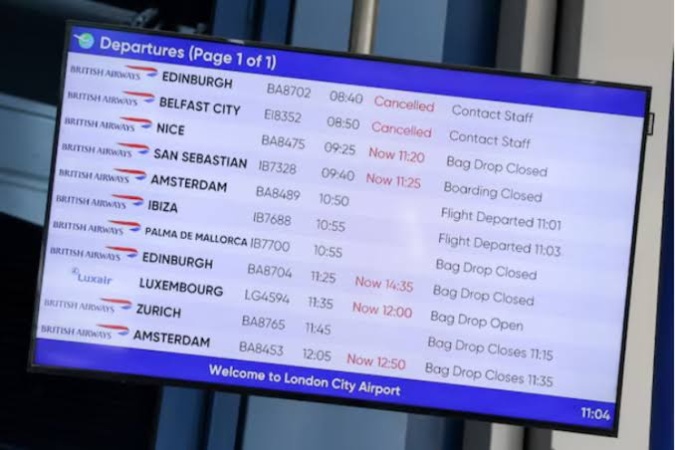
Since late December 2019, dozens of flights from Nigerian airports are delayed, cancelled or diverted to other airports within and outside the country because of inclement weather conditions that hit most of the country’s cities.
In January 2020 alone, more than 50 flights have been cancelled or delayed at the Lagos, Abuja, Port Harcourt, Calabar, Asaba, Uyo, Kaduna and several other airports across the country due to weather conditions that are not favourable for flying and landing.
These have remained unresolved despite the several navigational and landing aids installed at the nation’s airports by the Federal Airports Authority of Nigeria (FAAN) and the Nigerian Airspace Management Agency (NAMA).
In 2019, a report from the International Civil Aviation Organisation (ICAO), a United Nations (UN) agency, warned that higher temperatures caused by climate change could “have severe consequences for aircraft take-off performance,” including how many passengers and how much fuel airplanes are able to carry.
Global warming will also affect how airports are built. Changes in temperature and rainfall could “increase the demand for cooling for buildings or increase the drainage requirements for runways,” said the report.
Flight Diversions
A document obtained from the Consumer Protection Directorate (CPD) of the Nigerian Civil Aviation Authority (NCAA) indicated that at least 19,323 flights were delayed within the country’s airspace in the first half of 2018.
Within the same period, another 348 flights were cancelled among local and international airlines operating within and into the country.
The breakdown of the first half-year report from NCAA showed that out of the 19,323 flights delayed, domestic airlines had 16,880, while the remaining 2,443 were among the 33 foreign airlines operating into the country.
Within the same period, domestic airline operators cancelled 253 flights while their foreign counterparts recorded 95 cancelled flights.
The statistics further revealed that Middle East, Qatar Air, Royal Air Maroc, Rwandair, Saudi Airline, Sudan Air, South African Airways, Turkish Airlines, British Airways and Virgin Atlantic Airways have a fair share of flight delays among the international carriers, while Delta Air Lines joined a few foreign carriers that had incidences of flight cancellation in the international scene.
Besides, statistics released by the CPD revealed that for the periods of September and October 2019, a number of 6,600 flights were delayed in the country.
For the month of September, there were 3,551 flight delays with the breakdown showing 3,221 for domestic operators and 330 for international operators.
Another 23 flights were cancelled within the month under review; domestic 16 and international with seven cancelled flights. British Airways and African World Airline had two cancelled flights each, while Air France, Delta and Badr Air had one cancelled flight each.
For the month of October, at least 3,049 flights were delayed in the country among the local and international airlines.
The report indicated that domestic airlines had the highest number of passenger delays recording2,703 incidences, while the foreign airlines had 346 flight delays in the same month.
The breakdown indicated that Ethiopian Airlines had the highest number of flight delays among the foreign carriers with 50 delayed flights, closely followed on the international scene by Emirates Airlines with 37 flight delays, while Air Peace, had 1,080 delays within the month under review.
The further breakdown revealed further that African World Airline (AWA) from Ghana had 25 delayed flights, Air Cote D’Ivoire, 17, Air France, two, Asky Airline, 26, BADR Air, four, British Airways, six, Cronos, one and Delta Air Lines with two.
Others were Egypt Ai, 29, Etihad, one, Kenya Airways, 11, KLM, two, Lufthansa, five, Meridiana, two, Middle East Airlines, four, Qatar Airways, two, Rwandair, 21, South African Airways, two, Turkish Airlines, 24 and Virgin Atlantic Airways with two delayed flights.
On the local scene, Air Peace with the highest number of flight operations with 1,951 also had the highest number of flight delays with 1,080 flights.
This was followed by Arik Air, which had 1,145 flights in October but recorded 429 delays in the same period.
Others include Aero Contractors with 389 delays, Azman Air had 276 delays, Dana Air 267, Overland Airways 156, Max Air 282 delays, while Ibom Air, which commenced flight operations five months ago had 213 flight delays out of the 443 flights operated in the month of October.
Investigation revealed that Nigerian carriers, agencies, ground handling companies and other auxiliary companies losses in the range of N2bn during hazy weather conditions in Nigeria occasioned by flight delays, diverted or cancelled out-rightly.
Most times they make a return after hovering for minutes, occasioned by their inability to land, thereby leading to huge cost on aviation fuel.
NATCA, NAMA Bicker Over Navigational, Landing Aids
The Nigerian Air Traffic Controllers’ Association (NATCA), the umbrella body of Air Traffic Controllers (ATC) in the country, recently expressed concern over poor navigational and landing facilities at most of the nation’s airports, especially the Lagos Airport, the busiest aerodromes in terms of passenger and cargo traffic in the country.
The association noted that while the navigational equipment had been procured and installed by NAMA, they were yet to be calibrated by the respective authorities.
A statement by Mr. Yomi Agoro, the President of NATCA regretted the diversion of international flights out of the country due to poor visibility and hazy weather condition.
Apart from this, he noted that the diversion by the airlines added to the workload for air traffic controllers and called on respective agencies to address the unpleasant situation before it becomes irredeemable.
Agoro, however, called on relevant authorities to take immediate steps to restore the full serviceability of the navigational and landing aids at the Lagos airport to ensure an end to the “uncalled” hitches recently experienced and prevent a re-occurrence of same.
Refraining from apportioning blames, he emphasised that it was time for all authorities to work together to address the poor situation.
But, in a swift reaction, NAMA in a statement signed by Mr. Khalid Emele, the General Manager, Public Affairs, declared that its navigational infrastructure nationwide was not in any state of degradation as alleged by the association.
Though NAMA in September 2019, deployed and installed navigation aids at Lagos four months in order to beat the December and January inclement weather conditions, but four months after, the equipment is yet to be calibrated, which had put all efforts at nil.
NAMA, however, assured that the equipment would be calibrated on or before January 16, but as at the time of filing this report, the equipment was yet to be calibrated.
But, information gathered by Sunday Independent revealed that the efforts by the management to get the installed equipment calibrated before December 2019 date failed due to various reasons.
A source close to the Ministry of Aviation confided in our correspondent that immediately the navigation aids were installed in September, the management contacted the Agency for the Safety of Aerial Navigation in Africa (ASECNA) for the calibration of the equipment, but its calibration aircraft was unserviceable at the time, which stalled the use of the equipment as planned by NAMA’s management.
Besides, it was learnt that ASECNA at the time, also depended on the newly acquired calibration aircraft of Nigeria to calibrate some of its equipment.
Also, it was gathered that the management contacted Omni Blu Aviation Services for the usage of its equipment for the same purpose, but its calibration aircraft was not equally available for use.
Acquired $8.5m Calibration Aircraft Not Serviceable
Meanwhile, the nation’s calibration aircraft, which was acquired in September at a cost of $8.5m (about N3.1bn) was equally not serviceable at the time.
The minister had said at the time that “The agony of contracting it to South Africa at about $500,000 (₦181.5 million) every six months is over. Our airspace is safer. Thanks to Mr. President, we started and finished during your regime.”
The Minister also added, “The purpose of this aircraft is to calibrate our equipment and aids in the country for the purpose of flight operations. We used to have one in Nigeria, but for the last two decades, we never had one.”
But, rather than hand over the equipment to NAMA, it was learnt that the Ministry of Aviation held on to it despite lacking the human capacity to maintain the equipment, while pilots for the aircraft was retained with the Nigerian College of Aviation Technology (NCAT), Zaria. As at date, the ownership of the calibration aircraft was yet to be clarified.
NAMA, in some quarters, has adjudged as the owner of the calibration aircraft as forms part of its NAFIS department. Conversely, NCAA has its name inscribed on the airplane despite being the one to certify the aircraft and crew that will pilot the equipment, just as the document for the aircraft is domiciled with the Ministry of Aviation, which paid for the acquisition of the King Air 350i airplane.
The ministry sources said: “It is really pathetic that we are still where we are despite the installation of the Category III (CAT 3) Instrument Landing System (ILS) at the Lagos airport. We have a calibrated aircraft, but as I am talking to you now, it is not serviceable.
“The management of NAMA equally did not mount enough pressure on the government to put the facility to good use. The management knew we have inclement weather condition at this time, but hasn’t done enough.”
Experts’ Views
Grp. Capt. John Ojikutu (rtd) in an interview with our correspondent said that it was pertinent for NCAA to intervene in the situation in order to get to the route of the unpleasant situation.
Ojikutu who regretted that this was happening barely two years after the certification of some of these airports by the regulatory agency queried the periodic maintenance programmes for the airports, their critical safety infrastructure and facilities approved by the NCAA.
Surprised as the state of the Category III (CAT 3) equipment installed at the Lagos airport last September, he wondered why the sector in Nigeria had not wriggled out its recurring challenges, especially during the harmattan period.
He added: “If not, the NCAA needs to begin the process of ensuring that each airport evolves programmes that would help its inspectors for the periodic audits of these airports. Sincerely, I pity all carriers both domestic and foreign.”
Also, Capt. Dapo Olumide, the former Managing Director of Virgin Nigeria observed that most of the flight delays experienced in the Nigerian aviation industry were due to poor infrastructure at the airport and stations.
He decried that the infrastructure was yet to improve in the past 30 years despite the attendant increase in the number of air travellers and airlines within the period.
Specifically, he said aircraft are still being fuelled on the tarmac through petroleum tankers contrary to the global practice in other climes where pipelines are connected to link tarmac.
He said: “Flight delays in most cases are due to infrastructure. A lot has been said about our airport infrastructure, but we are yet to improve much in the past 30 years except installation of more air conditioners and tiles at the Lagos Airport.”
Besides, Capt. Edward Boyo, the Chief Executive Officer of Overland Airways, explained that no airline set out to delay or cancel flights, saying that the operating environment had made this unavoidable.
According to him, inadequate fuel supply, especially outside Lagos, Very Important Persons (VIPs) in some airports and single runways in busy airports in the country, made flight delays and cancellations inevitable.
He lamented that despite obvious shortcomings, stakeholders and government agencies in the country are still “unnecessarily” hostile to the airlines, maintaining that rather than condemning the airlines, they need encouragements from the public.
Just a few days ago, heavy fog disrupted flight operations at the Delhi airport with 20 flights diverted, four cancelled and about 530 flight delays.
Flights are operating at the airport under CAT III B conditions, which means the Runway Visual Range (RVR) is between 50 metres and 175 metres.
Giving an update on flight operations, an official of the airport said 16 flights have been diverted and four cancelled “as of now.”
“Around 530 flights – which include 320 departures as well as 210 arrivals approximately – have been delayed on Monday till 12.52 pm,” the official added.
In a statement, IndiGo Airline had said, “Owing to dense fog in north India our flights have been impacted across India. We will continue to review the situation and provide real-time updates on our social platforms.”
The airline also requested passengers to check flight status before leaving home and reach out to its customer care.
Also, for the most part of two weeks ago, the third busiest airport in the world, Dubai International Airport had to deal with delayed, diverted and cancelled flights as heavy rains led to intense flooding. The airport scrambled to cope with the extreme weather, working to get its operations back to normal.
“Dubai Airports can confirm that due to heavy rainfall and flooding earlier today, Dubai International (DXB) is experiencing operational disruption. We are working closely with our service partners to get back to full operations as soon as possible, however, flight delays are expected to continue through the day with some cancellations and diversions to Dubai World Central (DWC),” a Dubai Airport official said.
As a result, many roads were heavily waterlogged. Readings show that Dubai received 150mm of rain every hour for two-and-a-half hours. This is extremely out of the ordinary for Dubai as an average January experiences only 10mm of rain over the full month.
The UAE’s National Centre of Meteorology sent out an alert, warning residents to be extremely vigilant. In fact, “hazardous weather events of exceptional severity” were in the forecast as thunder and heavy rain have enveloped the Northern Emirates.
At higher elevations, freezing rain, snow, and hail are expected while at lower altitudes, temperatures may drop to as low as ten degrees Celcius.
The heavy rains led to flooding at Dubai International Airport. This has caused “operational disruptions” with many flights being delayed, diverted or cancelled.
Majority of flights were delayed between one to three hours. Some flights, like EK82 coming from Lyon, arrived five hours later than the scheduled time. Several flights were diverted to neighbouring airports such as Muscat International Airport (Oman) and Fujairah International Airport (UAE).
Most flights that were diverted went to Al Maktoum Airport, also known as Dubai World Central. A smaller percentage of flights were cancelled.
One flight didn’t even make it to the Gulf. Norwegian flight DY4601 flying from Stockholm was diverted to Paphos (Cyprus). Passengers were asked to check and confirm timings with airlines. (Sunday Independent)