ADAD

Updating your news feed...
NEWS EXPRESS is Nigeria’s leading online newspaper. Published by Africa’s international award-winning journalist, Mr. Isaac Umunna, NEWS EXPRESS is Nigeria’s first truly professional online daily newspaper. It is published from Lagos, Nigeria’s economic and media hub, and has a provision for occasional special print editions. Thanks to our vast network of sources and dedicated team of professional journalists and contributors spread across Nigeria and overseas, NEWS EXPRESS has become synonymous with newsbreaks and exclusive stories from around the world.













Loading banners
Loading banners...

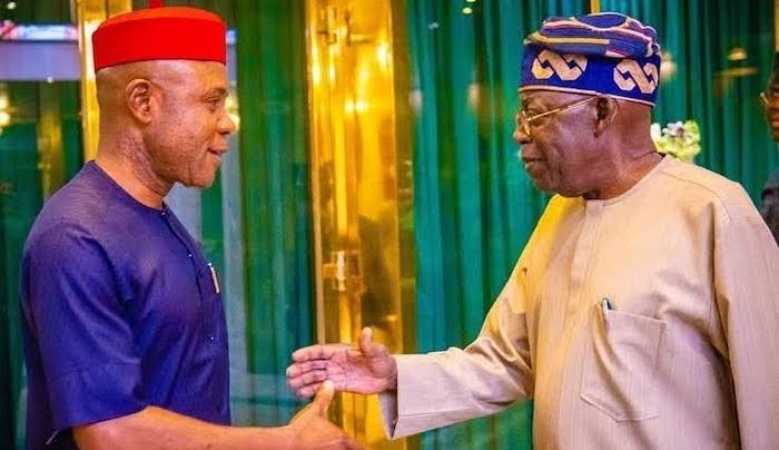
President Bola Tinubus and Enugu State Governor, Mbah
By IKE ABONYI
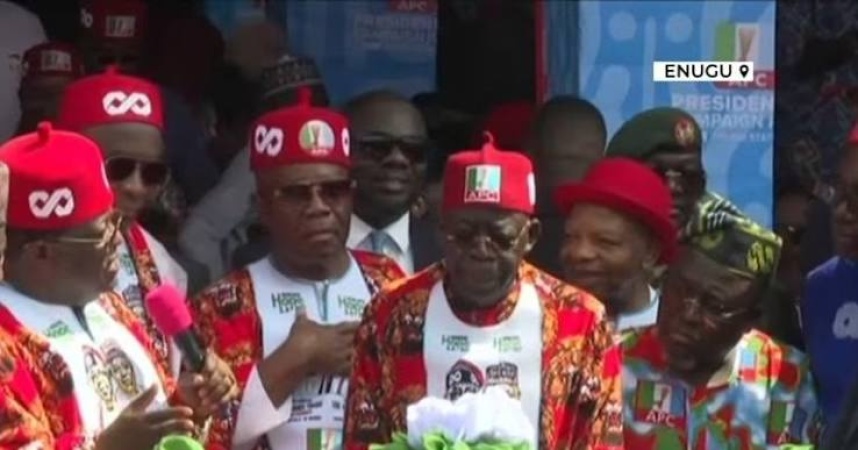
Today, President Bola Tinubu’s visit to Enugu will present political power in its most tangible form: roads shut, a public square secured, a governor aligned, and the region’s leaders brought together. The people’s mandate, however, will not be visible. It has been diverted, postponed, and made to wait—in traffic, in markets, and at polling units where a mock exercise took place on the same day as a rally. Governor Peter Mbah of Enugu State has undertaken the greatest political gamble of his career. Such a decision carries consequences, and I hope he has prepared for them.
To understand the scale of this gamble, the 2023 baseline must be stated clearly. In the Southeast in 2023, Peter Obi and the Labour Party received 1,952,998 votes, accounting for 89.62 per cent of the region’s total votes. Tinubu and the APC received 127,370 votes, or 5.85 per cent, while Atiku Abubakar of the PDP received 90,698 votes, or 4.16 per cent. A subsequent analysis presented the same disparity in approximate figures: Obi secured 1,960,590 votes in the Southeast, compared with Tinubu’s 127,607. 5%. That outcome represented a popular mandate expressed through ballots rather than endorsements. It was also a repudiation: the Southeast, which had traditionally supported the PDP, rejected both the governing APC and the established opposition in favour of a candidate who promised prudence, discipline, and a different approach to governance.
Since 2023, however, the political class has sought to overturn that verdict without necessarily winning over the voters who issued it. Defection and elite consolidation have been the principal instruments. By one spring tally, the APC controlled at least 31 of the 36 governorships, a level of concentration reminiscent of the PDP's dominance after 2003. The eight governors who joined the APC ahead of 2027 were Sheriff Oborevwori of Delta, Umo Eno of Akwa Ibom, Peter Mbah of Enugu, Abba Kabir Yusuf of Kano, Ahmadu Fintiri of Adamawa, Dauda Lawal of Zamfara, Siminalayi Fubara of Rivers, and Caleb Mutfwang of Plateau.
With Mbah's move, the APC held three of the Southeast's five states — Imo, Enugu and Ebonyi — while Anambra, governed by APGA, had also formally endorsed Tinubu. On paper, this represents a major transformation. In practice, however, the picture is less conclusive, since the apparent persistence of Peter Obi's appeal among sections of the grassroots indicates that political alignment among elites may not necessarily produce electoral compliance among voters.
Mbah's defection was announced on Tuesday, October 14, with the governor stating that the decision was intended to advance the state's interests through a stronger partnership with the ruling party at the centre. The formal switch was scheduled to take place that day in Enugu. Mbah and his allies have repeatedly argued that the PDP's longstanding loyalty was not rewarded and that closer alignment with the federal government represents the most practical path to securing federal investment.
That position received its clearest public expression in April 2026, when Mbah led a high-powered Enugu delegation to Abuja to declare support for Tinubu's re-election. The delegation, said to represent the state's seven million citizens, comprised ministers, former governors, former Senate President Ken Nnamani, traditional and religious leaders, and members of the National Assembly. Mbah told Tinubu that the relationship had generated trust and support, adding: "We will stand proudly with you on election day in January 2027."The central question is whether a governor whose performance is genuinely strong must defect to prove its value, or whether the defection indicates that the projects are being deployed to justify a political bargain rather than the bargain being a consequence of the projects.
Governor Alex Otto of Abia State has demonstrated that performance aligned with the people's interests should guide political alliances above all other considerations. Otti chose the people whose support he needed instead of embracing a larger political structure that his constituents had rejected at the polls.
The people of Enugu are not an extension of the governor's political machinery. They constitute an electorate with diverse political loyalties, interests and expectations. Some voters may favour Tinubu, while others may prefer Obi, Kwankwaso, or another candidate. Still, some may remain undecided. All of these positions are legitimate.
The problem arises when political leaders confuse control of government institutions with control over the electorate. The governor's political affiliation does not necessarily reflect the political allegiance of the people. This is why Tinubu's visit to Enugu carries broader political significance. Governor Peter Mbah's membership in the APC and his involvement in the President's political activities are matters of personal political choice. He has the right to support his party's candidate. However, the governor's preference cannot automatically be regarded as the preference of the people of Enugu electorates.
That distinction is central to representative democracy. A governor is elected to govern a state on behalf of its citizens. Election to office does not give him ownership of their political views, electoral choices, or constitutional rights.
Tinubu's visit may produce striking photographs, attract large crowds, secure political endorsements, and prompt declarations of support. However, the genuine verdict will not be rendered at Okpara Square. It will be determined by voters at polling units on January 16, 2027. That is where the calculations of governors, the mobilisation efforts of political parties, the influence of money and the ambitions of powerful individuals must ultimately be tested against the sovereign will of Nigerians. Enugu residents must recognise that they are not bystanders in shaping their political future. They are the central participants. They must refuse to let political leaders place personal interests above the shared aspirations of the people.
The central issue confronting Enugu and Nigeria is not who can draw the largest crowd or stage the most imposing demonstration of political influence. It is who can provide the people with a better country.
Tinubu may command Okpara Square today. He may have the roads cleared, security arrangements put in place, and the political establishment brought together. But he cannot control the conscience of the people of Enugu. Nor can any other political leader. The roads may be cleared for the President, but the people's mandate must be secured through competence, character, accountability and the ability to persuade. That is the distinction between holding political office and earning the people's mandate. That is the decision facing Enugu. That is the decision facing Nigeria.
The Enugu visit also reflects a persistent characteristic of Nigerian politics: the outsized role political establishments play in shaping the course of electoral contests. Governors command the administrative apparatus of their states. Political parties possess organisational structures and mobilisation networks. Legislators, commissioners, local government chairmen, and political appointees frequently function within established systems of patronage. The incumbent President also wields the visibility and influence associated with the nation’s highest political office. These constitute significant political advantages. Yet the central democratic question is whether such advantages are being employed to persuade citizens or to create conditions in which the preferences of political elites eclipse the choices of the electorate. A meaningful distinction must be made between political mobilisation and political ownership. Mobilisation aims to win public support. Political ownership presumes that those who control the machinery of government can determine how citizens operate.
But the fact is that a public gathering does not constitute a ballot. A governor’s proclamation does not amount to a vote. A presidential motorcade does not establish an electoral mandate. The central issue is what individual citizens believe, what they expect from their government, and whether they are free to express those preferences. Therefore, Tinubu was a guest of Peter Mbar and other APC leaders in the region, not the people of Enugu State.
•Ike Abonyi is Editor @Large.