ADAD

Updating your news feed...
NEWS EXPRESS is Nigeria’s leading online newspaper. Published by Africa’s international award-winning journalist, Mr. Isaac Umunna, NEWS EXPRESS is Nigeria’s first truly professional online daily newspaper. It is published from Lagos, Nigeria’s economic and media hub, and has a provision for occasional special print editions. Thanks to our vast network of sources and dedicated team of professional journalists and contributors spread across Nigeria and overseas, NEWS EXPRESS has become synonymous with newsbreaks and exclusive stories from around the world.











Loading banners
Loading banners...

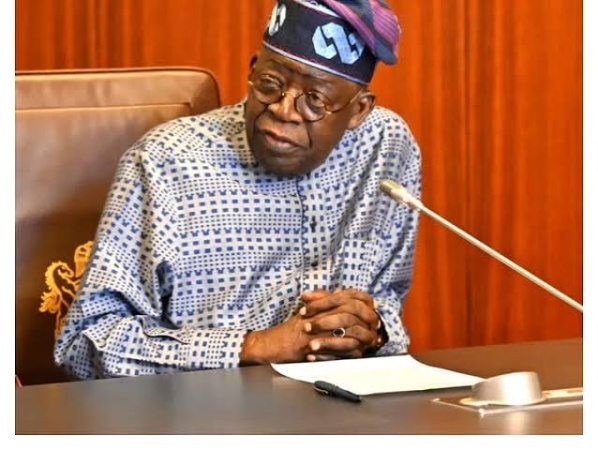
President Bola Tinubu addressing a joint session of the National Assembly
President Bola Ahmed Tinubu has asked the National Assembly to repeal and re-enact the 2026 Appropriation Act, proposing to reduce the aggregate expenditure from N68.323 trillion to N65.176 trillion.
This represents a reduction of about N3.15 trillion.
Tinubu’s request, contained in a letter dated November 20, 2026, was read in both the Senate and House of Representatives during Tuesday’s plenary.
He said the proposal seeks to realign the 2026 budget with available resources, existing financial obligations, and outstanding federal commitments.
He said the adjustment is necessary to address funding gaps that emerged during the implementation of the original budget and to ensure previously authorised expenditures are properly captured.
The letter said, “Under the revised framework, aggregate expenditure is N65.176 trillion, compared with N68.323 trillion in the approved budget, while projected FGN revenue, including government-owned enterprises, is N33.720 trillion. Aggregate capital expenditure is N26.232 trillion.
“The fiscal deficit, including project-tied loans, remains unchanged at N31.457 trillion, equivalent to 5.64 per cent of GDP.
“These adjustments prioritise existing commitments and improve the credibility and execution of the capital budget while maintaining fiscal restraint.
“Planned new borrowing also remains at N29.218 trillion, comprising N18.428 trillion in domestic borrowing and N10.790 trillion in foreign borrowing.
“The proposed $7.7 billion external borrowing, equivalent to approximately N10.368 trillion at N1,346.50/US, is intended to finance the existing foreign borrowing provision and does not increase the borrowing envelope.”
Tinubu asked the federal lawmakers for “expeditious consideration and passage” of the bill to facilitate “orderly implementation” of the revised budget and settlement of existing obligations.
In April 2026, Tinubu assented to the N68.323 trillion 2026 Appropriation Bill.
He earlier presented N58.47 trillion as the 2026 Appropriation Bill to the National Assembly in December 2025.
However, on March 31, 2026, the president asked the lawmakers to increase the budget estimates by N9.81 trillion, taking the total budget to N68.323 trillion.
What experts say
Economist and public affairs analyst, Dr. Marcel Okeke, criticised the Federal Government’s fiscal management, questioning its decision to review the 2026 budget towards the end of the year.
The economist said the proposed revision of the 2026 budget, including a reduction exceeding N2tn, was particularly troubling given that the year was approaching its end.
He questioned why the government was only now seeking to align its expenditure plans with available resources and existing obligations.
“Budgeting is based on projections and anticipation. Governments are expected to have a reasonable understanding of their revenues, obligations and expenditure requirements before presenting annual budgets,” he said.
Okeke argued that the government should have assessed its revenue outlook and financial commitments before preparing the 2026 budget rather than waiting until the closing weeks of the fiscal year to propose a comprehensive review.
He also expressed concern that the 2027 budget process appeared to be delayed, while implementation of the capital component of the 2025 budget remained outstanding.
Nwokoma urges FG to close previous budgets
On his part, another economist, Professor Ndubisi Nwokoma, has described the simultaneous implementation of multiple budgets as fiscal rascality and called for an end to what he termed disorder in public financial management.
Nwokoma said the administration of President Bola Tinubu had failed to maintain discipline in the budget process, noting that the government sometimes operated two or three budgets at the same time, including supplementary budgets.
He argued that the practice undermined the purpose of an approved budget, which should serve as the legal framework for government revenue and expenditure within a defined fiscal year.
At times, it runs three budgets at the same time. At times, it runs two, alongside a supplementary budget. They spend from one budget this time and move to another the next time. It does not follow any order,” he said.
“When the budget is passed, it becomes a law for a particular period. Then, in November, you are talking about what should be packed up. We are not talking about revising it downwards. I would call it fiscal rascality. It is simply recklessness,” he said.
He said the country needed a predictable budget cycle in which one budget would run from January 1 to December 31, with implementation guided by approved expenditure headings and transparent reporting.
“Under President Tinubu, there has not been order when it comes to public financial management. There is no order. We have situations where we are still spending from the 2024 budget while other budgets are being introduced,” he said.
He recalled concerns raised in an International Monetary Fund report about extra-budgetary spending, which the government had denied, adding that the absence of accountability for fiscal decisions was detrimental to national development.
“The summary of it all is fiscal rascality. Unfortunately, in this country, we don’t have people being called to account for some of these things. A country cannot make progress when you do whatever you like and expect positive outcomes,” he said.
He said first and second quarter reviews should provide opportunities to measure performance, identify gaps and ensure that expenditure remained within approved guidelines.
“There must be a functional budget. There must be implementation following the guidelines and the various subheads. You should also have quarterly reports for each budget so that you can assess how it has performed,” he said.
Nwokoma also raised questions about the funding framework for major infrastructure projects, including the Lagos-Calabar Coastal Highway, arguing that public expenditure should be subjected to clear budgetary procedures.
He urged the Federal Government to harmonise its outstanding fiscal commitments, close previous budgets and submit the 2027 budget proposal to the National Assembly without further delay.
Also speaking, a lecturer at Al-Hikmah University, Ilorin, Dr Muhammad-Bashir Yusuf, said the reduction in the 2026 budget might suggest fiscal discipline but warned that it had done little to address the country’s growing dependence on borrowing.
Yusuf said the projected revenue of about N33 trillion against the revised N65.18 trillion budget meant that only about 51.6 per cent of the proposed expenditure would be covered by revenue.
This leaves a huge financing gap, he noted.
He said the government would still depend on borrowing about N18 trillion domestically and another $17bn externally, a development he said raised concerns about the country’s debt sustainability.
“That speaks volumes about our economy because part of the problem we have is foreign debt servicing. Having to depend more on debt means we will need more resources to finance the debt, and that will actually reduce the amount that will be available for developmental projects,” he said.
The economist, however, said borrowing was not necessarily harmful, stressing that the economic implications depended on how the borrowed funds were deployed.
“If it is used to increase our capital, our infrastructure, that means it is going to expand our sources of revenue, which ultimately will be good for us. But if otherwise, then that means we are consuming our future now, which will not be good for us,” he said.
Yusuf said the government should ensure that the approximately 40 per cent of the revised budget earmarked for capital projects translated into productive investments capable of expanding the economy and generating the revenue required to repay the loans.
On the implications for ordinary Nigerians and businesses, he said the concern should be whether the expenditure cuts would affect essential programmes and projects designed to improve people’s welfare.
He said although reducing unnecessary expenditure was desirable, cutting allocations meant for interventions that directly benefited citizens could undermine the intended gains of the budget adjustment.
“Budget reduction means fiscal discipline. However, if you look at what is being reduced, it is not coming from the debt, and it is the expenditure that should go to other various things apart from capital projects,” he said.
Yusuf urged the government to explain the areas affected by the proposed cuts.
He said the implications would depend on whether the reductions were made from inflated or unnecessary provisions or from programmes meant to reach ordinary Nigerians.
“I think we may need to ask the government what that will mean because if eventually some of the things that are proposed to reach the masses are the ones being cut, then that may not look too good for the masses,” he said.
He said the more significant gain would have been a reduction in the government’s borrowing target alongside the downward review of the budget.
“The good news would have been that that particular amount is being reduced or deducted from the loans that will be taken. But now, the cut in the budget does not affect the amount that will be borrowed,” he said.
The economist added that reducing the proposed borrowing by about N3 trillion would have represented a significant step towards easing the country’s debt burden.
He urged the government to ensure that fiscal adjustments translated into lower borrowing requirements. (Daily Trust)