ADAD

Updating your news feed...
NEWS EXPRESS is Nigeria’s leading online newspaper. Published by Africa’s international award-winning journalist, Mr. Isaac Umunna, NEWS EXPRESS is Nigeria’s first truly professional online daily newspaper. It is published from Lagos, Nigeria’s economic and media hub, and has a provision for occasional special print editions. Thanks to our vast network of sources and dedicated team of professional journalists and contributors spread across Nigeria and overseas, NEWS EXPRESS has become synonymous with newsbreaks and exclusive stories from around the world.






















Loading banners
Loading banners...

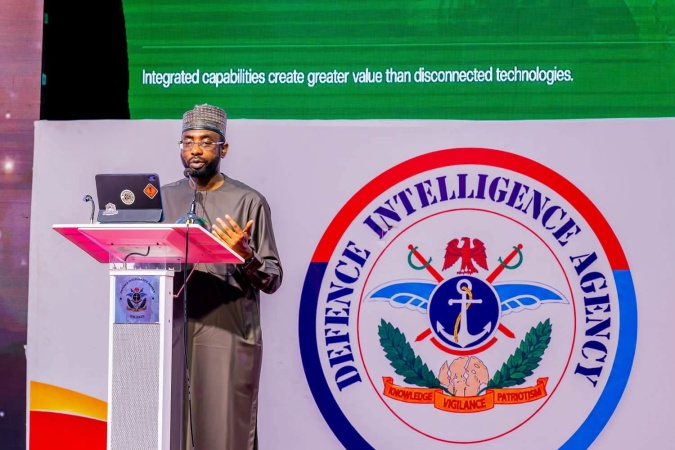
DG NITDA, Kashifu Inuwa CCIE, giving his keynote address at the event
By BONIFACE AKARAH
The National Information Technology Development Agency (NITDA) has proposed a strategic partnership with the Defence Intelligence Agency (DIA) to develop indigenous technologies capable of strengthening Nigeria’s intelligence operations and addressing emerging national security challenges.
The proposal was made by NITDA Director-General, Kashifu Inuwa, CCIE, while delivering a keynote address at the Chief of Defence Intelligence Annual Conference 2026, organised by the DIA in Abuja.
Speaking on the theme, “Optimising Nigeria’s Intelligence Enterprise through Technological Innovation and Strategic Partnership in a Complex Security Environment,” Inuwa called for closer collaboration between Nigeria’s technology ecosystem and the defence sector to reduce dependence on imported technologies and build sustainable local defence capabilities.
He said rapid advances in artificial intelligence (AI), autonomous systems, data analytics and interconnected digital infrastructure were changing the nature of intelligence gathering and modern warfare, creating opportunities for Nigeria to improve surveillance, threat detection and intelligence analysis.
Inuwa urged the defence sector to move away from reliance on foreign technology and tap into the country’s growing pool of technology professionals, innovators and startups.
“Those years are gone when we spend a lot of money to buy technology from foreign countries. Today, talent is everywhere,” he said.
He also identified data ownership and control as critical components of national security and sovereignty, warning that countries without adequate control over their data, communication infrastructure and digital platforms could expose sensitive information and national interests to external influence.
“Anybody that has data about you, who owns your data, controls you,” the NITDA boss cautioned.
He consequently called for stronger data governance, cybersecurity infrastructure and digital sovereignty, particularly across the defence and intelligence sector.
On artificial intelligence, Inuwa said combining AI with autonomous systems, satellite information, sensors and other emerging technologies could significantly improve the capacity of security agencies to process large volumes of information and generate actionable intelligence.
He, however, stressed that the deployment of AI in sensitive security operations must be guided by responsible governance, reliable data and human oversight.
“AI is a tool we can use to enhance our work. We should see AI as a co-worker and co-partner,” he said, stressing that human expertise and accountability must remain central to critical decisions.
To make the proposed partnership practical, Inuwa suggested that NITDA and the defence sector establish innovation challenges focused on areas including AI, autonomous systems and cybersecurity.
Under the proposed arrangement, he said specific security challenges could be presented to technology innovators and startups, with their solutions subjected to technical assessment, testing and evaluation before possible adoption.
The NITDA chief also advocated a change in the conventional approach to defence technology procurement, urging security institutions to identify specific operational challenges and work with local innovators to develop solutions tailored to their needs.
According to him, such an approach would reduce unnecessary costs, encourage continuous improvement and give Nigeria greater ownership of the technologies deployed for national security.
Inuwa cited Nigeria’s fintech ecosystem as an example of how government policies and private-sector collaboration could accelerate technological development, arguing that a similar model could be applied to defence technology.
“The best way to use this technology is to own it and build it with our people,” he said.
He also identified data governance, cybersecurity frameworks, secure digital infrastructure, interoperability standards and specialised human capacity as critical foundations for integrating emerging technologies into Nigeria’s defence ecosystem.
Inuwa reaffirmed NITDA’s commitment to supporting the country’s digital innovation ecosystem through policy development, capacity building, research, standards and strategic partnerships.
He expressed optimism that the proposed collaboration would move beyond discussions to practical implementation, including the development and evaluation of innovative security solutions ahead of the next conference.
The Chief of Defence Intelligence Annual Conference 2026 brought together senior government officials, Service Chiefs, Nigerian Defence Advisers accredited to 91 countries, DIA regional directors, state coordinators and foreign defence advisers, among other stakeholders, to discuss emerging security trends and approaches to strengthening Nigeria’s intelligence and defence capabilities.