ADAD

Updating your news feed...
NEWS EXPRESS is Nigeria’s leading online newspaper. Published by Africa’s international award-winning journalist, Mr. Isaac Umunna, NEWS EXPRESS is Nigeria’s first truly professional online daily newspaper. It is published from Lagos, Nigeria’s economic and media hub, and has a provision for occasional special print editions. Thanks to our vast network of sources and dedicated team of professional journalists and contributors spread across Nigeria and overseas, NEWS EXPRESS has become synonymous with newsbreaks and exclusive stories from around the world.










Loading banners
Loading banners...

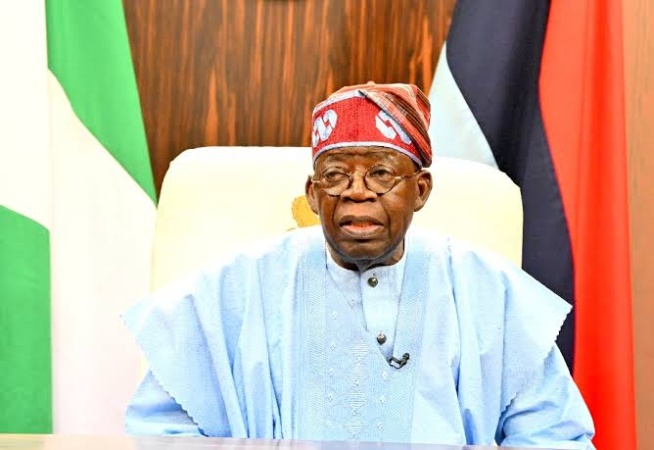
President Bola Ahmed Tinubu
Mohammed Sabiu, Isaac Shobayo and Bioluwatife Akinyemi examine the recent endorsement of President Bola Ahmed Tinubu for the January 16 election and the reactions it is generating from monarchs in the North and the Middle Belt.
On Wednesday, November 11, traditional rulers from the South-West met in Ibadan, the capital of Oyo State, to deliberate on the state of the nation. A communique read by the Alake of Egbaland, Oba Adedotun Gbadebo, among other things, backed the reforms of President Bola Tinubu and called for a retention of the North-South presidential rotation while declaring support for Tinubu to complete his second term in office. Twenty-two monarchs from Lagos, Ogun, Oyo, Osun, Ondo and Ekiti signed the communique. The Ooni of Ife, the Olubadan of Ibadanland, the Soun of Ogbomoso, the Akarigbo of Remoland and the Deji of Akure were among those present at the meeting.
The monarchs said: “The council unanimously reaffirmed its unwavering support for His Excellency, the President of the Federal Republic of Nigeria, and his administration.
“The traditional rulers acknowledged the efforts of the Federal Government in addressing national challenges and advancing the development agenda of the country.”
They also recognised the economic realities confronting Nigerians and supported the Federal Government’s policy direction in alleviating the hardship.
The council urged traditional rulers across the region to continue mobilising citizens in their respective domains to support government policies and programmes aimed at promoting economic growth, national stability and social development.
The council also expressed support for the proposed establishment of state police as a strategic measure to strengthen internal security.
It urged traditional rulers to sensitise youths across the region to prepare for employment and service opportunities that may arise from the initiative.
While calling for the continuation of presidential rotation between the north and south, the monarchs said that the presidency should remain in the south in the next electoral cycle.
They said: “In the interest of fairness, equity, and the continued strengthening of national unity, the council expressed the view that the rotational arrangement should be sustained and the presidency should remain in Southern Nigeria in the next electoral cycle, in line with the spirit of power rotation that has helped preserve peace and stability in the country.”
According to the monarchs, the position of the presidency was intended to promote national balance, mutual trust among federating units and the continued progress of the country. Other decisions reached by the monarchs include the call for stronger collaboration with traditional rulers in the north and other parts of the country, and a condemnation of the growing electoral violence, intimidation, vote-buying and other malpractices. They equally praised the decision of the Federal Government to establish some military formations in Oyo State, as, according to them, the decision would strengthen security in the South-West and help protect lives and property. The monarchs also lauded the ongoing federal infrastructure projects across the region and the country, and noted that such a development would impact economic activities, connectivity positively.
The Middle Belt reacts
The Middle Belt Forum quickly joined them. It declared support for the continuation of Southern leadership until 2031 and endorsed Tinubu’s re-election.
Tracing the history of rotational presidency, the Secretary to the Government of the Federation (SGF), Senator George Akume, told a delegation from the Order of the Knights of St. Mulumba (KSM) Nigeria, led by its Supreme Knight, Sir Steve Adehi, that it was an agreement to sustain national cohesion, fairness, and the growth of democracy since the return to civilian rule in 1999.
He recalled that the agreement was reached in Kaduna in 1999 after extensive consultations between governor-elects running on the Peoples Democratic Party (PDP) platform and prominent political leaders who recognised the importance of equitable political power distribution in preserving Nigeria’s unity.
Ousman ACF Chairman and Sultan
According to him, the leaders eventually agreed that presidential power should alternate between the North and the South in eight-year cycles, beginning with the South, as a practical measure to promote political balance, strengthen mutual trust and safeguard the country’s territorial integrity.
Therefore, the SGF also frowned at attempts by Northern candidates to contest the presidency before the completion of the South’s current eight-year tenure, insisting that the North should respect the established sequence and allow the arrangement to run its course.
What the ACF said on rotational presidency
But in Kaduna, the Arewa Consultative Forum (ACF) answered back sharply. It rejected the rotational presidency arrangement, describing it as unconstitutional and undemocratic and arguing that presidential succession should be determined through democratic competition.
The ACF maintained that although the Yoruba monarchs were entitled to express their opinions, power rotation remained a gentleman’s agreement among political parties and politicians rather than a constitutional provision.
The Forum’s National Publicity Secretary, Prof. Tukur Muhammad Baba, put it bluntly: “Our position is that if we are practising democracy, let us practise democracy. And if we have to have this, it should probably be made through a constitutional arrangement. But for now, we think it is not ideal for democracy, and that is our position.”
The historical records
Obasanjo (1999–2007). The 1999 arrangement was a political settlement among elites, not a law. PDP grandees chose Obasanjo, and zoning dictated that a northerner, Yar’Adua, would succeed him after two terms. Afenifere’s Okurounmu recalled in 2014 that Obasanjo “was anointed by the powers that be to pacify the Southwest over the annulment of Abiola’s June 12, 1993 election.” However, the arrangement lived in party constitutions and private understandings, never in the royal courts.
Yar’Adua (2007–2010). Yar’Adua was “the North’s turn” under PDP’s zoning. When he died, the argument turned on whether the North’s turn died with him. An Adamu Ciroma-led northern PDP group wrote to the party in 2010, insisting that the zone’s tenure had not ended. Dr. Goodluck Jonathan, who succeeded Yar’Adua, faced a herculean task contesting the 2011 election, which some northern leaders believed should be reserved for the north.
Though in 2015, the Ooni of Ife, Oba Okunade Sijuwade, and other traditional rulers pledged support for Jonathan’s second term, it would not see the light of day.
The Buhari years produced the sharpest institutional statements. Seventeen Southern governors met in Lagos in July 2021 and resolved that the next president should come from the South. Then came the northern reply. After a meeting in Kaduna in September 2021 of the Northern States Governors’ Forum, chaired by Governor Simon Lalong and attended by the Sultan of Sokoto and emirs, the northern governors condemned the Southern demand as contradicting the Constitution, citing the requirement of a majority plus 25 per cent in two-thirds of states. The northern voice of the Buhari era, with its monarchs in the room, therefore opposed rotation on constitutional grounds, which is roughly where the ACF stands today.
The ironies deserve a mention. In 2022, ten APC northern governors and a former governor, Aliyu Wamakko, urged northern aspirants to step aside for a Southern candidate, while the Presidency disputed claims that Buhari himself had endorsed a Southern successor. Northern elites invoked rotation when it handed the South a turn and the Constitution when it didn’t. Southern elites have done the opposite. Neither side is consistent, which is itself a data point.
X-raying the Northern traditional rulers on rotational presidency
This is not a new quarrel. It is an old Nigerian quarrel wearing new clothes. To understand today, we must go back to what Northern traditional rulers said and did not say during the presidencies of Olusegun Obasanjo, Umaru Musa Yar’Adua and Goodluck Jonathan.
When Obasanjo came to power in 1999, it was based on an understanding: the South would take the first eight years to heal the wound of June 12, 1993, when Chief M.K.O. Abiola’s victory was annulled. But by 2003, when Obasanjo sought a second term, the North was divided. Many northern politicians wanted a northerner to challenge him. Many ordinary northerners felt eight years was enough.
The North answers, and the North is not one voice.
The Arewa Consultative Forum (ACF) rejected rotational presidency as unconstitutional and undemocratic, saying succession should be settled by democratic competition. The ACF added that the monarchs were entitled to their views, but that rotation is a gentleman’s agreement among politicians and parties, not a constitutional provision. Its national publicity secretary, Professor Tukur Muhammad-Baba, had, in December 2024, made a sharper point against the “wait till 2031” line of the Secretary to the Government of the Federation, George Akume. He said voters elect a president for four years at a time and that assuming eight years is undemocratic.
Yet the Middle Belt Forum stands on the monarchs’ side, with a condition attached. It backed Tinubu’s re-election to keep the presidency in the South until 2031, expecting Southern leaders to reciprocate by supporting a Middle Belt candidate that year. Earlier this year, the Forum argued that 2031 should be a Middle Belt turn. Its spokesman, Luka Binniyat, puts it plainly: the position has long been that power stays in the South up to 2031.
So the contest is no longer simply South versus North. It is the South-West and the Middle Belt on one side, and the ACF and ambitious northern politicians on the other. Northern politicians are also split by interest. Senator Abdulaziz Yari in December 2025 called it “payback time” for the North to support Tinubu, because the South-West stood by the North in earlier years.
The historical records
Obasanjo (1999–2007). The 1999 arrangement was a political settlement among elites, not a law. PDP grandees chose Obasanjo, and zoning dictated that a northerner, Yar’Adua, would succeed him after two terms. Afenifere’s Okurounmu recalled in 2014 that Obasanjo “was anointed by the powers that be to pacify the Southwest over the annulment of Abiola’s June 12, 1993 election.” However, the arrangement lived in party constitutions and private understandings, never in the royal courts.
Yar’Adua (2007–2010). Yar’Adua was “the North’s turn” under PDP zoning. When he died, the argument turned on whether the North’s turn died with him. An Adamu Ciroma-led northern PDP group wrote to the party in 2010, insisting that the zone’s tenure had not ended.
Jonathan (2010–2015). This is the critical precedent, and it cuts against anyone who calls rotation self-enforcing. Northern leaders argued Jonathan’s 2011 candidacy breached the PDP’s zoning understanding, and Atiku opposed his bid on the same ground. Others argued zoning was outdated and that the Constitution contains no such provision. Jonathan won anyway, and the aftermath saw different agitations. The lesson the North drew was that conventions bind only those who choose to be bound.
In 2015, the Ooni of Ife, Oba Okunade Sijuwade, and other traditional rulers pledged support for Jonathan’s second term. That was a Southern incumbent against a northern challenger, which is today’s alignment in reverse. The endorsement did not hold the room. Some Osun State monarchs publicly dissociated themselves from the Ooni’s endorsement, and Buhari won, pointing to the fact that a palace’s blessing is not a bloc of votes.
Buhari (2015–2023). The Buhari years produced governors’ resolutions on rotation, but some monarchs’ behaviour appeared transactional.
In April 2018, Imo monarchs endorsed Buhari’s second term and in the same communiqué urged him to back an Igbo president in 2023. In January 2019, Ebonyi’s council of traditional rulers endorsed Buhari, citing the president’s relationship with the governor. Buhari responded by telling them the South-East would benefit from the Second Niger Bridge. Some of these endorsements were hollow. The Ebonyi council chairman later promised to deliver votes for Atiku. Ekiti obas, meeting Buhari’s campaign, asked him to fill the cabinet seat Fayemi vacated to become governor with an Ekiti minister, and Zamfara monarchs endorsed him too, with Buhari saying a second term was what the constitution allowed.
Legality, constitutionalism or co-existence?
It is not legality. No court could enforce the monarchs’ preference, and the monarchs do not claim it could. The ACF is right on the narrow legal point.
It is not constitutionalism in the strict sense either, but it is arguably constitutionalism in the broader sense of constitutional culture. Federal states in divided societies often rest on understandings written nowhere. Nigeria’s federal character principle, zoning in the parties, and the vice-presidential balancing act are all of that kind. The ACF’s insistence that the ballot alone decides is an argument for a pure legal constitution. But the same Forum’s constituents have invoked unwritten arrangements whenever it served them. Calling rotation “illegal” misdescribes it, and calling it “constitutional” overstates it.
What the communiqué actually argues is coexistence. Its operative words are fairness, equity, stability, cohesion and unity. It also closes with a pledge of stronger cooperation with the North. That is the language of a bargain, not a statute. The weakness of that bargain is that it has no enforcement mechanism and no clear terms. How many years is a “turn”? Does an incumbent’s death forfeit it, as Yar’Adua’s did? Does “the North” mean the Hausa-Fulani core, as the ACF assumes, or the Middle Belt, as the MBF now demands? Without answers, the convention is a promise too vague to keep and too useful to abandon.
There is a further problem the monarchs have not confronted. The communiqué mixes two different things: a constitutional right (Tinubu’s right to seek a second term) and a political convention (the South’s claim to a second term as of right). The first needs no one’s blessing. The second is what makes the document contestable. The ACF’s reply goes straight at that seam, and Muhammad-Baba had argued in December 2024 that re-election is a privilege to be earned and not an entitlement.
Will the North speak with one voice?
It is on record that the northern traditional rulers have never spoken with one voice on rotation. Under Obasanjo, they were silent and indecisive. Under Yar’Adua, they were comfortable and quiet. Under Jonathan, they first supported zoning, then supported Jonathan, then withdrew support when they felt betrayed. Today, they are largely silent while the ACF speaks. Silence, in northern politics, is also a statement.
It is also on record that endorsements by monarchs do not decide elections. The South-West Obas have endorsed Tinubu, just as Northern Emirs endorsed Jonathan in 2011. But in 2011, the people of the North voted differently from their Emirs. The lesson is that traditional rulers are respected as fathers, but voters are not subjects. They vote their conscience.
Again, the ACF’s argument has not changed. In 2010, the ACF and northern elders insisted that zoning was a PDP party matter, not a national law. In 2026, the ACF is insisting again that rotation has no constitutional backing. The consistency is striking. Whether you agree or not, the ACF has been consistent: if you want rotation, put it in the constitution.
The South-West monarchs are right that rotation has helped Nigeria manage diversity since 1999. The ACF is also right that rotation is not in the 1999 Constitution. But analysts believe that both cannot be right at the same time unless Nigeria decides what it wants.
Thus, the question is, do we want a democracy where anyone from anywhere can contest, as the ACF says? Or do we want a democracy where power is shared by agreement, as the communique by the South-West Obas suggested? Unless the constitution is amended to accommodate a particular line in this argument, every election will continue to raise the argument about zoning and endorsements. Northern rulers will endorse; the ACF will reject or accept, but ultimately the people will decide. (Nigerian Tribune)