ADAD

Updating your news feed...
NEWS EXPRESS is Nigeria’s leading online newspaper. Published by Africa’s international award-winning journalist, Mr. Isaac Umunna, NEWS EXPRESS is Nigeria’s first truly professional online daily newspaper. It is published from Lagos, Nigeria’s economic and media hub, and has a provision for occasional special print editions. Thanks to our vast network of sources and dedicated team of professional journalists and contributors spread across Nigeria and overseas, NEWS EXPRESS has become synonymous with newsbreaks and exclusive stories from around the world.




Loading banners
Loading banners...

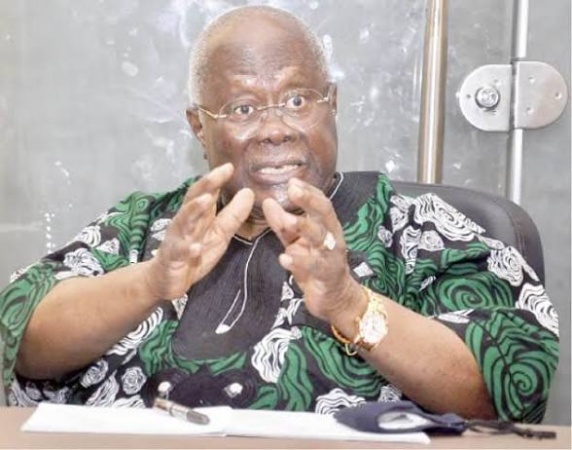
Great grandnephew of Herbert Macaulay, Chief Olabode George
By ADEYEMI ADELEYE
Descendants of Herbert Macaulay, Nigeria’s foremost nationalist, have appealed to President Bola Tinubu to return the property housing the General Post Office in Lagos to the family for a permanent memorial in his honour.
Chief Olabode George, former Deputy National Chairman of the Peoples Democratic Party (PDP) and great grandnephew of Macaulay, made the appeal on Saturday at the Herbert Macaulay Memorial Colloquium organised to mark the nationalist’s 162nd birthday anniversary.
The event, held at the Nigerian Institute of International Affairs (NIIA), Victoria Island, Lagos, had former President Goodluck Jonathan as Chairman of the Occasion.
George said the family was prepared to develop the property into a permanent memorial hall to preserve Macaulay’s legacy and educate younger generations about his contributions to Nigeria’s political development.
He said the house where Macaulay lived was demolished after his death in 1946, while the General Post Office was subsequently built on the site.
“If you look at the back of the programme pamphlet, you will see the house in which he lived. The British colonial authorities were so apprehensive of his activities and influence.
“Following Papa’s death in 1946, the house was demolished, and the General Post Office was subsequently built on the site. That building remains the General Post Office today.
“We therefore wish to appeal to the President to consider returning that property to the family. We are prepared to build a permanent memorial hall in honour of Herbert Macaulay,” he said.
George described Macaulay as a special gift to Nigeria, whose courage, commitment and political philosophy remained relevant to contemporary leadership.
He said Macaulay demonstrated that public office and political participation should be driven by service to the people rather than personal benefits.
“Herbert Macaulay is a special gift to Nigeria from Almighty God. We have this opportunity to listen to distinguished scholars and discuss the philosophy, strategies and remarkable achievements of our great-granduncle, Herbert Macaulay.
“He was committed, courageous and resourceful. He demonstrated that when you decide to become a public officer or venture into politics, it should not be for personal benefit.
“It must be an act of service to the people,” George said.
He said the family initiated the colloquium to preserve Macaulay’s memory and bring his principles and values to the attention of contemporary politicians.
George urged Nigerians to support the family’s appeal to the President, adding that a permanent memorial would enable younger generations to appreciate the sacrifices of the country’s founding nationalists.
Speaking, Mr Gladstone Macaulay, a great grandson of Macaulay said that history would continue to remember the ex-nationalist for his good deeds and contributions to liberate Lagos and Nigeria.
In his address, Former President Goodluck Jonathan, who was the chairman of the occasion, described Macaulay as a man of remarkable intellect, courage and conviction who played a significant role in Nigeria’s nationalist movement.
He said Macaulay distinguished himself as an engineer, surveyor, journalist, political activist and public intellectual.
Jonathan said Macaulay was among the earliest voices to challenge colonial injustice and demand greater political participation and self-determination for Nigerians.
“Through his advocacy and political engagement, he helped awaken the consciousness that Nigerians had both the right and the capacity to participate in governing their own affairs.
“As we celebrate this great nationalist, I believe we must go beyond remembering what he did to asking ourselves what he and his contemporaries hoped to achieve.
“What was the vision of our founding nationalists when they clamoured for independence? What kind of Africa, and indeed what kind of Nigeria, did they imagine and fight for?” he said.
The former President said the vision of Nigeria’s founding nationalists went beyond transferring political power from colonial authorities to indigenous leaders.
He said they envisaged a sovereign nation where citizens would determine their destiny, control their resources and deploy them for national development and the well-being of the people.
Jonathan said the nationalists also expected independence to deliver economic emancipation, industrialisation, quality education, accessible healthcare, employment opportunities and social justice.
He, however, questioned the extent to which Nigeria had fulfilled those aspirations 66 years after independence.
“Winning independence was a historic achievement. Building a prosperous and united nation remains an ongoing responsibility for us and future generations.
“The question we must confront today is whether, 66 years after independence, we can authoritatively say that these expectations have been substantially met.
“How much of the dreams of our founding nationalists have been realised? Have we made the kind of progress they envisioned? Are we satisfied with where Nigeria stands today?” he asked.
Jonathan urged Nigerians to examine the country’s development challenges honestly, identifying leadership failures, institutional weaknesses, corruption, policy inconsistency, inadequate infrastructure, insecurity and over independence on raw-material exports as major obstacles.
Comparing Nigeria’s development with countries such as South Korea, India and Singapore, he said they had recorded remarkable progress in industrialisation, technology, education, healthcare and human development.
He challenged Nigeria to translate its enormous human and natural resources into sustainable development, urging the country to prepare for its independence centenary in 2060.
Jonathan said the milestone should provide an opportunity to assess the nation’s progress and define its development priorities, rather than allow another generation to inherit the same challenges.
“By 2060, Nigeria will celebrate 100 years of independence. That is about 34 years from now.
“A child born today will be about 34 years old when Nigeria marks its centenary of independence. These same questions will inevitably arise again.
“The question is: What kind of country will we be celebrating in 2060?” Jonathan said.
He asked whether Nigeria would have overcome its present challenges by then or whether another generation would still be lamenting the same failures.
Jonathan said the country must establish a national development agenda with clear objectives, measurable targets, timelines and identifiable responsibilities to ensure that the centenary celebration reflected tangible achievements.
“These questions must not remain matters of academic debate. They should become the foundation of a national development agenda with clear objectives, measurable targets, timelines and identifiable responsibilities.
“Our political leaders must provide direction in line with a well-established national vision.
“Our public institutions must deliver efficiently. Our businesses must invest in productive capacity. Our educational institutions must prepare our people for the demands of the future,” he said.
He also called for greater commitment to hard work, integrity and responsible citizenship, stressing that national development required collective responsibility.
Jonathan said the nationalist struggle did not end with independence, adding that younger generations had a responsibility to advance the ideals of freedom through innovation, enterprise, civic participation and accountability.
He urged Nigerians to preserve the memories of those who fought for independence, warning that a country that forgot its history risked losing its identity and direction.
He said the greatest tribute to the founding nationalists would be to build a country that reflected the ideals for which they struggled.
“We must not allow that to happen. We must not make Herbert Macaulay, Nnamdi Azikiwe, Obafemi Awolowo, Ahmadu Bello and other founding nationalists regret, even in their graves, the struggle they waged for our independence.
“Those entrusted with the responsibility of governing and building this country must not disappoint the generations that sacrificed for our freedom.
“The present generation must therefore resolve that the lamentations of today will not become the inheritance of our children and grandchildren,” he said.
Jonathan identified democratic reform, improved political recruitment processes and functional education as key priorities Nigeria must address to achieve meaningful development before 2060.
On democracy, he called for reforms to strengthen popular participation, the rule of law, separation of powers, respect for human rights, judicial independence and accountability.
He described Nigeria’s present democratic practice as opaque and amorphous, arguing that the country needed stronger democratic institutions and a vibrant civil society.
On political recruitment, Jonathan expressed concern that leadership selection remained influenced by religion, ethnicity and other considerations rather than competence, character and capacity.
He said Nigeria must move away from what he described as a primitive approach to selecting political leaders if it hoped to achieve sustainable growth.
The former President also stressed the need to prioritise functional education capable of driving technological advancement, innovation and knowledge creation.
He said although Nigeria had excellent universities and capable academics, the country needed to strengthen its educational institutions to meet future development demands.
Jonathan, who said he obtained all his academic degrees in Nigeria, stressed that his advocacy for improved education was not a rejection of the country’s universities.
“We have excellent universities and capable academics, but we must do better than we are doing at present.
“Education is critical. We cannot make meaningful progress with weak educational institutions.
“The memory of Herbert Macaulay challenges us to become worthy inheritors of the freedom he and other nationalists fought to secure,” he said.
Jonathan urged Macaulay’s descendants and other Nigerians to sustain efforts to preserve the nationalist’s legacy and promote the ideals of nationalism and nation building.
The News Agency of Nigeria (NAN) reports that Macaulay, born on Nov. 14, 1864, died in 1946, 14 years before Nigeria attained independence in 1960.
He was a pioneer of Nigerian nationalism and co-founded the Nigerian National Democratic Party (NNDP) in 1923. (NAN)