ADAD

Updating your news feed...
NEWS EXPRESS is Nigeria’s leading online newspaper. Published by Africa’s international award-winning journalist, Mr. Isaac Umunna, NEWS EXPRESS is Nigeria’s first truly professional online daily newspaper. It is published from Lagos, Nigeria’s economic and media hub, and has a provision for occasional special print editions. Thanks to our vast network of sources and dedicated team of professional journalists and contributors spread across Nigeria and overseas, NEWS EXPRESS has become synonymous with newsbreaks and exclusive stories from around the world.
.webp)








Loading banners
Loading banners...

Nigeria is heading towards the 2027 general elections under an increasingly disturbing atmosphere of violence, intimidation, intolerance and political desperation. With campaigns already exposing the ugly side of our politics, there is little to suggest that the country is preparing for democratic competition rather than a battle for political survival.
While political parties are seeking support, the bloodshed, threats and obstruction of political activities recorded across the country are deeply alarming.
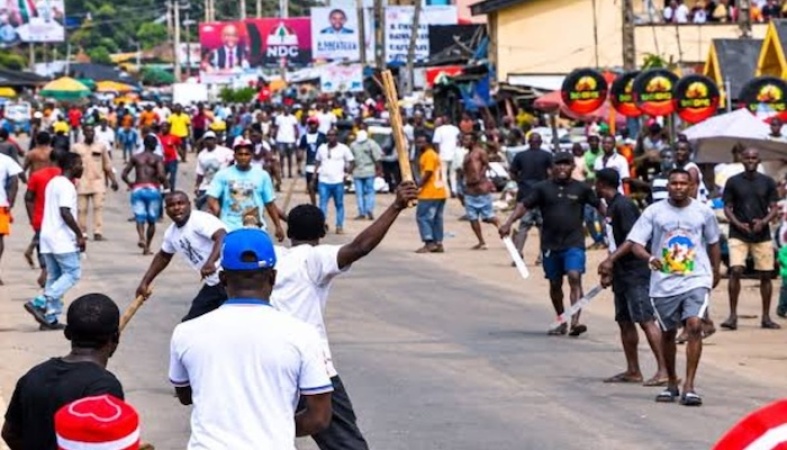
More disturbing is that political violence is no longer limited to clashes between rival supporters. It increasingly involves attempts to deny opponents access to public spaces, prevent meetings, disrupt campaigns and intimidate citizens supporting alternative political platforms. This is a dangerous assault on democracy that should concern every Nigerian, regardless of political affiliation.
Recent incidents paint a grim picture. In Lagos, suspected political thugs armed with guns, cutlasses and axes disrupted a Nigeria Democratic Congress (NDC) town hall meeting organised for its presidential candidate, Peter Obi, and running mate, Rabiu Kwankwaso. Two supporters were injured, while vehicles and property were damaged. Although the Lagos APC denied involvement, the police confirmed the incident, which demands a thorough investigation.
In Delta State, an attack on NDC supporters during a rally left one person dead and five injured. Violence during an APC rerun primary in Zamfara reportedly claimed two lives, with others sustaining gunshot injuries. Edo has witnessed attacks on party offices, billboards and supporters, including the reported shooting of an ADC member in Igueben. In Gombe, armed youths blocked roads, set tyres ablaze and attacked vehicles to obstruct the entry of PDP governorship candidate Isa Ali Pantami into the state capital.
Reports from Katsina, Kebbi, Enugu, Ekiti, Ondo, Ebonyi, Osun, Cross River and Nasarawa further point to a widening pattern of political hostility.
The situation in Sokoto is particularly reprehensible. Reported attempts to frustrate the African Democratic Congress (ADC) campaign through the sabotage of bookings and sealing of its secretariat suggest an alarming misuse of political and administrative power. State governments have no business deploying public institutions and machinery against political opponents.
The National Peace Committee’s monitoring report is equally troubling. It documented 109 breaches of the National Peace Accord across 26 states and the Federal Capital Territory between August 19 and October 27.
The Nigeria Civil Society Situation Room also reported 70 physical election-related attacks across 19 states and the FCT between January 1 and October 27, 2026. Twenty incidents resulted in 27 deaths. These figures are frightening.
Public anxiety is just as alarming. A September survey by Yiaga Africa found that 61 per cent of respondents feared violence could prevent them from voting, while 82 per cent were concerned that insecurity could affect the elections. An election in which citizens fear attending rallies, travelling to campaign venues or approaching polling stations is already failing an essential test of democracy.
International organisations have also raised the alarm. Amnesty International, reacting to the attack on Pantami’s campaign convoy in Gombe, described it as a deliberate attempt to prevent him from entering the state capital. It warned that persistent attacks on opposition figures could make peaceful political activities impossible and demanded impartial investigations and prosecution of those responsible. The European Union has similarly warned that electoral violence, hate speech and intimidation undermine democracy and discourage participation.
The Commonwealth has also consistently condemned election-related violence in Nigeria, urging political parties to honour the National Peace Accord and stressing that violence has no place in a modern democracy. These concerns should not be dismissed as routine diplomatic observations. Nigeria’s position as Africa’s largest democracy carries responsibilities its political class cannot afford to trivialise.
What is emerging is a political environment in which tolerance for opposing views is rapidly disappearing. This is particularly disappointing when compared with the atmosphere preceding the 2015 elections, when the then opposition APC campaigned across the country. The PDP’s tolerance of those activities provided an important democratic contrast. Freedom to campaign should be a basic right, not a privilege granted at the discretion of those in power.
The same intolerance is evident in inflammatory rhetoric and threats. INEC has warned against the dangerous slogan, “Rig and Die”, which could expose election officials and other participants to attacks. Political disagreements are increasingly framed as existential battles in which opponents are treated as enemies rather than fellow citizens. We at Weekend Trust find this development utterly disturbing. The pursuit of power must never override respect for the rights and lives of Nigerians.
The conduct of some government officials and the apparent deployment of state power against opposition activities are equally troubling. President Bola Tinubu, as leader of the APC, cannot absolve himself of responsibility for the conduct of governors elected on the party’s platform. He should rein in those using incumbency to suffocate political competition. Opposition parties, for their part, must win support through credible programmes and superior arguments, not intimidation or inflammatory rhetoric.
The Electoral Act 2026 provides safeguards against these abuses. It prohibits the use of state apparatus to advantage or disadvantage any political party or candidate and guarantees parties the right to hold rallies, meetings and processions. Its provisions against threats and violence during campaigns also prescribe penalties for offenders. INEC’s Regulations and Guidelines for Political Parties provide further safeguards. These provisions must not remain mere declarations of good intentions. INEC should monitor compliance, investigate violations and apply appropriate sanctions, while referring criminal offences to the relevant authorities.
Security agencies must also protect the political space impartially. Allegations of complicity or partisan conduct by security operatives are a serious wake-up call. Their constitutional duty is to protect all Nigerians, not serve the interests of those in power.
The National Peace Committee must equally move beyond raising the red flag. Having secured commitments from political parties to peaceful campaigns, it should engage political leaders, governors and security agencies, mediate emerging conflicts and demand accountability for violations.
The House of Representatives’ condemnation of the attacks and decision to investigate them are welcome, but Nigerians need more than resolutions. They need concrete action to stop the violence before it overwhelms the electoral process. All political actors must recognise that democracy cannot survive where opponents are denied the freedom to compete and citizens are frightened into silence. (Weekend Trust)