ADAD

Updating your news feed...
NEWS EXPRESS is Nigeria’s leading online newspaper. Published by Africa’s international award-winning journalist, Mr. Isaac Umunna, NEWS EXPRESS is Nigeria’s first truly professional online daily newspaper. It is published from Lagos, Nigeria’s economic and media hub, and has a provision for occasional special print editions. Thanks to our vast network of sources and dedicated team of professional journalists and contributors spread across Nigeria and overseas, NEWS EXPRESS has become synonymous with newsbreaks and exclusive stories from around the world.










Loading banners
Loading banners...

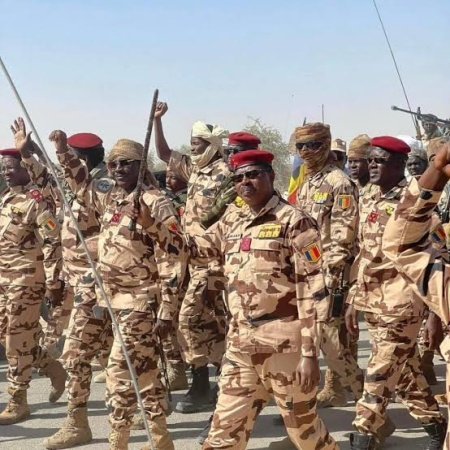
Chadian military
At least 23 soldiers of Chad’s elite Directorate-General of Special Services and Special Institutions (DGSSIE) have reportedly been killed in fierce fighting in Arkinya, in the Tibesti region, as clashes over control of gold mining areas intensify.
The fighting, which reportedly occurred on November 10, also left about 10 other soldiers injured, including several said to be in critical condition and requiring evacuation to Faya, according to a report by TchadOne, citing military sources.
Among those reportedly killed was a commander of the Command, Support and Assistance Company (COM/CCAS) attached to a DGSSIE regiment, indicating the severity of the confrontation.
The latest casualties underscore the growing human cost of the struggle for control of mineral-rich territories in northern Chad, where gold mining has increasingly become intertwined with armed conflict, military operations and competing economic interests.
According to sources the Chadian military has suffered hundreds of casualties, including dead and wounded personnel, since the beginning of the campaign to control gold-rich areas in Tibesti.
The report described the confrontation as a deadly conflict linked to the mining interests of the administration of President Mahamat Idriss Déby Itno, popularly known as Mahamat Kaka.
Tibesti, a vast and strategically sensitive region bordering Libya and Niger, has long been associated with gold mining, informal commercial networks and armed groups competing for influence over mineral-rich territories.
The region’s difficult terrain, remote settlements and porous borders have also complicated government efforts to establish effective security and administrative control.
The latest fighting raises fresh questions about the militarisation of mineral extraction in the Sahel, where gold has increasingly become both an economic lifeline and a source of violent competition.
Across Chad, Niger, Mali, Sudan and parts of northern Nigeria, the struggle over mineral resources has created overlapping interests involving armed groups, criminal networks, informal miners and state-linked economic actors.
The reported deaths in Arkinya further illustrate how mineral wealth, instead of generating prosperity for communities, can become a catalyst for prolonged military confrontation. (Zagazola)