ADAD

Updating your news feed...
NEWS EXPRESS is Nigeria’s leading online newspaper. Published by Africa’s international award-winning journalist, Mr. Isaac Umunna, NEWS EXPRESS is Nigeria’s first truly professional online daily newspaper. It is published from Lagos, Nigeria’s economic and media hub, and has a provision for occasional special print editions. Thanks to our vast network of sources and dedicated team of professional journalists and contributors spread across Nigeria and overseas, NEWS EXPRESS has become synonymous with newsbreaks and exclusive stories from around the world.












Loading banners
Loading banners...

Stranded travellers
By EMMANUEL YASHIM
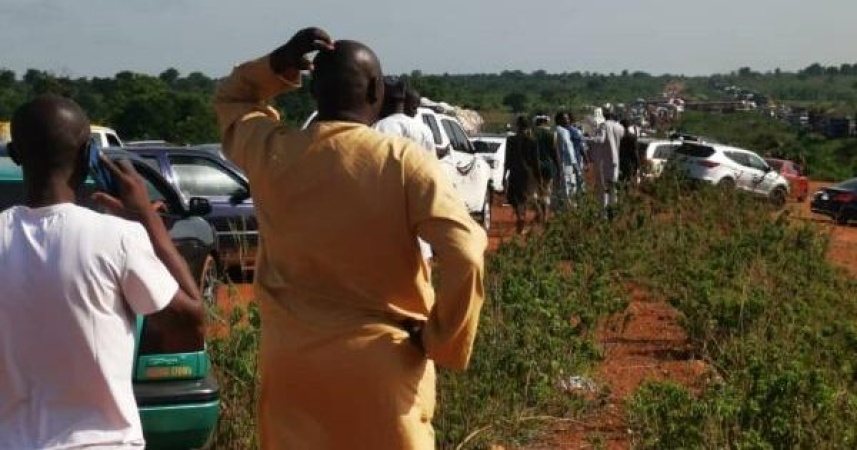
Many travelers were stranded for hours on Monday at Gidan Busa, just before Katari, on the Kaduna-Abuja highway, following multiple accidents involving long vehicles.
The gridlock, which stretched beyond the point where the eye could follow it and faded into the haze, left motorists, passengers and goods stranded under the sun, with many missing appointments and deliveries.
Sarah Monday, a fashion designer travelling to Abuja for a contract meeting, told the News Agency of Nigeria (NAN) that she lost the meeting due to the standstill.
For Monday, the gridlock was never just a traffic jam. It was a contract meeting in Abuja that she was never going to reach.
She appealed to the Federal Government to complete the highway soon, so that the hardship faced by its users would be reduced, especially during Salah, Christmas and other festive periods.
Her frustration was shared by everyone caught in the queue.
Along the stretch, the road had stopped being a route and become a place to wait.
Cattle trucks with their loads of livestock stood bumper to bumper with Lorries piled high with sacks and bundled cargo, and fuel tankers loomed over saloon cars and minibuses wedged into every available gap.
With no prospect of moving, people made a kind of life out of the delay.
Passengers climbed on top of the loads, settling among sacks and cargo with their legs dangling over the sides, while on another truck a handful of men sat atop the cattle frames, watching the endless line below. Behind the slatted sides of the blue trucks, the animals stood in the rising heat.
On the red-earth diversion beside the unfinished concrete carriageway, men in long gowns and caps stood in small clusters, hands on hips, trading guesses about when the line might move.
Some leaned against car doors, while others paced the length of the queue as though measuring it. A few sat in the shade of an excavated bank, resting against the dirt.
Near a grey estate car, a motorist lifted the bonnet and bent over the engine, one more problem in a place that already had too many.
Beside the dusty diversion, the half-finished road told its own story. A smooth stretch of concrete ran alongside coarse gravel, the road that is meant to be, next to the one travelers were forced to use. Yellow wildflowers bloomed on the embankment nearby, oblivious to the stalled traffic.
Abubakar Lawal, a driver caught in the traffic, blamed the gridlock on the impatience of motorists. With the situation as it was, he said, nobody knew when the road would be cleared.
Another driver, Yusuf Aliyu, said if he had known the highway would be in such a state, he would not have embarked on the trip to Abuja at all.
For those whose livelihoods depend on the road, such regrets carry weight. Every hour lost at Gidan Busa meant delayed deliveries, missed appointments and tired travelers, as well as animals and perishable goods waiting in the open.
Adewale Usman, a businessman, said trailers and other long vehicles were the greatest contributors to such situations.
He called on the Federal Government to ensure that the railways were brought on stream, so that fuel tankers and similar vehicles would no longer have to use the highways to travel long distances to freight goods across the country.
His appeal reflects a view common among road users, that the movement of heavy goods by road puts pressure on highways that were never meant to carry so much, with consequences for everyone sharing them.
A road safety official, who asked not to be named, echoed the drivers’ view, saying the gridlock could have been avoided if drivers had been patient.
But the official also pointed to a more sobering reality behind the day’s delay.
According to him, no fewer than 20 accidents involving long vehicles occur on the route every month, with a lot of fatalities recorded and animals sometimes affected as well.
The figure suggests that Monday’s standstill was not an isolated event.
For many who use the corridor, it is part of a recurring pattern in which a single crash by a heavy vehicle can freeze the traffic behind it for hours, especially where roadworks have pushed vehicles onto narrow diversions.
As of the time of filing this report, patience had begun to run out. Many motorists had started turning back towards Kaduna, with a lot of them saying they would travel to Abuja through the Kachia-Bwari road instead.
For those who chose to stay, the wait continued under the sun, in a queue where nobody could say when the line would move again.
For travelers like Monday, the cost of the delay was measured in more than hours. It was the meeting missed, the journey regretted and the festive seasons ahead that she hopes will not bring the same ordeal.
Her plea, and those of the drivers and businessman around her, was simple: finish the road, ease the burden on those who use it, and make sure a journey to Abuja does not end at Gidan Busa. (NAN)