 ADAD
Updating your news feed...

NEWS EXPRESS is Nigeria’s leading online newspaper. Published by Africa’s international award-winning journalist, Mr. Isaac Umunna, NEWS EXPRESS is Nigeria’s first truly professional online daily newspaper. It is published from Lagos, Nigeria’s economic and media hub, and has a provision for occasional special print editions. Thanks to our vast network of sources and dedicated team of professional journalists and contributors spread across Nigeria and overseas, NEWS EXPRESS has become synonymous with newsbreaks and exclusive stories from around the world.





.webp)











Loading banners
Loading banners...

A federal judge in Minnesota has ordered that the Donald Trump administration return a Nicaraguan national from the Central African Republic, where he has been since August despite having never visited or holding any connection to the country.
Kenis Adalberto Lopez Gonzalez came to the U.S. in 2022—immediately turning himself into immigration authorities—and was permitted to remain thanks to a 2024 ruling based on credible fears he could face torture if returned to his home country.
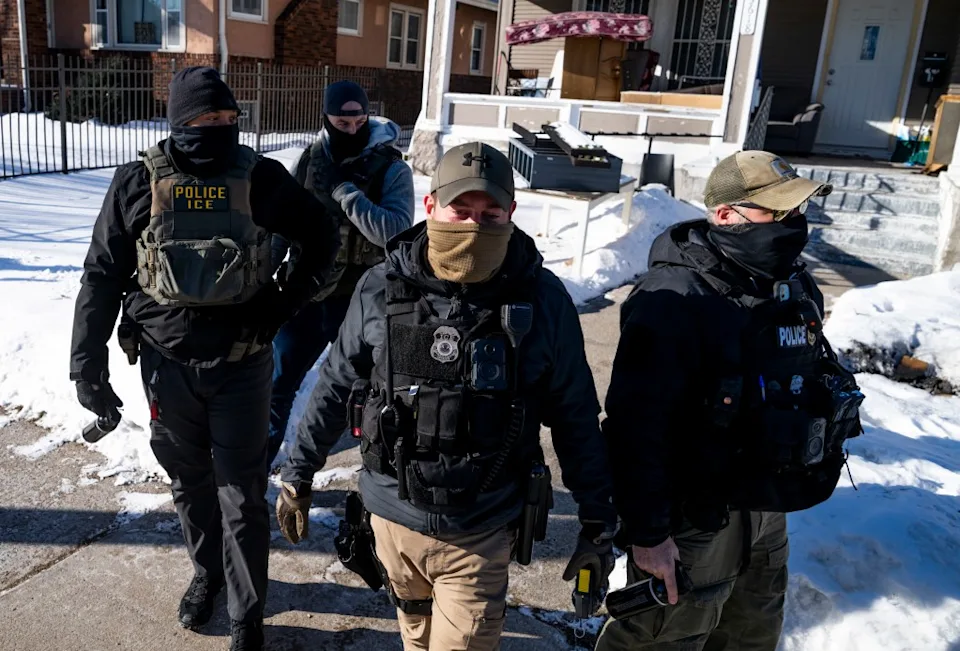
Immigration and Customs Enforcement (ICE) detained him in January before he was sent to the African nation—one of dozens the U.S. now has a third-country deportation arrangement with.
But on Friday, the U.S. District Court for the District of Minnesota ordered the government to arrange his return to the U.S. "as soon as practicable."
"ICE violated Mr. Lopez's constitutional rights, and hardly even denied it," Simon Sandoval-Moshenberg, an attorney for Lopez, told Newsweek in an emailed statement Saturday. "Their main argument was that since he's now been deported, he's beyond the reach of the federal courts. We are pleased that the district judge did not credit that argument, and has now ordered the government to bring him back to Minnesota so that he can finally have his day in court."
Newsweek has contacted ICE and the Department of Homeland Security (DHS) for comment.
As chronicled in court records, Lopez entered the U.S. in late 2022. While he was subject to a removal order, a judge ruled in August 2024 that he could not be deported due to concerns over his safety if he was returned to Nicaragua.
However, Lopez was detained in January 2026 amid the largescale enforcement operation in Minnesota—Operation Metro Surge—and was deported to the Central African Republic in August following several months in detention centers. According to the court's findings, Lopez previously resided in Shakopee, Minnesota, ran a construction company and had no criminal record.
The court has learned that, during his time in the African nation, he has been "a target for violent criminals," that he cannot leave the country "for lack of status," and that he "fears bodily harm if he goes outside."
The court noted that there exist "serious and known risks to foreigners in the Central African Republic," and that the U.S. State Department has since January assigned it a Level 4 "do not travel" travel advisory.
While it did not weigh on the broad legality of third-country deportation by the U.S. government, the court finds at this preliminary stage that immigration officials likely violated his due-process rights when Lopez was taken into custody this year.
In Friday's order, Judge Jeffrey M. Bryan told DHS and ICE to "arrange for and facilitate Lopez's return to the United States from the Central African Republic by taking all reasonable steps within their control to do so."
"Defendants shall return Lopez to the District of Minnesota and shall thereafter not remove him from the District while this matter is pending," the order reads.
"ICE violated Mr. Lopez's constitutional rights, and hardly even denied it," Simon Sandoval-Moshenberg, an attorney for Lopez, told the Minnesota Reformer.
The administration has been open in defending third-country deportations, framing this as a necessary and fair enforcement tool in situations where an individual's country of origin will not accept them, and if the policy is focused on serious criminals.
In a press release last week, Department of Homeland Security (DHS) Secretary Markwayne Mullin said agreements with several nations now allowed the U.S. to remove "those who are so barbaric that even their home countries won't take them back."
"For far too long, illegal aliens ordered removed by a judge have avoided deportation simply because DHS had no place to send them," Mullin continued.
The U.S. Department Of Homeland Security logo is displayed at an office on January 16, 2026 in San Diego, CA.
Federal immigration law does establish circumstances in which individuals may be deported to a country they do not hail from and where they have not previously lived, though the practices has still faced criticism on legal and human rights grounds.
Writing on X, Minnesota Representative Angie Craig said that Gonzalez had "fled political violence" in Nicaragua, and described him as a "business owner" who had a "work permit as well as a court order preventing his deportation."
Craig called third-country deportations "dangerous and unacceptable," and said there was "no reason a law-abiding Minnesotan should be deported to a country where they have never been."
Thanks to agreements with several countries and the Supreme Court lifting bans on third-country deportations, the administration has been able to remove thousands during Trump's second term. According to the website Third Country Deportation Watch, 20,000 individuals have ended up in Mexico.
As of as of Oct. 27, Third Country Deportation Watch says over 170 individuals have been transferred to the Central African Republic. (Newsweek)




