ADAD
Updating your news feed...

NEWS EXPRESS is Nigeria’s leading online newspaper. Published by Africa’s international award-winning journalist, Mr. Isaac Umunna, NEWS EXPRESS is Nigeria’s first truly professional online daily newspaper. It is published from Lagos, Nigeria’s economic and media hub, and has a provision for occasional special print editions. Thanks to our vast network of sources and dedicated team of professional journalists and contributors spread across Nigeria and overseas, NEWS EXPRESS has become synonymous with newsbreaks and exclusive stories from around the world.







.webp)






.webp)






Loading banners
Loading banners...

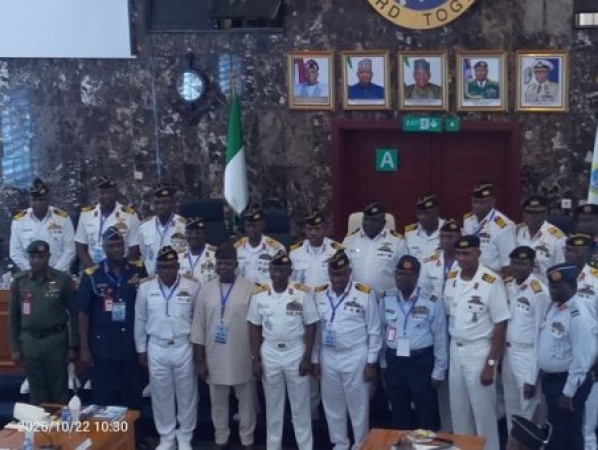
The Nigerian Navy is planning to establish a research institute and research and development cells across its commands to develop indigenous technologies, reduce operational costs and strengthen its combat capabilities.
The Chief of Naval Staff (CNS), Vice Admiral Idi Abbas, disclosed this on Thursday while delivering the keynote address at the Nigerian Navy’s 2026 Research and Development Seminar, held at the Naval Headquarters, Abuja.
Abbas said the initiatives were designed to institutionalise innovation, harness naval personnel’s ingenuity, and translate research into practical, affordable solutions to operational challenges.
He said the Navy needed to embrace emerging technologies to counter increasingly sophisticated maritime threats, protect critical national infrastructure and improve its contribution to national security.
“The objective is not to simply acquire more technology, but to achieve greater operational effect with the resources available at our disposal,” the CNS said.
He noted that criminal networks were increasingly exploiting technology to evade detection and threaten critical national assets, requiring improved intelligence gathering, accurate surveillance and more effective deployment of military resources.
Abbas said technology-enabled maritime surveillance had improved the Navy’s awareness of activities within Nigeria’s maritime domain and helped direct patrols towards identified threats.
According to him, the intelligence-led approach also enabled the service to deploy its limited assets more efficiently, reduce fuel and maintenance costs, and improve operational response.
The naval chief said surveillance of offshore installations and other critical infrastructure had strengthened efforts to combat crude oil theft and related economic crimes, helping to create a more secure environment for oil production.
He added that emerging technologies offer opportunities to extend surveillance to creeks and adjoining coastal areas to monitor and protect pipelines.
Abbas said the Navy’s progress in indigenous shipbuilding and maintenance through its dockyard and shipyard demonstrated the service’s growing capacity to develop and sustain operational capabilities locally.
He said the increasing deployment of naval personnel, including Marines and Special Forces, in joint counter-terrorism and counter-insurgency operations had heightened the need for improved intelligence gathering, unmanned surveillance, secure communications and battlefield awareness.
He said the proposed research institute and command-level research and development cells would help meet these requirements by turning research into equipment and systems operational units could deploy.
Abbas, however, stressed that developing effective military technology required collaboration with universities, research institutions and indigenous industries.
He said, “It is important to note that meaningful innovation cannot be achieved through isolated efforts. It requires purposeful collaboration with universities, research institutions, and indigenous industries, with emphasis on developing, testing, and deploying solutions that meet operational needs.
“I therefore expect this seminar to identify specific capability gaps, recommend viable research partnerships, and establish practical pathways for translating promising innovations into equipment and systems that can be employed by our operational units.”
He urged participants at the seminar, themed “Deepening the Application of Emerging Technologies for Operational Effectiveness,” to identify capability gaps, recommend viable research partnerships and establish practical ways to translate promising innovations into operational solutions.
He said the initiative’s success would be measured by the capabilities developed, resources saved, and operational results achieved.
The CNS commended President Bola Tinubu for his continued support in strengthening the Navy’s operational capabilities. He also praised the Naval Transformation and Innovation Branch for organising the seminar.
The Chief of Transformation and Innovation, Rear Admiral Chijioke Oyenmobi, said the seminar was designed to harness emerging technologies and intensify research efforts in line with the Chief of the Naval Staff’s vision to enhance operational capabilities and promote indigenous solutions.
He said developing local technological capacity was essential to improving the service’s operational readiness and achieving self-reliance.
Oyenmobi said emerging technologies, including unmanned systems, artificial intelligence, advanced sensors, and additive manufacturing, are reshaping naval operations, fleet maintenance, and sustainment.
He said rising costs for imported platforms and spare parts, coupled with long supply lead times, make it imperative for the Navy to strengthen its domestic research and technological capabilities.
“A navy that depends entirely on others for its technology cannot fully control its own readiness,” he said.
He described research and development as the link between emerging technologies and the Navy’s operational requirements, as well as a pathway towards reducing external dependence. (The Nation)