 ADAD
ADADUpdating your news feed...

NEWS EXPRESS is Nigeria’s leading online newspaper. Published by Africa’s international award-winning journalist, Mr. Isaac Umunna, NEWS EXPRESS is Nigeria’s first truly professional online daily newspaper. It is published from Lagos, Nigeria’s economic and media hub, and has a provision for occasional special print editions. Thanks to our vast network of sources and dedicated team of professional journalists and contributors spread across Nigeria and overseas, NEWS EXPRESS has become synonymous with newsbreaks and exclusive stories from around the world.

















Loading banners
Loading banners...

Gov Otti
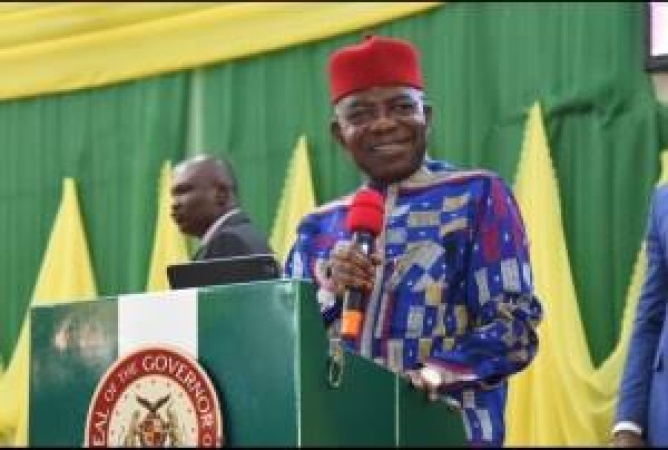
Abia State Governor Alex Otti has pledged to support the development of Michael Okpara University of Agriculture, Umudike (MOUAU), and announced plans to establish technology-driven farm settlements to boost food production and transform the state into a net exporter of agricultural produce.
Otti made the pledge on Thursday at the third Dr Michael Iheonukara Okpara Memorial Lecture, organised by MOUAU in honour of the late premier of the defunct Eastern Region.
The governor, who spoke on the theme, “The Immortality of Good Works,” said Abia must acknowledge its shortcomings and take practical steps to improve its performance, particularly in agriculture and economic development.
“We are not a failure, but we have not done well, and we must accept it. This is, therefore, a wake-up call for us to start doing well, because we can do well,” he said.
Otti announced the constitution of a working group comprising government officials, university representatives and agricultural experts to identify Abia’s comparative advantages and develop an implementation plan for the proposed farm settlements.
He said he would lead and facilitate the team’s work, while directing the university’s Vice-Chancellor, Professor Ngozi Ursula Akanwa, to nominate up to two experts to join the group.
The governor pledged to fund the initiative and expressed optimism that it would begin producing the desired results within one year.
“I want us to start with a farm settlement. We want to take it to this level now, where we introduce technology, and we don’t only want to be self-sufficient in food production. We want to be a net exporter of food for Abia State,” he said.
Otti identified palm produce, cocoa, avocado and cashew as potential investment areas, stressing the need to move beyond subsistence farming to commercial agriculture, processing and exports.
He urged stakeholders to harness research and technology to unlock the state’s agricultural potential, improve productivity and make farming more profitable.
The lecture brought together thousands of participants from different walks of life at the university’s new lecture theatre to reflect on Okpara’s legacy and explore ways to adapt his development philosophy to contemporary challenges.
Okpara, born on December 25, 1920, served as premier of the defunct Eastern Region from 1959 to 1966. He died on December 17, 1984, aged 63.
Participants recalled his contributions to agriculture, food production, exports, industrialisation, employment, education and accountable governance, urging leaders in the South-East to revive his development vision through strategic investments and modern technology.
The chairman of the event, renowned businessman and Oranto Petroleum chief, Prince Arthur Eze, was represented by the Pro-Chancellor of Paul University, Awka, Anambra State, Dr Emeka Eze.
Eze announced a N200 million support for the university and joined other speakers in highlighting Okpara’s reputation for public service and personal integrity.
He said the late premier built public wealth through development initiatives without accumulating a personal fortune, noting that he died without building a befitting home for himself.
He challenged Nigerian leaders to embrace Okpara’s philosophy that government should create wealth and improve citizens’ welfare rather than serve as a platform for personal enrichment.
According to him, Okpara transformed the Eastern Region through agriculture, making it one of the world’s fastest-growing economies at the time.
He cited farm settlements in Ohaji, Igbariam, Ulonna and Obubra, alongside industrial development, free education and scholarships, as examples of the late premier’s achievements.
Other speakers, including Otti, MOUAU’s Pro-Chancellor and Chairman of Council, Comrade Fidelis Edeh; Akanwa; the Executive Director of the National Root Crops Research Institute (NRCRI), Umudike, Professor Chiedozie Egesi; and Okpara’s son, Chief Uzodinma Okpara, paid tribute to the late premier.
They lamented that successive administrations in states carved out of the defunct Eastern Region had not fully replicated the development achievements associated with Okpara’s government.
They called for a renewed commitment to his vision, arguing that modern technology, effective leadership and investment in agriculture could help address food insecurity, create jobs and stimulate economic growth.
Edeh said leadership should be measured by courage, integrity, sacrifice, unity and tangible contributions to society rather than the length of time spent in office or the positions occupied.
He described Okpara as a great statesman whose agricultural revolution remained a significant example of development-oriented leadership.
Edeh urged contemporary leaders to learn from the late premier’s commitment to harnessing agriculture for economic transformation. He also commended Otti’s performance and said the governor’s continued membership of the political party that brought him to power demonstrated that good governance was possible.
Akanwa said the university’s priorities aligned with President Bola Tinubu’s Renewed Hope Agenda and Otti’s agricultural reforms, particularly in food security, commercial farming, productivity and sustainable agricultural value chains.
She said Nigeria must embrace digital technologies to improve farm productivity, reduce post-harvest losses and strengthen agricultural value chains rather than rely solely on traditional farming methods.
The vice-chancellor called for increased investment in agricultural technology, research and innovation to address food insecurity, expand agribusiness and drive economic development.
She said Okpara’s achievements demonstrated how strategic investments in agriculture, education, research and rural infrastructure could promote industrial growth, prosperity and employment.
Akanwa also commended Otti for supporting the university’s development and improving its facilities, including the installation of a statue of the late premier at the institution’s main entrance.
She pledged that the university would translate Okpara’s legacy into practical results through relevant research, quality graduates and solutions to agricultural challenges.
“Our task is to move beyond commemoration to action, emphasising the need to ensure that technological innovation delivers food security, stronger agribusiness and sustainable livelihoods,” she said.
Akanwa said MOUAU was positioning itself as a leading agricultural hub in the South-East through infrastructure improvements, functional laboratories, digital facilities and entrepreneurial training.
She listed artificial intelligence, precision farming, biotechnology, improved crop varieties, smart irrigation, satellite monitoring and digital agricultural markets as tools that could transform Nigeria’s agricultural sector.
The NRCRI chief, Egesi, also advocated technology-driven agriculture to increase farmers’ earnings, reduce losses and stimulate industrialisation.
He said the institute was deploying conventional breeding and modern genomic techniques to develop higher-yielding, disease-resistant, climate-resilient and nutritious varieties of cassava, yam, sweet potato and other root and tuber crops.
Egesi stressed the need to improve farmers’ access to quality planting materials through decentralised seed multiplication systems.
He defined technology as “anything that enables a farmer to produce more, to lose less, to earn more and to manage his risk better”.
He called for stronger collaboration among universities, research institutes, businesses and governments to turn research into commercially viable innovations.
“ Nigeria must move beyond exporting raw produce to processing crops into food products, livestock feed, starch and other industrial raw materials,” he said.
Okpara’s son, Uzodinma, expressed appreciation for the tributes paid to his father and commended the university for sustaining his agricultural legacy.
He urged the South-East and the wider country to revive the late premier’s Green Revolution vision by deploying modern technology to improve food security, increase agricultural productivity and create wealth.
“It will not simply be about growing more. It will be about growing more in a smarter way, adding value, connecting to markets, and turning science into prosperity,” he said.
He also praised Akanwa and her management team for sustaining the university’s agricultural mandate, noting that its farm experiments and departmental research reflected a commitment to practical agriculture.
Delivering the lecture, Payaza Africa Limited founder and Chief Executive Officer, Seyi Ebenezer, urged Nigerian and African leaders to draw lessons from Okpara’s development philosophy.
He maintained that Africa possessed the resources and capacity to drive its own development without depending excessively on external assistance, stressing the importance of innovation, technology and purposeful leadership in building a more productive agricultural sector. (The Guardian)




