Updating your news feed...

NEWS EXPRESS is Nigeria’s leading online newspaper. Published by Africa’s international award-winning journalist, Mr. Isaac Umunna, NEWS EXPRESS is Nigeria’s first truly professional online daily newspaper. It is published from Lagos, Nigeria’s economic and media hub, and has a provision for occasional special print editions. Thanks to our vast network of sources and dedicated team of professional journalists and contributors spread across Nigeria and overseas, NEWS EXPRESS has become synonymous with newsbreaks and exclusive stories from around the world.












Loading banners
Loading banners...

The World Bank, yesterday, tasked state governments to convert the substantial fiscal space created by recent economic reforms into better jobs, public services, and living standards.
The bank said increased revenues would have limited development impact if not matched by more efficient and accountable spending.
World Bank Country Director for Nigeria, Mathew Verghis, gave the charge in Abuja while presenting the latest Nigeria Development Update (NDU), titled, “Beyond the Federal Purse: How Higher Revenues Reshaped State Priorities.”
Verghis said the reforms had substantially increased fiscal revenues available to states, creating a “unique opportunity” to expand critical economic and social infrastructure.
He stated, “The bold macroeconomic reforms have substantially increased fiscal revenues at the state level, providing a unique opportunity to improve infrastructure, education, healthcare, and water services, which are critical to creating more and better jobs.
“Strengthening spending efficiency, accountability, and service delivery will be essential to ensuring that public resources improve the lives of Nigerians.”
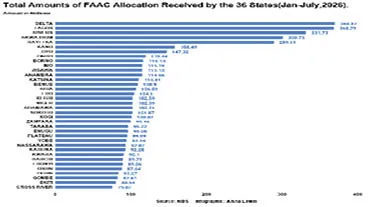
According to the update, gross federation revenues increased by 69 per cent in real terms between 2023 and 2025, while state revenues rose by about 93 per cent over the same period. State expenditure also increased by about 92 per cent.
But the surge in resources had so far been channelled more aggressively into economic infrastructure and fiscal consolidation than human-capital development.
World Bank said the share of capital expenditure in total state spending rose from 46 per cent to 61 per cent between 2023 and 2025, with transport infrastructure recording the largest increase.
Presenting the report, World Bank Chief Economist for Nigeria, Dr. Fiseha Haile, said spending priorities had shifted towards economic infrastructure in 29 of the 33 states for which data were available.
“Transport, particularly road infrastructure, experienced the largest increase in spending across more than 30 states out of the 35 states for which we have data,” Haile said.
While spending on health, education and social protection also increased in absolute terms, they expanded more slowly than economic infrastructure, the report said.
The share of education in total state expenditure consequently declined from 14.9 per cent in 2021 to 12.1 per cent in 2025, while health spending remained broadly stable at seven per cent.
Social protection performed better, with its share rising from 1.4 per cent to 4.4 per cent.
World Bank said the pattern underscored the need for states to use their improved fiscal positions to strengthen human capital and service delivery, particularly if Nigeria was to translate economic growth into sustained poverty reduction and employment.
21 States Cut Debt Burden
Beyond infrastructure spending, higher revenues also strengthened state balance sheets.
The report disclosed that 21 states significantly reduced their debt-to-GDP ratios between 2021 and 2025, supported largely by stronger federation transfers.
However, Haile cautioned that the aggregate improvement concealed substantial differences among states, with some recording strong fiscal surpluses while others posted deficits, as expenditure outpaced revenues.
He said the policy challenge was no longer simply to increase revenues but to ensure that the additional fiscal space generated measurable development outcomes.
States also recorded progress in internally generated revenue, with about 14 states posting increases of more than 50 per cent. Enugu, Abia and Osun were among the leading performers.
The bank urged states to deepen domestic revenue mobilisation, particularly through personal income and property taxation, in order to reduce exposure to volatile federation transfers.
It also noticed significant improvements in fiscal transparency, with nearly all states now publishing budgets, quarterly budget implementation reports, audited financial statements, and debt reports.
Haile said the next challenge was to translate improved fiscal information into better spending decisions.
“Building on these significant gains, the next step is to strengthen fiscal institutions to turn better information and improved fiscal data into better results,” he said.
He identified persistent weaknesses in the alignment between budgeted and actual capital expenditure, cash and commitment controls, public investment management and fragmented financial management systems.
The bank called for stronger own-source revenue mobilisation, credible budgeting, improved public investment management, and closer alignment between expenditure and development priorities.
It urged stronger federal-state fiscal coordination to reward reforming states, improve resource utilisation, and reduce exposure to revenue volatility.
At the broader economic level, World Bank said the Nigerian economy remained resilient in the face of renewed global shocks, with real GDP expanding by 4.2 per cent in the first half of 2026, compared with 3.9 per cent and 3.5 per cent in the corresponding periods of 2025 and 2024, respectively.
The bank said the expansion was driven largely by services, alongside stronger contribution from agriculture.
It added that the improvement in growth had stabilised the poverty rate for the first time since 2019.
The Middle East conflict, however, produced mixed effects on the economy.
Higher oil prices boosted export earnings and helped expand the current account surplus to $12 billion, equivalent to 7.1 per cent of GDP, in the first half of 2026, from $8.6 billion or 6.7 per cent of GDP a year earlier.
Gross external reserves also rose above $55 billion in September, supported significantly by foreign portfolio inflows, while reforms continued to improve the functioning of the foreign exchange market.
Haile said the premium between the parallel and official foreign exchange markets had remained marginal at less than two to three per cent for an extended period.
Infrastructure Spending Rises Faster Than Social Sectors
The report examined how higher public revenues were changing state finances between 2023 and 2025. It stated that gross federation revenues increased by 69 per cent in real terms over the period, driven largely by exchange-rate reforms, the removal of the petrol subsidy, and stronger revenue administration, with states receiving the biggest boost through higher statutory allocations, refunds, intervention funds and stronger VAT collections.
As aggregate state revenues rose by about 93 per cent rose in real terms between 2023 and 2025, the World Bank report said expenditures increased by about 92 per cent.
Capital spending expanded and its share of total expenditure climbed to 61 per cent, from 46 per cent, led by transport infrastructure as well as higher spending on housing, agriculture, and other growth-related investments.
Spending on health, education and social protection also increases, but at a slower pace than economic infrastructure. Education’s share of total expenditure falls to 12.1 per in 2025 from 14.9 per cent in 2021, health spending stays broadly stable at around 7 per cent, and social protection’s share rises to 4.4 per cent. from 1.4 per cent.
Inflation Still Weighs on Households
Despite the improved external position, inflation remained a major constraint on household welfare and business activity.
World Bank said headline inflation had fallen sharply from 27.6 per cent in January 2025 to 15.2 per cent in December 2025, supported by tight monetary policy and reduced exchange-rate volatility.
However, higher fuel prices following the Middle East conflict, coupled with lean-season food pressures, had slowed the disinflation process.
Haile said higher energy costs were feeding into food and transportation prices while raising production costs for businesses and financing pressures for governments.
He stated that Nigeria’s inflation remained high compared with several peer economies, citing Ghana’s decline from above 50 per cent in 2023 to about five per cent by August 2026.
Fiscal Gains Face Election-year Test
World Bank also reported an improvement in Nigeria’s fiscal position during the first half of 2026.
The federal fiscal deficit narrowed from five per cent to four per cent of GDP, while the aggregate fiscal surplus of states increased from 0.7 per cent to 0.9 per cent of GDP, reflecting stronger federation transfers.
The public debt-to-GDP ratio consequently declined from about 40 per cent in 2025 to an estimated 38 per cent in 2026.
However, Haile warned that spending pressures could intensify in the second half of the year due to faster project execution, development expenditure, and election-related spending.
He identified the Middle East conflict, possible global monetary tightening and El Niño-related shocks as key downside risks.
World Bank projected average economic growth of 4.4 per cent between 2026 and 2028, while inflation was expected to decline gradually to about 12 per cent by 2028.
Haile stressed, however, that growth alone would not be enough, stating that jobs, particularly better-quality jobs, should remain the “North Star” of Nigeria’s reform agenda.
He called for sustained macroeconomic stability, increased investment in energy and human capital, improved regulation, stronger market competition and greater mobilisation of public and private capital.
Haile said Nigeria’s experience over the past three years had demonstrated that difficult reforms were possible.
“The task going ahead is to carry the same level of ambition into the structural reforms,” he said.
Essentially, the report disclosed that the country’s revenue reforms had delivered a substantial fiscal windfall to state governments, stating, however, that the bulk of additional resources has been channelled into economic infrastructure and debt reduction rather than a commensurate expansion of education and other human-capital investments.
The report stressed that state revenue windfall, occasioned by fuel subsidy removal, among other reforms, had triggered a major reallocation of spending towards economic infrastructure, while human-capital spending had not kept pace.
Haile said transport spending, particularly road infrastructure, accounted for the sharpest increase, rising from 13 per cent of total state expenditure to about 27 per cent in 2025.
“Transport, particularly road infrastructure, experienced the largest increase in spending across more than 30 states out of the 35 states for which we have data,” Haile said.
The shift followed a 69 per cent increase in gross federation revenues in real terms between 2023 and 2025, driven largely by the removal of the petrol subsidy, foreign exchange reforms, and stronger revenue administration.
States benefited from higher statutory transfers, improved VAT collections, refunds, intervention funds, and the settlement of longstanding federal obligations.
However, World Bank warned that the increase in public resources had yet to translate fully into stronger human-capital outcomes.
According to the report, although state capital expenditure increased significantly, the share of education in total expenditure fell from 14.9 per cent in 2021 to 12.1 per cent in 2025.
Health expenditure remained broadly stable at seven per cent, while social protection increased from 1.4 per cent to 4.4 per cent.
The bank said the spending pattern presented both an achievement and a policy challenge, particularly as Nigeria sought to convert economic recovery into sustained poverty reduction and job creation.
Oyedele Says Per Capita Income Has Grown by About 15 Per Cent
In a panel discussion, Minister of Finance and Coordinating Minister of the Economy, Mr. Taiwo Oyedele, stated that reforms had helped stabilise the economy and put it on a path to faster growth.
Oyedele said Nigeria’s economy was growing faster than its population, adding that with better navigation, inclusive growth was foreseeable.
He added that with the trend, if sustained, poverty reduction would be achieved.
He, however, pointed out that Nigeria’s improving economic indicators were not a sign of full recovery.
The minister said the government recognised the improvement in key economic indicators but insisted that the real test was whether stronger growth would translate into jobs, higher incomes, and improved living standards.
The minister said, “The fact that the economy is growing does not mean that we have arrived. We must avoid complacency.”
While insisting that stability was the foundation and not the destination, he stressed the need for Nigerians to allow ongoing reforms to establish a stronger economic foundation.
He said the government was targeting growth that would have a direct impact on Nigerians rather than simply pursuing higher headline growth figures.
Oyedele said, “We want growth, but not growth for the sake of it. We want growth that creates jobs.”
The minister also pointed to rising government revenue relative to population growth as an indication of improvement in Nigeria’s per capita income, saying per capita income has grown by about 15 per cent in 2026. ( This Day)