Updating your news feed...

NEWS EXPRESS is Nigeria’s leading online newspaper. Published by Africa’s international award-winning journalist, Mr. Isaac Umunna, NEWS EXPRESS is Nigeria’s first truly professional online daily newspaper. It is published from Lagos, Nigeria’s economic and media hub, and has a provision for occasional special print editions. Thanks to our vast network of sources and dedicated team of professional journalists and contributors spread across Nigeria and overseas, NEWS EXPRESS has become synonymous with newsbreaks and exclusive stories from around the world.



















Loading banners
Loading banners...

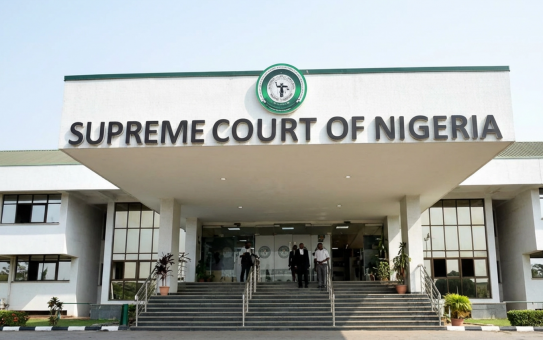
Many candidates in next year’s elections are now anxiously awaiting the official position of the Independent National Electoral Commission (INEC) on their fate, following the recent restoration of certain sections of the Electoral Act 2026 by the Supreme Court.
The commission is expected to speak on the implications of the Supreme Court ruling at a press conference scheduled for Tuesday, October 6 in Abuja.
The apex court, in its ruling, validated Sections 77(5), 77(6), 77(7), and 84(2) of the Act, which the Court of Appeal had taken away on the ground that those sections of the act were inconsistent with the provisions of the 1999 Constitution.
The sections are on party membership registers and nominations.
In specific terms, anyone who participated in more than one party primary risks disqualification, while those whose names are not in a party’s register as of May 2026 are deemed not to be members of the party and also risk disqualification.
The ruling has sparked wild speculation and fears over the fate of candidates who switched camps close to the INEC deadline for the political parties to submit their membership registers.
Candidates whose names appear in the membership register of more than one party are deemed to be in violation of the act and stand the risk of disqualification.
The Nation gathered that following the Supreme Court ruling, the commission has been inundated with inquiries by candidates, parties, and other vested interests for information on those who are deemed to be affected by the decision.
Last week’s judgment of the Federal High Court sitting in Gombe, which voided the APC primary that produced the former Minority Whip of the House of Representatives, Ali Isa JC, has further heightened tension within the parties.
The court had ruled that Ali Isa joined the APC 16 days before the primary that produced him as a candidate, as against the 21 days required by the Electoral Act.
The court held that his name was not established to be in the register submitted to INEC at least 21 days before the primary.
The membership card of the lawmaker shows that he formally joined the APC on April 20, 2026, while the submission of the membership register to INEC closed on May 10.
The APC primary that produced him as a candidate for the Balanga/Billiri Federal Constituency of Gombe State took place on May 16, about 26 days after he joined, but the court ruled that there was no evidence that his name was on the register submitted to the commission.
Justice Vera E. Ibrahim held that Ali Isa’s participation in the APC primary was invalid, unlawful, null, and void because of non-compliance with Section 77, and banned him from participating in a fresh primary to be conducted within 30 days.
Section 77(4) provides that each political party shall make its membership register available to the Commission not later than 21 days before the date fixed for the party primaries, congresses, or conventions, while subsection (5) states that only members whose names are contained in the register shall be eligible to vote and be voted for in party primaries, congresses, and conventions.
The section also bars political parties from using “any other register for party primaries, congresses and conventions except the register submitted to the Commission” and states that “a party that fails to submit the membership register within the stipulated time shall not be eligible to field a candidate for that election”.
INEC sources told The Nation that the commission was studying the judgment of the apex court and might make its final position known at the press conference.
“I know that a team of the commission’s lawyers and the management has been reviewing the judgment,” one of the sources said yesterday.
“Since we have a world press conference on Tuesday, the chairman may speak on it extensively,” the source added.
The source also said that the commission was reviewing the membership registers submitted by the political parties in line with the provisions of the Electoral Act, adding that candidates whose names were not in the registers 21 days before the primaries may be excluded from the election.
Supporters of the All Progressives Congress (APC) governorship candidate in Rivers State, Kingsley Chinda, who rivals claim may be affected by the Supreme Court ruling, say his candidacy is safe.
The Association of Legislative Drafting and Advocacy Practitioners (ALDRAP) had asked INEC to disqualify Chinda on the ground that his name was not on the APC membership register submitted to the commission.
Chinda’s loyalists, including the Progressive Voices Network (PVN), rejected calls for his disqualification.
“Contrary to their erroneous assumptions, Rt. Honourable O.K. Chinda is not affected at all; he formally defected to the APC on April 23, 2026, his resignation and defection letter carried this effective date and he finalized his registration on the online APC membership portal a few days later, on April 27, 2026, not about one month later as they erroneously assumed,” PVN President Michael Olajide argued.
The Federal High Court in Port Harcourt, on Wednesday, adjourned a suit filed by Samuel Amatonjie against INEC, Chinda, the PDP, APC, the Speaker of the House of Representatives, and the Clerk of the House, and fixed November 4, 2026, to hear the suit.
The plaintiff, who is challenging Chinda’s eligibility to contest the 2027 Rivers State governorship election on the platform of the APC, requested additional time to study and respond to processes served on him by some of the defendants on September 28. (The Nation)