Updating your news feed...

NEWS EXPRESS is Nigeria’s leading online newspaper. Published by Africa’s international award-winning journalist, Mr. Isaac Umunna, NEWS EXPRESS is Nigeria’s first truly professional online daily newspaper. It is published from Lagos, Nigeria’s economic and media hub, and has a provision for occasional special print editions. Thanks to our vast network of sources and dedicated team of professional journalists and contributors spread across Nigeria and overseas, NEWS EXPRESS has become synonymous with newsbreaks and exclusive stories from around the world.
















Loading banners
Loading banners...

Manchester City being found guilty of fuelling an era of glittering Premier League success via a network of sponsorship deals, found by an independent commission to be a “sham”, has shaken the world of sport.
But it isn’t the first time.
The lure of glory and riches on the biggest stages have tempted plenty of others to cheat.
BBC Sport looks back on nine more sporting scandals, stretching back more than a century.
Lance Armstrong’s great lie
Cancer survivor. Cycling legend. American hero. Cheat.
Lance Armstrong had spent years vehemently and aggressively insisting that he had won all seven of his Tour de France titles between 1999 and 2005 without the help of performance-enhancing drugs.
His story was remarkable. Aged 25, Armstrong had been diagnosed with testicular cancer, with doctors warning he was likely to die given the disease had spread to other parts of his body.
He not only survived, but returned to dominate top-level cycling. His Livestrong Foundation was wildly successful, selling millions of yellow wristbands to raise money to support fellow cancer sufferers.
However, as the evidence and former team-mates allegations against him stacked up, Armstrong was stripped of his Tour de France titles.
Armstong eventually confessed to cheating in a blockbuster interview with talk show host Oprah Winfrey.
“I made those decisions, they were my mistake and I’m here to say sorry,” he said, adding that the culture in professional cycling made using drugs non-negotiable.
Armstrong says sorry for doping
Hansie Cronje was the golden boy of South African sport.
Good looking and charming, he led the nation’s cricket team with style and authority.
President Nelson Mandela singled out Cronje in 1996 for the “excellent manner” in which he captained the Proteas.
However, Cronje’s love of money, combined with a fast-growing betting industry and the organised crime it attracted, proved his downfall.
Cronje entertained the offers of match-fixers, calling team meetings to discuss the possibility of throwing matches and sharing thousands of dollars in inducements.
Most infamously, Cronje contrived to lose a rain-affected Test against England in 2000.
With South Africa still in the midst of their first innings on the final day, Cronje convinced England counterpart Nasser Hussain that in the interest of sporting entertainment each side should forfeit an innings, producing a sudden run-chase and giving England a shot at victory.
Cronje was praised for his Corinthian spirit. In reality, he had been motivated by a bribe of £5,000 to ensure the match did not end in a draw.
Cronje was undone when an Indian police wiretap of a bookmaker caught him in discussions about fixing matches.
Cronje confessed in early 2000, was banned from cricket for life and died in a plane crash two years later at the age of 32.
Hansie Cronje, match-fixing and plane crash that left a complex legacy
There was something particular about turn 17 of the Marina Bay Street Circuit.
In 2008, before the inaugural Singapore Grand Prix was held at the circuit, Renault driver Nelson Piquet Jr knew it did not have any overhead cranes to lift a damaged car from the track. There were no side entrances to allow a stranded driver to be pushed out of danger’s way by marshals either.
On lap 14, Piquet Jr found himself in exactly in that unfortunate position. And, despite his initial claim that he had made a “simple mistake”, the Brazilian had put himself there deliberately.
When Renault dropped him in 2009, Piquet Jr revealed that he steered himself into a concrete wall to crash his car. The safety car was deployed as officials cleared debris off the track.
Crucially, Piquet Jr’s team-mate Fernando Alonso was the only frontrunner to have stopped for fuel and new tyres at the point of the crash.
As Alonso’s rivals went into the pits, the Spaniard, benefiting from the reduced gaps caused by the safety car, moved up the field and went on to win the race.
While Alonso was cleared of any wrongdoing or knowledge of the plot, Renault team principal Flavio Briatore and chief technical officer Pat Symonds were banned from F1 for several years.
Still in F1 10 years after ‘crashgate’
Frank Lampard wheeled away in celebration after his well-hit shot from the edge of the penalty area beat Kevin Miller in the Crystal Palace goal in the 65th minute of a Monday evening Premier League game in November 1997.
As he was mobbed by team-mates, Upton Park was plunged into darkness.
The following month similar happened at Selhurst Park. Thirteen seconds into the second half – with Wimbledon and Arsenal goalless – the lights went off. The Christmas lights in nearby Croydon were raised as a possible cause.
The actual cause was more sinister.
An Asian betting syndicate had pulled the plug, using a remote control circuit breaker, to get each match abandoned at a scoreline which would maximise their profits.
The gang were foiled in their attempts to pull the deception for a third time. They had bribed a security guard at Charlton Athletic to allow them to plant a device at The Valley before Liverpool’s visit in February.
However, a suspicious member of staff at the club tipped off police.
Four men were given sentences of between 18 months and four years for their involvement.
Four jailed for floodlight plot
No expense was spared for the Winter Olympics in Sochi in 2014.
With a budget of $50bn (£38bn) – more than 25 times Vancouver’s 2010 Winter Olympics spend – organisers created two entirely new resorts, bristling with security and military personnel.
But building facilities from scratch also gave the Russian hosts a chance to design an elaborate way around anti-doping measures.
A secret tunnel allowed a Russian secret service agent, disguised as a sewer engineer, to swap out his compatriots’ urine samples, which contained traces of banned substances.
A special method had been developed to remove the tamper-proof lids of sample bottles, which were then refilled with ‘clean’ urine that had been frozen before Russian athletes began doping programmes.
Forty-three Russian athletes were banned for life, 28 of whom successfully appealed against the full extent of their punishment.
Russia was banned from competing at the following Winter Olympics in South Korea, although athletes who could demonstrate a clean record were permitted to compete under a neutral flag.
Russia banned from 2018 Winter Olympics
A camera crew caught the aftermath of the attack on Nancy Kerrigan in January 1994.
The 24-year-old figure skater was captured clutching her leg and repeatedly wailing “why?”.
Kerrigan had been training at a rink in Detroit before the American national championships. As she stepped off the ice, a man rushed towards her and struck her on the leg with a telescopic baton.
Kerrigan’s ‘why’ was soon answered.
The bodyguard and ex-husband of Kerrigan’s rival Tonya Harding had hired a man to break Kerrigan’s leg. They hoped to rule her out of the forthcoming Winter Olympics in Lillehammer, boosting Harding’s chances.
It didn’t work. Kerrigan recovered from heavy bruising in time to make the USA team, alongside Harding.
Amid a media frenzy, Harding, struggling with a broken lace on her boot, finished eighth in the Olympic final.
Kerrigan took silver.
The competition broke viewing records in the US.
Harding was banned for life from the sport after admitting attempting to conceal the identity of Kerrigan’s assailant after the attack.
Harding’s ex-husband Jeff Gillooly, the attacker he hired, and a getaway driver, all spent time in prison for their part in the crime.
When Olympic figure skating met whodunnit
“Say it ain’t so Joe.”
The headline written in the Chicago Daily News summed up the disbelief of a city, a nation and a sport when it emerged that superstar Joe Jackson and seven of his Chicago White Sox team-mates had apparently taken bribes to lose the 1919 World Series, baseball’s biggest game.
First baseman Chick Gandil was the ringleader, while star pitcher Eddie Cicotte was the key figure.
A fee of $100,000 – worth about $1.6m today – was agreed with the head of a betting syndicate, with the money to be shared among the eight conspirators.
Cicotte’s pitch, deliberately hitting Maurice Rath on the back, was a sign to his team-mates, and gamblers in the know, that the fix was on.
After the White Sox lost the series 5-3 to the Cincinnati Reds, the White Sox’s suspicious owner Charles Comiskey sent word that the players needed to collect their pay cheques from him in person.
None of the eight fixers did. They left the stadium without their money. Rumours spread, followed by an investigation, and soon the players were in the dock.
Although a criminal court failed to convict the players, they were banned from Major League Baseball for life.
Jackson insisted until his death in 1951 that he was not involved and that, despite receiving $5,000, he had been deceived into signing a confession.
The data revolutionary who exposed baseball’s big fix
At half-time in their first match at the 2000 Paralympics the coach of Spain’s intellectual disability basketball team told them to stop scoring so quickly and let their opponents shoot more.
He knew the vast majority of the team were there under false pretences.
Of the 12 players in the squad, 10 had no intellectual impairment at all but were keen amateur players who had been recruited months before the Sydney Games to supplement the team.
Spain, perhaps unsurprisingly, won gold convincingly, beating Russia 87-63 in the final.
The scam unravelled because one of the ringers was also a journalist.
Realising he was in the midst of an incredible scoop, Carlos Ribagorda played in Sydney and then published an article detailing the scandal on his return.
The team were stripped of their medals and the incident led to a total ban on athletes with an intellectual disability from the 2004 and 2008 Paralympics, destroying the careers of thousands of sportspeople around the world.
Fake Paralympians boss: ‘I didn’t know about cheating’
When public prosecutors tapped telephone calls at Italian football giants Juventus in 2004, they were hunting for evidence of doping.
What they believed they found was corruption on a far more systematic scale.
They thought they had evidence of Juve general manager Luciano Moggi pressurising referee officials to favour certain clubs, including his own. Moggi denied the claims.
However, Juve, AC Milan, Fiorentina, Lazio and Reggina were all implicated in influencing referees.
All were given points deductions, but only Juventus ultimately dropped into the second tier of Italian football.
There was a split in the club’s superstar squad.
Zlatan Ibrahimovic and Patrick Vieira joined rivals Inter Milan for a combined £23m, Fabio Cannavaro and Emerson went to Real Madrid for £13.7m, Lilian Thuram and Gianluca Zambrotta joined Barcelona for £13m, and Adrian Mutu went to Fiorentina for £5.5m.
But other key players – notably Gianluigi Buffon, Alessandro del Piero, Giorgio Chiellini, Pavel Nedved and David Trezeguet – remained with Juve in Serie B.
Despite beginning the season with a nine-point penalty and an opening-day draw with minnows Rimini, Juventus were promoted at the first attempt.
The club still lay claim to the 2004–05 and 2005–06 titles that were stripped from them, counting 38 rather than the official 36. (BBC)
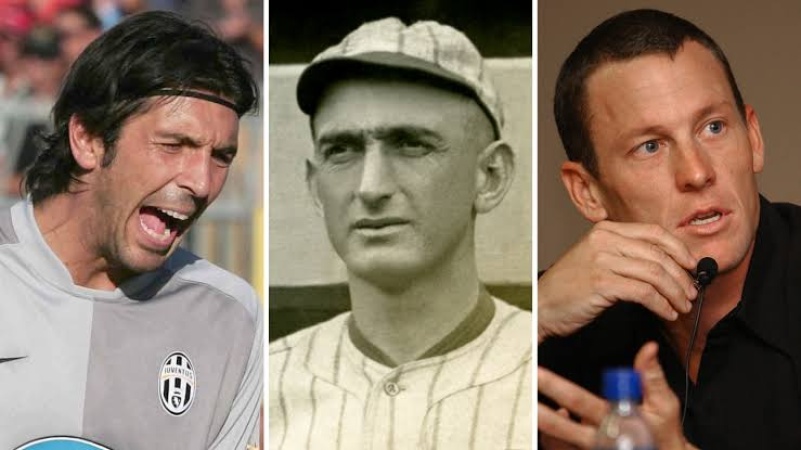
•Gianluigi Buffon, Joe Jackson and Lance Armstrong all found their careers derailed, to different degrees, by sporting scandal