Updating your news feed...
NEWS EXPRESS is Nigeria’s leading online newspaper. Published by Africa’s international award-winning journalist, Mr. Isaac Umunna, NEWS EXPRESS is Nigeria’s first truly professional online daily newspaper. It is published from Lagos, Nigeria’s economic and media hub, and has a provision for occasional special print editions. Thanks to our vast network of sources and dedicated team of professional journalists and contributors spread across Nigeria and overseas, NEWS EXPRESS has become synonymous with newsbreaks and exclusive stories from around the world.







.webp)

.webp)
.webp)



.webp)










Loading banners
Loading banners...

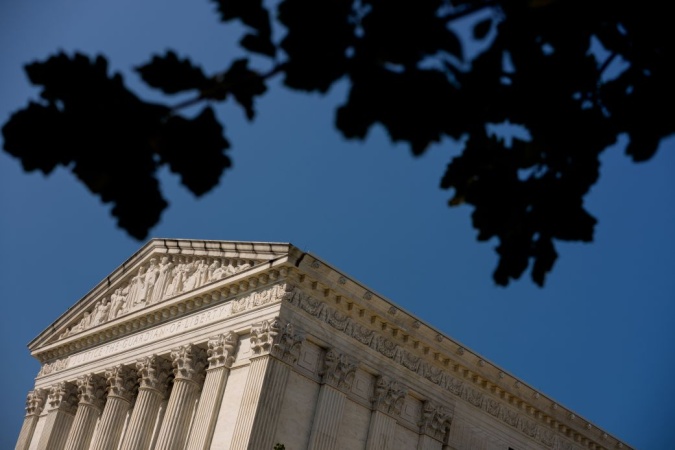
The Supreme Court agreed Thursday to review President Donald Trump’s policy of imposing mandatory detention without bond hearings for people who entered the country illegally, taking up one of the administration’s most aggressive and controversial moves to crack down on immigration.
By granting an appeal on the Immigrations and Customs Enforcement policy, the high court is once again making immigration a central theme of its new term that begins next week. The court is already considering a significant election appeal over state policies to combat noncitizen voting.
After returning to power in 2025, Trump broke with decades of past practice – including that of his first administration – and reinterpreted an immigration law Congress enacted in the 1990s to find that people in the country illegally should be subject to mandatory detention without bond hearings.
As a result of that shift, immigration officials have posted a staggering increase in the number of migrants held in detention, from just under 38,000 at the end of the Biden administration to more than 65,000 this past summer.
Trump’s policy change prompted thousands of migrants who were swept up in ICE raids to file habeas corpus petitions in federal courts across the country challenging their detention.
“The administration’s ability to indefinitely detain tens of thousands of noncitizens pending their removal depends entirely on whether its novel reading of the statute is correct — a reading that has provoked more than 20,000 rulings in the lower courts, the overwhelming majority of which have gone against the Trump administration,” said Steve Vladeck, CNN Supreme Court analyst and professor at Georgetown University Law Center.
“Under what had been the government’s view until last July, most arrestees would’ve been entitled to a bond hearing – and, if they pose no risk of flight or harm to others, to release pending their removal,” Vladeck added. “And there was little reason to use the government’s resources to arrest folks who’d just be promptly released.”
The case the court granted is centered around a Brazil native who entered the United States illegally around 2004 or 2005, according to court records. ICE came into contact with him during a traffic stop in Massachusetts last year.
The Justice Department had asked the Supreme Court to take up another one of its appeals dealing with the same issue instead of the one it granted.
“The government’s detention of such unlawfully present aliens while their removal proceedings unfold implements the statute Congress enacted,” the Justice Department said in the other case that the court did not grant. “Congress’s decision to mandate detention pending removal proceedings for aliens who are not entitled to be admitted into the country reflects vital policy objectives. Detaining aliens who are living in the country after an illegal entry while their removal proceedings unfold prevents those aliens from evading hearings and helps ensure their removal from the United States.”
Opponents of the administration say that many of the migrants caught up in mandatory detention have been living in the United States for years or decades, often with children who are US citizens.
The Supreme Court is likely to hear arguments in Rhoney v. Barbosa Da Cunha early next year and hand down a decision by late June.
The legal issues effectively boil down to two provisions in federal immigration law. One provision says that migrants who are arrested may be detained pending the outcome of their removal proceedings and may be released on bond while that process plays out. That language has long been interpreted to give immigration officials flexibility on who is detained.
But another provision says that “in the case of an alien who is an applicant for admission,” officials “shall” detain that immigrant if immigration officers determine that the person “is not clearly and beyond a doubt entitled to be admitted.”
Trump’s opponents say that second clause, which mandates detention, has long been applied only to migrants confronted at the border, not to people who have lived in the interior of the country for years. Last year, the Trump administration said it would interpret even migrants who are long-term residents as “seeking admission” and subject to the stiffer approach.
Earlier this week, the court granted another important immigration case dealing with the Trump administration’s policy of removing certain immigrants to countries other than their homeland – despite human rights concerns that have been raised about some of those countries.
Over the dissent of the three liberal justices, the court allowed those deportations to continue while it considers the underlying legal questions raised in the DOJ appeal. Lower courts found that the policy violated a federal law that requires migrants facing deportation to so-called “third countries” to be able to make individual legal claims that they could be tortured in those countries. (CNN)