
Updating your news feed...
NEWS EXPRESS is Nigeria’s leading online newspaper. Published by Africa’s international award-winning journalist, Mr. Isaac Umunna, NEWS EXPRESS is Nigeria’s first truly professional online daily newspaper. It is published from Lagos, Nigeria’s economic and media hub, and has a provision for occasional special print editions. Thanks to our vast network of sources and dedicated team of professional journalists and contributors spread across Nigeria and overseas, NEWS EXPRESS has become synonymous with newsbreaks and exclusive stories from around the world.











.webp)
Loading banners
Loading banners...

After an accident changed the course of his life, retired Nigerian Air Force officer and laboratory scientist, Flight Lieutenant Philip Dauda Midala, refused to abandon a healthcare vision conceived in 2006. Today, that vision has become a diagnostic centre in Kuje, Abuja, with plans to expand into dental and eye care.
For Flight Lieutenant Philip Dauda Midala, the wheelchair he now uses is only one part of a much larger story. The retired Nigerian Air Force officer and trained laboratory scientist has spent years adapting to life after an accident. But rather than allow the physical consequences to end his professional ambitions, he has turned his experience and training into a healthcare initiative for residents of Kuje and surrounding communities in Abuja.
That initiative is Phil-Med Diagnostic Centre, a facility established to provide laboratory investigations closer to people who might otherwise have to travel into the Abuja city centre for diagnostic services. The idea, however, predates both the accident and the facility.
Midala said he conceived the concept of a community-based diagnostic centre in 2006, while he was still serving in the Nigerian Air Force. At the time, it existed only as an idea because there was no building, no laboratory equipment and no established centre to operate. What he had was an understanding of the importance of laboratory science to medical care and a desire to make diagnostic services more accessible to ordinary members of the community. Almost two decades later, the idea has become a physical facility.
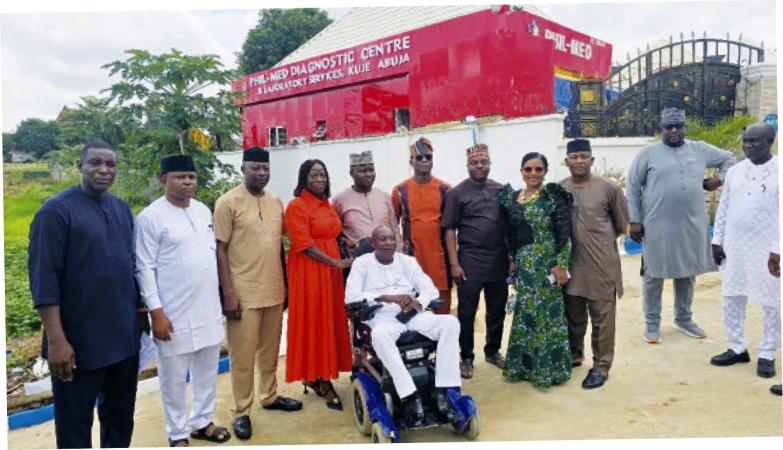
At its inauguration of the facility in Kuje, Abuja, former military colleagues, medical professionals, family members and community leaders gathered to celebrate the opening, and also reflect on the journey that brought Midala to that point.
Chief of Air Staff, Air Marshal Sunday Kelvin Aneke, who was represented at the event, by Air Vice Marshal A.A. Martins, described Midala’s achievement as an example of what could be accomplished despite physical challenges. “You have shown that there’s ability in disability,” Martins told him.
Martins said he had known Midala during his years in the Nigerian Air Force, and recalled that the retired officer had always demonstrated a tendency to think ahead of peers. “Midala was already discussing the possibility of establishing a diagnostic facility as far back as 2006. That vision continued after the car accident and eventually survived the transition from military service to civilian life. The journey was also complicated by problems over the premises where Midala initially operated,” he said.
Martins recalled that a disagreement with a former landlord also contributed in forcing Midala to leave his former location. “For several months, the dispute created uncertainty, but the setback ultimately pushed Midala towards developing a more permanent facility. Rather than abandoning the project, he found another location and continued building,” Martins added.
For Martins, the experience demonstrated that setbacks can sometimes create opportunities for a different and potentially better outcome. But the new centre was not the only contribution Midala made to his immediate environment. The Air Chief representative also highlighted his involvement in improving the road leading to the facility.
The road, he said, had suffered from erosion and neglect despite the presence of substantial buildings in the surrounding area. “Midala contributed significantly to fixing part of the road, providing a practical intervention that benefited not only his facility but other residents and visitors.”
Martins used the example to make a broader point about community responsibility, insisting that development should not be left entirely to government. “Individuals with the capacity, knowledge or resources should look around their communities and identify areas where they can contribute,” he admonished.
Former Minister of State for Health, Dr. Idi Hong, who is a relative of Midala, in his submissions at the event, explained that the importance of a laboratory goes beyond the building housing it. “Reliable diagnostic results are critical to effective patient management,” he submitted.
“A doctor may examine a patient and develop a clinical picture of the illness, but laboratory investigations provide additional evidence that can help confirm or refine the diagnosis.”
He compared the process to using Google Maps. “A doctor may know the general direction of a patient’s problem, but an accurate laboratory result helps the physician pinpoint the condition.
“Undoubtedly, a wrong result could send the doctor in the wrong direction, just as an inaccurate map could take a traveller to the wrong destination,” he said.
He therefore stressed that patients should pay attention not only to the appearance or location of a diagnostic centre but also to the quality and reliability of the services it provides.
He maintained that standardisation, qualified personnel, appropriate equipment and accurate reporting are essential to laboratory practice, and also expressed confidence that Midala’s professional training would help maintain those standards.
“As a trained laboratory scientist, Midala understands the technical requirements of diagnostic work. His years in the military have also exposed him to an environment where discipline and precision are expected.
“The combination could strengthen the quality of the services provided by the new facility. The centre could also make a modest contribution to employment in the community,” Dr. Hong said.
He estimated that it could create between five and 10 jobs, depending on its operations and future expansion. “This is another reason to view the project as a contribution to the community rather than merely as a private enterprise. The healthcare objective remains central.”
He said the original idea was to reduce the time and cost associated with accessing diagnostic services, and to make investigations available closer to residents.
“For people living in Kuje and surrounding areas, that could mean less travelling for laboratory tests and quicker access to results needed by their doctors. It is a practical response to a familiar problem in healthcare: the distance between patients and the services they require. Midala’s professional experience appears to have shaped that understanding.
“As a laboratory scientist who worked within the military medical system, he has firsthand knowledge of the role diagnostic services play in clinical decision-making. His transition into establishing his own facility therefore represents a continuation of his professional expertise in a different setting,” Dr. Hong said.
In his speech, Midala expressed appreciation to military officers, former course mates, family members, community leaders, friends and others who supported the project.
His remarks also indicated that he is already looking beyond the diagnostic centre. He said his next plans include establishing a dental clinic and an optometry centre. “The dental facility is intended to promote safer dental and oral practices, including proper sterilisation and the use of appropriate equipment.”
He expressed concern about situations where patients may be exposed to unnecessary risks because of inadequate equipment or poor practices, that the proposed eye-care project is expected to include outreach programmes, with plans for free eye services and support for people who require glasses. “That would extend the centre’s community-health focus beyond laboratory investigations.”
The plans also demonstrate that the facility is being developed as part of a broader healthcare vision. “The journey to this point has taken nearly 20 years. It began in 2006 with an idea. A car accident subsequently introduced a major physical challenge into Midala’s life.
“Sudden retirement from military service brought another transition, while difficulties with my earlier premises created yet another obstacle. But the project continued to evolve. Being on the wheelchair did not prevent me from using my professional skills. The loss of an earlier location did not end the project. Instead, both became part of a longer process that culminated in the establishment of the Phil-Med Diagnostic Centre.”
For the people who spoke at the inauguration, the centre represents different things. To Midala’s former military colleagues, it is evidence of the discipline, initiative and resilience they associate with him. To medical professionals, it is an additional diagnostic resource that could support clinical care. To residents, it offers the possibility of accessing laboratory services closer to home. And to the community, his contribution to the road provides another example of private citizens taking responsibility for their immediate environment.
Some of the speakers said the most significant aspect of Midala’s story is that disability has not erased his professional identity. “The accident changed the way he moves through the world, but it did not take away his knowledge as a laboratory scientist, his military experience or his interest in community service. Instead, those elements have combined in a new phase of his life.”
They maintained that the commissioning of Phil-Med Diagnostic Centre is therefore not simply the story of a retired Air Force officer opening a laboratory, but a story of a professional who experienced a major personal setback and subsequently found another way to deploy his skills. (The Sun)




