
Updating your news feed...
NEWS EXPRESS is Nigeria’s leading online newspaper. Published by Africa’s international award-winning journalist, Mr. Isaac Umunna, NEWS EXPRESS is Nigeria’s first truly professional online daily newspaper. It is published from Lagos, Nigeria’s economic and media hub, and has a provision for occasional special print editions. Thanks to our vast network of sources and dedicated team of professional journalists and contributors spread across Nigeria and overseas, NEWS EXPRESS has become synonymous with newsbreaks and exclusive stories from around the world.










Loading banners
Loading banners...

Governors of Katsina, Kebbi, Bauchi, Plateau, Benue, Kwara, Oyo, Gombe and Niger
Ahead of the 2027 elections, where 28 governorship seats are up for grab, our correspondents report that the tempo and fervour of the contest vary from states, noting that the political battle would be most intriguing in at least nine states due to the issues and personalities involved.
The states are Katsina, Kebbi, Bauchi, Plateau, Benue, Kwara, Oyo, Gombe and Niger.
While the chances of some are hampered by anti-party squabble, there are those affected by unresolved disputes from primaries and other issues like parties not having enough structures on ground.
The incumbency factor, according to observations, may work in favour of some of the candidates in office but may not matter in others.
Factors that will determine the swing of the pendulum in the respective states
Katsina: No easy ride for the incumbent
The battle for the Katsina State Government House in 2027 is gradually assuming the pattern of a three-way contest, with Governor Dikko Umar Radda of the All Progressives Congress (APC), Senator Ahmad Babba Kaita of the African Democratic Congress (ADC) and Senator Garba Yakubu Lado-Danmarke of the Peoples Democratic Party (PDP) in the race.
Governor Radda currently enjoys institutional advantage as the incumbent. He enters the contest with the machinery of the ruling party, as well as the backing of the state political establishment. The recent endorsement of his second-term bid by the state House of Assembly has further strengthened his position within the ruling structure.
However, according to Mustapha Ahmad Bayo of the Forum for Sustainable Democracy, incumbency does not automatically translate into victory. He said the 2027 election would, in many respects, be a referendum on Radda’s first-term performance, adding that his administration would have to convince voters that its investments in infrastructure and other sectors made a meaningful difference in their lives.
For Danmarke, his emergence as the PDP governorship candidate gives the party an experienced politician around whom it can build its campaign. He was formally affirmed as the party’s candidate in May after being adopted as a consensus aspirant.
Aminu Abashe Mashi of the PDP said Danmarke was not a newcomer to the governorship contest, having previously contested the position and served in both the House of Representatives and the Senate. He said his years in politics and longstanding connections across the state had given him an established political identity.
However, Mashi acknowledged that the PDP faces significant challenges, including internal disputes and defections, which could affect its ability to convert its historical support into votes if the party fails to maintain unity.
Kaita, the ADC candidate, brings a different political proposition to the race. A former member of the House of Representatives and senator, he has built a political network through years of occupying elective positions.
The ADC chieftain, Malam Abubakar Adam, said Kaita’s previous electoral victories, particularly in Katsina north, showed his capacity to mobilise substantial support. He said Kaita’s handling of the party’s primary and his resistance to pressure had further positioned him as a serious contender whose political alignment could influence the 2027 contest.
With the APC controlling the state machinery, the PDP seeking to rebuild its structure and the ADC attempting to emerge as a credible alternative, the 2027 governorship contest is already shaping up as a battle in which no candidate can afford complacency.
Bauchi: Bumpy road for each candidate
The Independent National Electoral Commission (INEC) confirmed that there are 19 contestants for the governorship position in Bauchi State.
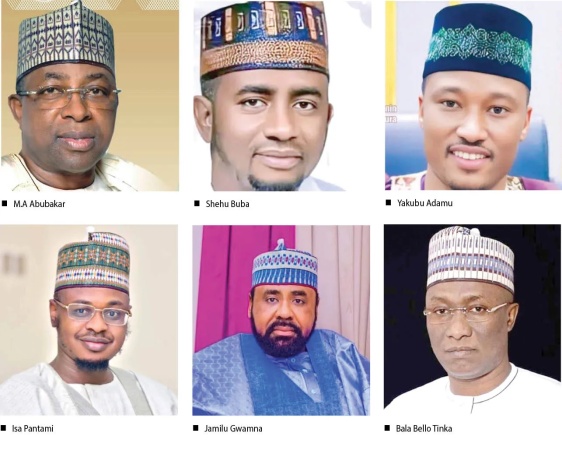
They include Yakubu Adamu of the Allied Peoples Movement (APM), former Governor Muhammad Abdullahi Abubakar of the APC and Shehu Buba Umar of the Peoples Redemption Party (PRP), Halliru Dauda Jika of the ADC and Usman Adamu Sufi of the PDP.
Shehu Buba has a considerable personal political capital. He has grassroots appeal, political visibility and a strong base in Bauchi South, the state’s most electorally significant senatorial district.
However, his biggest weakness is PRP’s limited statewide structure compared with the APC and the political machinery now associated with the APM.
His decision to leave the APC on the eve of the party’s primary has created a challenge.
The banditry allegation raised during his political confrontation with Governor Bala Mohammed, which he has denied has recently been revived by his opponents. Although the allegation remains unproven, the perception has spread.
Yakubu Adamu of the APM appears to have gained a major advantage following Governor Bala Mohammed’s defection to the APM with a significant part of his political structure.
However, the Economic and Financial Crimes Commission (EFCC) allegations hanging over him remain a major vulnerability. Although allegations do not amount to conviction, the controversy provides opposition parties with a potent campaign weapon to question his credibility and portray the APM as a party lacking a clean political alternative.
Adamu may also face another challenge, which is whether the political structure being transferred to him truly belongs to him or Bala Mohammed.
If the governor’s political machinery is the main reason for his strength, opponents could portray him as merely a proxy candidate. The question will be whether Yakubu can develop a personal connection with voters beyond the governor’s influence.
His reliance on Bala Mohammed’s political structure could, therefore, be both strength and weakness.
For Muhammad Abdullahi Abubakar, the biggest challenge is the deep division within the APC following the party’s governorship primary.
The emergence of Shehu Buba as a rival candidate outside the APC has already created a major problem for the party. Other influential figures who lost the primary may also be unwilling to fully commit themselves to Abubakar’s campaign.
A public affairs analyst and lecturer at the Abubakar Tafawa Balewa University (ATBU), Dr Aminu Makama, said that Bauchi State was witnessing an unprecedented political realignment.
Unlike previous elections where the contest was largely between the PDP and the APC, the political landscape has become more fragmented, with the APM, PDP, APC, PRP and ADC all presenting themselves as viable platforms.
Makama said, “One fundamental question remains: Which of these parties possesses not only popular personalities but also the organisation, discipline and unity required to win an election?”
Another public commentator and lecturer at the Abubakar Tatari Ali Polytechnic (ATAP), Bauchi, Malam Abdul Ahmad Burra, said the Bauchi governorship election would not be an easy ride for any of the candidates because of Bauchi’s unique voting pattern and the political atmosphere in the state at the moment,
Battle intensifies for Alia in Benue
The battle for control of Benue State has entered a new phase as governorship candidates across the major political parties begin the race to outwit incumbent Governor Hyacinth Alia ahead of the March 6, 2027 election.
With campaigns officially opening on September 9, the contest is gradually shaping up as a multi-party battle involving the ruling APC, PDP, ADC, Nigeria Democratic Congress (NDC), Social Democratic Party (SDP) and other parties.
Although Alia enjoys the advantage of incumbency, the race may not be an easy ride for him as opposition candidates are banking on political grievances, party structures and voters seeking alternatives to the ruling party.
Alia enters the contest with the power of incumbency and the advantage of government projects and visibility across the state. His supporters are also counting on his popularity and the strength of the APC structure.
However, internal divisions within the APC could pose a major challenge. Critics have accused the administration of uneven appointments and distribution of political opportunities, while concerns about the governor’s relationship with some political stakeholders could affect his ability to unite the party.
The Benue south factor will also remain critical as the zone’s voting strength could determine how competitive the contest becomes.
The PDP candidate, Michael Aondoakaa (SAN), a former Attorney-General of the Federation and Minister of Justice, seems to be relying on his political experience and leadership credentials to challenge Alia.
Aondoakaa could benefit from aggrieved members of the APC and other political actors opposed to the incumbent.
The major challenge of the ADC candidate, Herman Hembe, a former member of the House of Representatives for Vandeikya/Konshisha federal, will be converting his influence beyond his traditional political base into statewide support across the 23 local government areas.
For the NDC, Prof Terhemba Shija is campaigning on reform, accountability and political consciousness, while benefitting from the growing visibility of the party nationally.
His challenge will be building enough grassroots machinery to translate the party’s growing popularity into votes, particularly in rural communities.
Ropshik, Sura set to face Muftwang in Plateau
With INEC’s recent release of the list of candidates and campaigns nationwide, the race for Plateau’s Government House has intensified as three major contenders jostle for the seat.
Three major contenders — incumbent Governor Caleb Mutfwang of the All Progressive Congress, Kefas Ropshik of the PDP and Brigadier-General John Sunday Sura (retd) of the ADC — whose names were published by the Independent National Electoral Commission – have begun strategising on how to clinch the number one seat in the state.
Our correspondent gathered that all the three major candidates have started holding political meetings to reconcile factions and appeal for unity ahead of the election, with each candidate believing that he is the one to beat in the contest.
Although Governor Mutfwang is the incumbent, political analysts argue that his defection from the PDP to the APC created a rift between him and his former PDP supporters who were loyal to him while he was in the party. They added that it would not be an easy task for the governor to secure a landslide victory in the election.
Analysts said some PDP members who feel they lost the power they worked for remain aggrieved and may support Ropshik. They added that members of the former governor, Simon Lalong’s legacy group, whose interests were affected, are also unhappy with the governor’s move to the APC and could engage in anti-party activities.
Sources also said the relationship between Governor Mutfwang and the Federal Capital Territory (FCT) Minister Nyesom Wike, depending on how cordial, it is, would have an impact on the race.
For the PDP gubernatorial candidate, who is new in politics, pundits said he lacked grassroots appeal, considering that he is not as well-known as the incumbent. They also noted that although the PDP has had structure at the local level even before now, the candidate does not have a single local government chairman who can sell him to the public and ensure his victory.
Brigadier Sura, the ADC candidate, is also relatively new to politics, having served as a military officer for decades. Analysts said although he is connected to people at the grassroots level, especially in his local government area, that will not make him generally popular or politically known across all 17 local government areas.
Coupled with that, pundits said his platform did not have the kind of structure compared to the APC and PDP, which have ruled the state for years. They said this could make it very difficult for him to win easily. They added that he still had time to move around the state although that would not be an easy task for him and his ADC.
Kwara : ADC, PDP, APC in neck-to-neck contest
The 2027 Kwara governorship election is shaping up as a contest in which none of the leading candidates can take victory for granted. With 13 candidates in the race, APC’s Salihu Yakubu Danladi, PDP’s Sulaiman Bolakale Kawu, ADC’s Zakari Mohammed and NDC’s Abdulmumin Yinka Ajia, among others, are confronting different political realities that could make the race unusually competitive.
For Danladi, incumbency remains a formidable advantage. The APC controls the state machinery, while the candidate is campaigning on continuity, promising to sustain Governor AbdulRahman AbdulRazaq’s “good works”. But that advantage comes with the burden of defending an administration whose succession politics has produced significant disaffection within the party.
The G15/TOP realignment and Senator Saliu Mustapha’s defection to the PDP have, therefore, complicated the APC’s calculations. Mustapha has maintained that his disagreement is with AbdulRazaq’s political camp, not President Bola Tinubu, while describing his new alignment with Saraki and other former APC actors as a “Rainbow Coalition”.
For the governorship, the critical issue is whether that realignment can translate discontent within the establishment into coordinated votes capable of weakening APC’s statewide structure.
Danladi also faces a peculiar zoning dilemma. His emergence gives Kwara north its strongest claim to the governorship since the return to democratic rule, but Zakari Mohammed is also from the zone. A divided northern vote could dilute the advantage Danladi’s hope to derive from zoning, leaving him with the harder task of building a winning coalition across Central and South.
PDP’s Kawu, on the other hand, has an opportunity created by the APC’s internal rupture. Saraki’s return to frontline politics, the movement of former APC figures into the PDP and the wider G15/TOP alignment have given the opposition a broader political base. Kawu has consequently stressed an “all-inclusive” approach and urged unity to “reclaim power.” But the challenge is turning an alliance of political interests into an electoral coalition across the state. He appears to be enjoying a momentum and it remains to be seen how long it will last.
Zakari brings another complication. His insistence that “issues, not incumbency, will decide” the election allows him to campaign beyond the traditional APC-PDP confrontation.
Ajia, on his part, appears to be standing on a different pedestal and has even told the electorate to do away with the Abdulrazaq-Saraki political establishment in the state, while presenting himself as the best alternative. He, however, needs more grassroots structures to achieve that.
The ultimate battle may, therefore, be less about who has the biggest political name than who can build the most durable coalition across Kwara’s three senatorial districts. With the APC seeking to retain power, PDP attempting a comeback and ADC and NDC disrupting the traditional contest, every candidate has a plausible route to Government House.
Gombe: Tinka, Gwamna, Pantami intensify bids
There are at least six major candidates contesting for the governorship seat of Gombe State in the forthcoming 2027 general elections, but analysts said it would be a three-horse race among the candidates of three major parties.
Weekend Trust reports that the likely top three contenders are Bala Bello Tinka of the African Democratic Congress, Dr Jamilu Isyaku Gwamna of the All Progressives Congress and Prof Isa Ali Pantami of the Peoples Democratic Party.
Tinka is one of the frontline contenders. He is a successful businessman and founder of a construction company, Tinka Point Limited. He was a close associate of Governor Yahaya before he defected to the ADC and clinched the party’s governorship ticket.
But political observers said lack of well-articulated political structure within the Gombe ADC could affect Tinka’s chances at the polls.
Gwamna is a onetime gubernatorial candidate in the state. The technocrat cum politician had contested for the governorship under the defunct All Nigeria Peoples Party (ANPP) in 2007. He contested against the then Governor Muhammad Danjuma Goje.
He also contested for the PDP ticket in 2022 and lost to Senator Usman Bayero Nafada, who was later defeated by Inuwa Yahaya in the 2019 elections.
Pundits who spoke to Weekend Trust said Governor Yahaya’s track record in the last seven years would count and be of advantage for Gwamna, who is the APC candidate in the 2027 general elections.
In addition to his vast experience in both the public and private sectors, Jamilu Gwamna, who is also the Sardaunan Gombe, has good relationships with people at the grassroots and enjoys massive support; especially from women and youths.
However, pundits are of the opinion that the unpopularity of the APC, especially at the centre, and some unpopular policies introduced by Governor Yahaya’s administration could affect Gwamna’s chances at the poll.
Prof Pantami, the immediate past Minister of Communication and Digital Economy, had declared interest to contest the governorship seat under the APC, but later withdrew and defected to the PDP, where he clinched the party’s ticket.
According to political pundits, the emergence of Prof Isa Ali Pantami as PDP governorship has boosted the party’s chances at the poll.
Pundits said Pantami’s political networks, especially on the social media, may prove decisive in the upcoming election. However, lack of appeal, especially with the ‘Gombe elite’ could potentially affect his prospects as a candidate.
However, apart from campaign, he is currently battling ongoing court cases with at least two of the gubernatorial aspirants who had contested for the PDP’s ticket with him.
APC, ADC in tight race to Kebbi Government House
The battle for the office of the governor of Kebbi State may have begun as the Abubakar Malami Campaign Council of the African Democratic Congress, on Wednesday kick-started his campaign.
The governorship list released by INEC few days ago shows that five candidates from five political parties, with the exception of the Peoples Democratic Party, are to contest the governorship election in Kebbi State.
Umar Faruku for the Social Democratic Party, Basiru Musa for Labour, Abubakar Malami for the African Democratic Congress, Umar Usman Besse for the Nigeria Democratic Congress and the incumbent governor, Nasir Idris for the APC.
Though Governor Nasir Idris of the APC may appear to be more favoured in the coming governorship election because of the formidable structure of the APC in the state, there are resources and the strong political personalities backing his candidacy.
Besides, he has three former governors in the persons of Senator Adamu Aliero, Saidu Dakingari, Abubakar Atiku Bagudu, who is currently serving as Minister of Budget and Economic Planning, and a host of other eminent figures, such as Senator Yahaya Abdullahi Malamawa, General Ishaya Bamaiyi (retd), General Muhammad Magoro (retd), APC national publicity secretary, Muhammed Suleiman Argungu, other members of the national assembly and political appointees backing his return bid to office.
A chieftain of the APC, Abdullahi Usman Aliero, said that aside the over 760 youth and women groups canvassing votes for Governor Idris across the 21 local government areas of the state, the party has demonstrated a strong commitment to win the 2027 by creating structures for the Renewed Hope Agenda and City Boy Movement in Kebbi.
A political analyst, Dr Rahman Ahmed said: “Malami may not have the array of the personalities backing governor Idris’s return bid to the Kebbi Government House, but the KHADIMIYA political movement he created while serving as minister of justice to project his governorship ambition and popularity in the state, if well utilised, may support his chances in the battle for Kebbi governorship contest.
Intraparty squabbles in Nasarawa
After conclusion of the governorship primary elections in Nasarawa State and emergence of the candidates, internal party crisis, defections, regional balancing are set to define the election. No single candidate can claim a clear path to victory.
The All Progressive Congress candidate, Senator Ahmed Aliyu Wadada, is contending with the fallout of the primary that produced him as candidate. He defeated former Inspector General of Police Mohammed Abubakar Abdullahi and other aspirants.
Ex-IGP Adamu exited from the party after the primary and joined Social Democratic Party with his supporters, a development that is likely to affect APC votes in key areas.
As the APC remains the ruling party and is making efforts to consolidate its structures across the state, the defection has created a crack the opposition will want to exploit. Definitely, Wadada will have to contend with the burden of incumbency and the supporters’ expectation that the party must deliver more than it did in the last eight years.
For the SDP flag bearer, former Inspector-General of Police Mohammed Abubakar Adamu, his challenges are even steeper; one of which is that he is relatively new in partisan politics, having joined the fray over two years ago.
Another thing is that the APC under Governor Abdullahi Sule remains influential and controls state structures. Most damaging is the factional crisis in the SDP as the party’s factional chairman, Mohammed Danlami Musa is laying claim to the party’s ticket challenging Adamu’s candidature.
Without the case resolved and INEC’s final list still awaiting, the internal wrangling may distract the campaign and confuse voters who are unsure of the authentic candidate for the SDP.
Emmanuel David Ombugadu, who is flying the PDP ticket, is a three-time governorship contender with strong support, especially in Nasarawa north, particularly his local government area of origin, Nasarawa Eggon, where he polled 70 per cent to 80 per cent of votes during the past elections; yet 2027 may not be easy for him.
Seen as a new comer in the state politics, Angbazo himself faces credibility issues. He lacks the deep political network needed to mobilise across the state.
His emergence in the ADC was also contested, as former Minister of Environment, Mohammed Hassan Abdullahi, rejected the primary outcome and gone to court, while Senator Mohammed Ogoshi Onawo dumped the ADC for APM to pursue his ambition. ADC’s structure may remain weak outside Anbgazo’s base without unity.
Jonathan Gaza Gbefwi, a three-time member representing Karu/Keffi/Kokona and Labour Party candidate, is popular in Nasarawa west. However, his visibility outside the constituency he is representing remains limited. In an election that is statewide, it may not be enough to concentrate in one senatorial district while winning requires spread across north, south and west.
Oyo: APM, APC, ADC candidates in bracket race
Among the 16 governorship candidates and their running mates recently released by the Independent National Electoral Commission for Oyo State are Senator Sharafadeen Alli, representing Oyo south and flying the flag of the APC; Governor Seyi Makinde-backed Bimbo Adekanmbi, representing the Allied Peoples Movement (APM); Taofeek Adegboyega Adegoke, the candidate of the ADC; and Oriyomi Hamzat, who is drawing attention on the Accord platform.
With this, it appears the 2027 governorship election is beginning to resemble a four-cornered battle in the state.
Weekend Trust reports that all the four leading candidates are indigenes of Ibadan, the state capital.
The incumbent Governor Seyi Makinde, who is expected to complete his second term in 2027, also hails from the Ibadan axis. And from the line-up of candidates, Makinde’s successor is going to be an Ibadan man.
But what makes the contest interesting is that each candidate brings a different political asset to the table. The APC has structure and national influence, the APM has the political machinery associated with Governor Seyi Makinde, the ADC has the appeal of a fresh third force, while Accord can potentially rely on Hamzat’s personal popularity and grassroots recognition.
Ironically, keen watchers believe that the leading candidates’ strengths may also serve as their respective weaknesses in the coming election.
Alli, a former secretary to the state government, chief of staff and local government chairman, has the APC platform as his greatest advantage.
As a sitting senator and experienced Oyo politician, Alli enters the contest with an established political identity, and more importantly, access to the APC’s statewide organisation and national machinery.
Alli is a protégé of the Olubadan of Ibadan and former governor, Oba Rashidi Ladoja, who, despite being a monarch, remains a political kingmaker in Oyo State. It was rumoured that Alli’s emergence materialised due to Ladoja’s influence.
Besides, the influence of President Bola Tinubu in the South-West could also provide the APC with a political advantage as the 2027 elections approach.
Some analysts believe that what they call the “religious card” also favours Alli, as many Oyo Muslim leaders believe that after Makinde’s exit, his successor should be a Muslim.
However, Alli’s biggest challenge is the internal wrangling rocking his party after his disputed primary victory.
Heavyweight political figures who lost the APC ticket to Alli, such as former Senate Leader Teslim Folarin, Oyo north Senator Fatai Buhari and the immediate past Minister of Power Bayo Adelabu, are still nursing their wounds.
Bimbo Adekanmbi largely relies on the political structure associated with Governor Seyi Makinde and the state machinery to battle the nation’s ruling party.
Insiders said Adekanmbi, who was a member of the APC until January this year, may also enjoy some support from the APC bloc. He was the commissioner for finance under Governor Abiola Ajimobi’s APC government.
His challenge will be to benefit from Makinde’s political structure while establishing an identity of his own.
The belief that Oyo’s next governor should be a Muslim may also deny him the votes of some Muslims in the state.
Taofeek Adegboyega Adegoke represents the most conventional third-force proposition in the contest. His campaign can appeal to voters who do not want either an extension of the Makinde political camp or a return of the APC.
But the ADC’s central problem is organisation and the unresolved battle for the ticket between him and Dr Gbemileke Alagbe, a 40-year-old banker. Although INEC has recognised Adegoke as a candidate, the internal crisis remains unresolved.
Hamzat, the media entrepreneur and proprietor of Agidigbo FM, introduces a different kind of challenge.
A large personal following is not the same as having ward structures, local government coordinators and polling-unit mobilisation across Oyo’s 33 local government areas.
Hamzat’s candidacy is also being challenged in court by a chieftain of the Accord Party in Oyo State, Olakunle Busari. (Weekend Trust)




