ADAD
ADADUpdating your news feed...

NEWS EXPRESS is Nigeria’s leading online newspaper. Published by Africa’s international award-winning journalist, Mr. Isaac Umunna, NEWS EXPRESS is Nigeria’s first truly professional online daily newspaper. It is published from Lagos, Nigeria’s economic and media hub, and has a provision for occasional special print editions. Thanks to our vast network of sources and dedicated team of professional journalists and contributors spread across Nigeria and overseas, NEWS EXPRESS has become synonymous with newsbreaks and exclusive stories from around the world.














Loading banners
Loading banners...

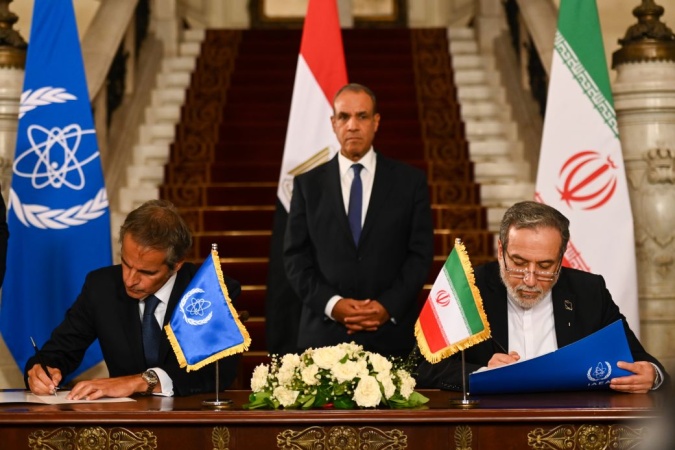
The UN’s nuclear watchdog agency is asking the body to hold Iran accountable for failing to stick with safeguards meant to prevent the development of nuclear weapons, diplomatic officials announced Wednesday.
It’s the latest chapter in a more than decade-long effort to keep an eye on Iran that has seen the country descend from compliance to sabotaging inspection efforts – such as disabling monitoring cameras and “excessively invasive physical searches” of inspectors – according to multiple former officials, diplomats and more than a decade of UN documents reviewed by CNN.
Iran’s 2015 nuclear deal with the US and other countries established the world’s most invasive nuclear inspection regime, overseen by the International Atomic Energy Agency. And for years, Tehran’s nuclear program complied with the agency’s inspectors.
But during the years after President Donald Trump withdrew from that deal, Iran gradually and systematically defied its nuclear safeguards, according to contemporaneous IAEA reporting, and the agency later concluded that Iran failed to disclose nuclear material-related sites.
“The Iranians were really playing rope-a-dope and consistently making it hard for the IAEA to get access, presenting information that was laughably not true or plausible,” said a former US diplomat whom CNN granted anonymity to freely discuss the sensitive topic.
The UN nuclear watchdog sometimes downplayed issues for political reasons, including efforts to be less confrontational with Iran, a former IAEA official and a former US diplomat told CNN.
The saga demonstrates the limitations of monitoring and verification in the face of concerted noncompliance, leading top experts to argue that even a full diplomatic solution to the war that includes a new nuclear deal won’t be enough to stop Iran from getting a nuclear bomb.
“I think for both technical and political reasons … if Iran wants to get the bomb at this point, it’s going to get it,” said James Acton, a physicist who heads the Carnegie Endowment for International Peace’s nuclear policy division.
Acton told CNN he believes “there’s a 50-50 chance that Iran gets the bomb” within the next three years.
23 governors sitting on the International Atomic Energy Agency voted Wednesday to report Tehran to the Security Council, with Russia, China and Niger voting against the action, which stems from a June 2025 resolution declaring Iran non-compliant with nuclear safeguards.
That resolution came seven months before the current war with Iran, and days before US strikes against Iranian nuclear facilities in Operation Midnight Hammer.
Tehran was last reported to the Security Council in early 2006, and the UN body responded with a cascade of actions including sanctions against the regime. It’s unclear whether the Security Council will respond similarly to Wednesday’s report; Russia and China are permanent members of the body who may unilaterally veto proposed actions.
Iran’s diplomatic mission to the IAEA decried the resolution as “political” and “nonconsensually adopted” in a statement on social media.
The 2015 deal, known as the Joint Comprehensive Plan of Action or JCPOA, followed 20 months of intense negotiations. The JCPOA placed strict limits on the country’s nuclear program — especially around uranium enrichment activity — that would be independently verified by the IAEA.
The JCPOA placed strict limits lasting a decade or more on Iran’s enriched uranium stocks and resulted in the country shipping most of its excess uranium to Russia for destruction. The agreement restricted enrichment centrifuge manufacturing, plutonium reprocessing, nuclear weapons design and other related areas.
The deal also permitted the IAEA to enact the most intrusive monitoring scheme on the planet: seals, cameras, sensors, daily in-person inspections, and a mechanism to investigate suspected covert nuclear facilities.
When the deal went into force in January 2016, the IAEA certified that the Iranians were following its terms. And until mid-2019, Iran remained in compliance with the deal’s access requirements and safeguards on its enrichment centrifuges and declared uranium stockpile despite Trump pulling out of the JCPOA in May 2018.
But Iranian compliance began to unravel in 2019, according to the IAEA’s reports, which were issued on a roughly quarterly basis.
In July 2019, inspectors reported that Iran had accumulated enough low enriched uranium to break the JCOPA’s cap on nuclear material. That fall, Tehran resumed enrichment using advanced centrifuges in facilities where the agreement had banned such work.
Then in 2020, Iran blocked IAEA inspectors from accessing two locations suspected of being used for nuclear-related activities before the JCPOA was signed.
IAEA access was curtailed further after Iran’s parliament passed a law in December 2020 that slashed cooperation with the watchdog agency on enhanced monitoring and verification provisions. The law, passed in the wake of Israel killing a top Iranian scientist, also directed the acceleration of Tehran’s nuclear program — to include enriching uranium to 60% purity — unless the US reduced sanctions. 60% is a key threshold that enables rapid further processing into weapons-grade material.
Iran initially agreed to keep IAEA monitoring equipment installed and store the data locally, but that agreement collapsed in mid-2021 — that summer, the Iranians disabled monitoring cameras, destroying one, in a centrifuge workshop in Karaj before demanding the agency remove all its JCPOA monitoring equipment about a year later in June 2022.
Members of Iran’s security forces also intimidated IAEA inspectors through “excessively invasive physical searches” in 2021, the agency said.
The IAEA discovered an undeclared set of centrifuges at the Fordow nuclear facility in January 2023 that were enriching uranium up to 83.7% purity, a level nearing weapons grade (about 90%).
The discovery came when an experienced Russian inspector spotted a subtle change to centrifuge piping, the former US diplomat said. Months later, Iran kicked that inspector and several other IAEA uranium enrichment experts out of the country.
Rafael Grossi, the IAEA’s chief, described the booting of the inspectors as a “very serious blow” to the agency’s ability to monitor Iran’s nuclear program.
The relationship deteriorated further in subsequent years, with Iran and the IAEA trading allegations of espionage.
The interference, continued enrichment and lack of candor regarding undeclared nuclear sites led the agency to pass a resolution declaring Iran in violation of its nonproliferation promises in June 2025. Israel launched strikes against Iran the day after the resolution passed, and the US bombed three key nuclear sites at Fordow, Natanz and Isfahan less than two weeks later.
Iran’s representatives have disputed the IAEA claims in the past and sharply criticized Wednesday’s referral resolution that built upon the June 2025 finding. In their statement before the vote, the Iranians argued that the agency never “verified the diversion of nuclear materials.”
Tehran’s diplomats claimed that the US and other Western states sponsoring the Security Council referral “shed crocodile tears over proliferation while hypocritically evading even a simple verbal condemnation of unprecedented massive aggressions against peaceful safeguarded nuclear facilities, brutal war crimes, and crimes against humanity.”
Since February 2026, when the US and Israel launched their air campaign against Iran, the IAEA has been unable to visit any Iranian nuclear facility other than the Bushehr nuclear power plant.
Inspectors have not visited the nuclear facilities previously bombed by the US and Israel in June 2025, either. The lack of access compounds the early 2021 lapse of IAEA monitoring of centrifuge production, movement and installation.
IAEA officials have stressed that the inspection blackout broke the agency’s “continuity of knowledge” on Iran’s uranium, enrichment centrifuges and related items under the watchdog’s monitoring. That means it cannot vouch for the status, amount or location of those items.
Reestablishing that monitoring baseline poses a monumental task for the agency, according to experts who spoke with CNN.
Eric Brewer, a former National Security Council counterproliferation director who now researches nonproliferation at the Nuclear Threat Initiative nonprofit, told CNN that “the IAEA is starting from a pretty massive deficit when it comes to understanding the picture on the ground in Iran.”
“They would need to have much stronger monitoring and a much longer time to go back in and establish a new monitoring baseline to try to put the pieces of the puzzle back together,” Brewer said.
The Security Council will ultimately determine whether Iran will face new international consequences for its alleged violation of the non-proliferation treaty.
After the last such report in 2006, the body passed a series of resolutions that enabled crushing economic sanctions on Tehran.
But with the US currently taking military and economic action against Iran, it’s unclear what impact additional actions would have, and it’s unclear whether any Security Council resolutions on the matter would make it past the veto powers that Russia and China hold. (CNN)